
Electric buses in Kenya are often discussed as an environmental ambition. In practice, their viability depends less on technology than on financing, fleet operations, and the structure of the country’s matatu industry.
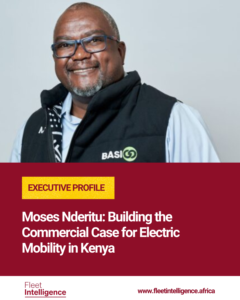 Moses Nderitu is the Managing Director of BasiGo Kenya, an electric bus company founded in Nairobi in 2021. The company operates a lease-and-pay-per-kilometre model aimed at enabling public transport operators to adopt electric buses without bearing the full upfront capital cost, which remains one of the main barriers to electrification in African transport systems.
Before his current role, Nderitu served as Chief Revenue Officer at BasiGo, where he led commercial expansion and operator partnerships in Kenya. He was part of the team that introduced electric buses into the Kenyan matatu sector and helped build early demand, including securing more than 450 operator reservations for initial deployments.
His earlier career spans transport regulation and mobility advisory roles. He served as Director and Regulatory Advisor at ARC Ride, and previously held a senior governance role within Kenya’s National Transport and Safety Authority (NTSA), where he served as Board Member and Vice Chair for six years. That experience placed him within Kenya’s transport regulatory system during a period when digitization, road safety enforcement, and licensing reforms were being advanced.
He is also associated with the Electric Mobility Association of Kenya (EMAK), an industry body formed to coordinate policy engagement and standards development for the emerging electric mobility sector in Kenya.
BasiGo’s operating model is built around a Pay-As-You-Drive structure. Operators do not purchase buses outright; instead, they access electric buses under a financing arrangement where repayment is tied to kilometres driven. This model is designed to match operating costs with revenue cycles in a sector characterized by daily cash flows and limited access to long-term asset financing.
The company began operations in Nairobi in 2021 and deployed its first electric buses in 2022. Early fleet data released by the company indicates that within the initial months of operation, the first buses collectively carried over 150,000 passengers and covered more than 150,000 kilometres in service.
Since then, BasiGo has expanded from Nairobi into inter-city and inter-county pilot routes across Kenya. These include corridors such as Nyeri–Nyahururu, Nyahururu–Nakuru, and Thika–Nairobi, where electric matatus are being tested in higher-mileage conditions. Each bus is designed for an operating range of approximately 300 kilometres per charge, supported by dedicated charging infrastructure and scheduled charging cycles aligned with route operations.
The model extends beyond vehicles. BasiGo has developed charging infrastructure in Nairobi, including high-capacity charging stations designed for fleet operations. The company has also pursued local assembly initiatives in Kenya to support scale-up and reduce reliance on imported fully built units.
These developments sit within a broader effort to build a functioning electric mobility ecosystem rather than a vehicle-only transition. That ecosystem includes electricity supply reliability, depot-based charging systems, maintenance networks, financing partners, and cooperation with SACCOs that operate Kenya’s matatu routes.
In parallel, the company has engaged in industry coordination efforts around standards and policy development, reflecting the fact that electrification in public transport requires alignment between regulators, financiers, utilities, and operators.
Nderitu’s role therefore sits at the intersection of regulation, commercial scaling, and system design. His career has moved across regulatory institutions, early-stage mobility ventures, and now large-scale fleet deployment, giving him exposure to both policy formation and market execution.
The broader shift underway in Kenya’s transport sector is not the replacement of the matatu system, but its gradual reconfiguration. Diesel fuel, maintenance structures, and asset ownership models are being tested against electric alternatives that change the cost base and operational rhythm of public transport.
BasiGo’s approach represents one of the more structured attempts to test whether that transition can be made commercially viable at scale.