



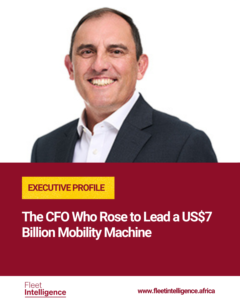
 Ockert Janse van Rensburg’s career sits inside one of the most complex automotive ecosystems to emerge from emerging markets: Motus Holdings, a diversified mobility group whose scale now places it among the largest automotive retail and distribution platforms in the southern hemisphere.
His professional foundation was built at PricewaterhouseCoopers, where he qualified as a Chartered Accountant (South Africa) and rose to partnership after more than a decade in audit. It was a formative environment defined by financial scrutiny at scale, where the architecture of large organisations is studied line by line through governance, reporting, and risk. That discipline would later define his leadership approach in industry.
He moved from professional services into operations when he joined Foodcorp Holdings as Chief Financial Officer. Foodcorp, one of South Africa’s major food manufacturing and distribution businesses, exposed him to the mechanics of physical supply chains, commodity volatility, and working capital intensity. Over nearly eight years, he operated in a world where performance is not abstracted through fees or advisory cycles, but measured in throughput, efficiency, and margin discipline under constant cost pressure.
In 2015, he joined Motus Holdings as Group CFO, stepping into a business that had evolved from dealership roots into a multinational mobility platform.
Motus traces its lineage to 1948 and today stands as South Africa’s largest automotive retail and distribution group, with operations spanning South Africa, the United Kingdom, Australia, and parts of Europe and Asia. The group employs roughly 20,000 people and operates more than 1,200 retail, rental, and service outlets, making it one of the densest automotive networks in the region.
Financially, Motus is a mid-billion-dollar enterprise by global standards. In the year ended June 2025, the group reported revenue of approximately R112.6 billion (about $6.9 billion). Over a trailing twelve-month period, revenue stood at around R114.1 billion (about $7.0 billion). Despite its scale, profitability remains relatively lean, with net income of approximately R2.67 billion (about $164 million), reflecting the structurally low-margin nature of automotive retail and distribution.
Its market capitalisation sits in the range of R17.8 billion (about $1.1 billion), placing it firmly within the mid-cap industrial cohort, even as it manages a revenue base several times larger than its valuation suggests.
The group is structured around five core segments: Import and Distribution, Retail and Rental, Mobility Solutions, Aftermarket Parts, and Head Office functions. The Retail and Rental division alone contributes the majority of revenue, underscoring Motus’s core identity as a downstream automotive retail engine rather than a manufacturer.
Its brand portfolio is extensive and multi-layered. In South Africa, Motus is a key importer and distributor for brands such as Hyundai, Kia, Renault, Mitsubishi, and Tata, while also retailing and servicing a wide range of global OEMs including Toyota, Volkswagen, Ford, Nissan, BMW, Mercedes-Benz, and emerging Chinese entrants such as Chery, Omoda, Jaecoo, and MG. Across its ecosystem, the group engages with more than 20 manufacturers and over 30 brands, reflecting its position as a critical route-to-market partner for global automakers.
Beyond distribution, Motus operates one of the most extensive dealership and aftermarket networks in Africa, alongside vehicle rental platforms and used-vehicle businesses such as Auto Pedigree and Motus Select. The group also maintains a significant aftermarket footprint through brands like Midas, which supplies parts and accessories across Southern Africa.
Internationally, its UK and Australian operations extend its reach into mature automotive markets, where it operates dealership groups and aftermarket distribution businesses. This geographic diversification has become increasingly important as the automotive cycle in emerging markets becomes more volatile and currency-sensitive.
Within this system, the role of Group CFO is structurally central. Capital allocation decisions span dealership expansion, vehicle inventory financing, acquisitions, cross-border integration, and investment into mobility services. It is a role that sits at the intersection of macroeconomics, consumer credit cycles, OEM strategy, and currency volatility.
Since joining, Janse van Rensburg has helped steer Motus through a period of structural transition in the global automotive industry: the entry of new Chinese OEMs into African markets, the gradual shift toward electrification, and the slow but persistent move from ownership to usage-based mobility models. Each of these shifts carries implications for inventory risk, capital intensity, and long-term return on equity.
More recently, following leadership transition within the group, he has moved into the CEO role, taking responsibility for the entire platform at a moment when the automotive industry is being reshaped not by single disruptions, but by the accumulation of several: digital retail, electrification, supply chain reconfiguration, and changing consumer financing behaviour.
The company he now leads is not simply a dealership group. It is a multi-country mobility and distribution system generating roughly $7 billion in annual revenue, managing thousands of employees, and acting as a critical intermediary between global manufacturers and consumers across Africa, Australia, and Europe.
His trajectory reflects the evolution of the organization itself: from financial precision in audit, to operational discipline in industry, and ultimately to strategic leadership of a large, distributed industrial platform navigating one of the most structurally disrupted sectors in the global economy.