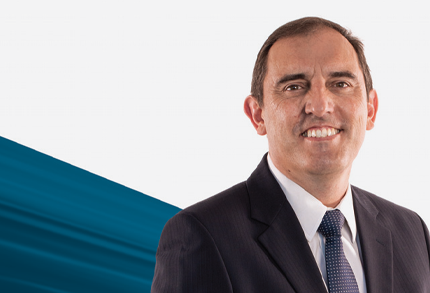





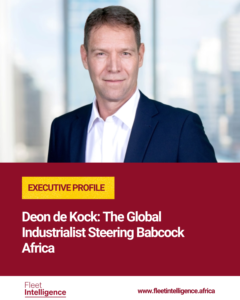
 Deon de Kock has spent much of his career in places where heavy industry meets uncertainty. Mines in remote regions, sprawling industrial plants, construction projects measured not in months but decades, and businesses exposed to the unpredictable rhythms of commodity cycles have formed the backdrop to a professional life spanning more than three decades. It is perhaps fitting, then, that he now finds himself leading one of Africa’s most established industrial engineering businesses at a time when the continent’s mining, energy and logistics sectors are undergoing profound change.
In January 2026, De Kock was appointed Chief Executive Officer of Babcock’s African operations, succeeding Roger O’Callaghan, who had led the business for more than twenty years. The appointment marked both continuity and renewal for a company that has become deeply woven into Southern Africa’s industrial landscape.
For De Kock, the move represented the latest chapter in a career defined by scale, operational complexity and international experience.
An engineer by training, De Kock earned a Bachelor of Engineering degree from the University of Pretoria before complementing his technical grounding with an MBA from Bond University in Australia. The combination of engineering discipline and commercial acumen would become a hallmark of his leadership style.
Long before arriving at Babcock, De Kock had already established himself as a global industrial executive. His career has taken him across Africa, Europe, the Middle East and Asia, exposing him to some of the world’s most demanding industrial environments.
Prior to joining Babcock, he served as Chief Executive of Electrical Engineering and Renewable Energy at JSE listed Reunert Limited, one of South Africa’s largest industrial groups. There, he oversaw businesses operating at the intersection of traditional electrical infrastructure and the rapidly evolving renewable energy sector, an increasingly strategic space as Africa grapples with energy shortages and decarbonisation pressures.
Earlier, De Kock spent significant periods with global industrial giants Sandvik and FLSmidth.
At FLSmidth, the Danish engineering multinational that supplies equipment and technology to the mining and cement industries, he served as President for Sub Saharan Africa, the Middle East and South Asia. The role placed him at the centre of markets stretching from African mining belts to some of the world’s fastest growing industrial economies.
Before that, he held senior leadership positions at Sandvik, eventually becoming Vice President for Southern Europe, North Africa and the Middle East. Sandvik, headquartered in Sweden, generates annual revenues exceeding SEK 123 billion, equivalent to approximately US$11.5 billion, and employs around 41,000 people globally. Managing operations across multiple jurisdictions demanded not only commercial expertise but also an ability to navigate sharply differing regulatory, political and cultural environments.
Those experiences appear particularly relevant to his new assignment.
Babcock’s African business is itself a complex industrial ecosystem. Operating across Southern Africa, the company supplies and supports equipment, engineering services and technical solutions that underpin some of the region’s most important industries.
The business represents several globally recognised brands, including DAF Trucks, Volvo Construction Equipment, SDLG and Terex equipment in selected African markets. Beyond equipment distribution, Babcock provides engineering support services, industrial plant maintenance, welding and fabrication solutions, crane operations, and aftermarket support for heavy industrial fleets.
Its customers include mining houses, utilities, construction companies, transport operators and manufacturers, sectors that collectively form the backbone of Southern Africa’s economy.
The African operation is part of London listed Babcock International Group, a major engineering support services company listed on the London Stock Exchange. For the financial year ended March 2025, the parent company reported revenues of approximately £4.83 billion, equivalent to about US$6.5 billion, while employing roughly 27,000 people worldwide. The group’s order backlog stood at £10.4 billion, or nearly US$14 billion, providing substantial long term revenue visibility.
Although Babcock does not disclose separate financial figures for its African operations, South Africa contributes approximately seven percent of group revenues, underscoring the significance of the region within the wider organisation.
De Kock assumes leadership at a pivotal moment. Africa’s mining industry is entering a new investment cycle driven by demand for critical minerals essential to the global energy transition. At the same time, logistics operators are under pressure to modernise fleets, improve efficiency and reduce emissions. Energy infrastructure across much of the continent requires extensive investment, while customers increasingly expect not merely equipment supply but integrated lifecycle support.
Against this backdrop, Babcock’s future growth will depend on its ability to combine traditional engineering strengths with digital technologies, localisation initiatives and sustainability imperatives.
For De Kock, whose career has repeatedly involved steering industrial businesses through periods of disruption and transformation, the challenge is familiar.
His appointment suggests that Babcock believes the next phase of growth in Africa will demand more than technical expertise alone. It will require a leader equally comfortable in boardrooms, workshops and mine sites, someone capable of translating industrial capability into long term competitive advantage.
Few executives in African industry possess a résumé quite as international, or as deeply rooted in heavy engineering, as Deon de Kock. As Africa’s infrastructure, mining and energy sectors enter a new era, his stewardship of Babcock will be closely watched, not only by customers and competitors, but by an industrial economy increasingly searching for resilience in a volatile world.