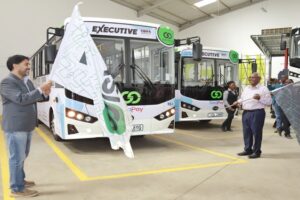
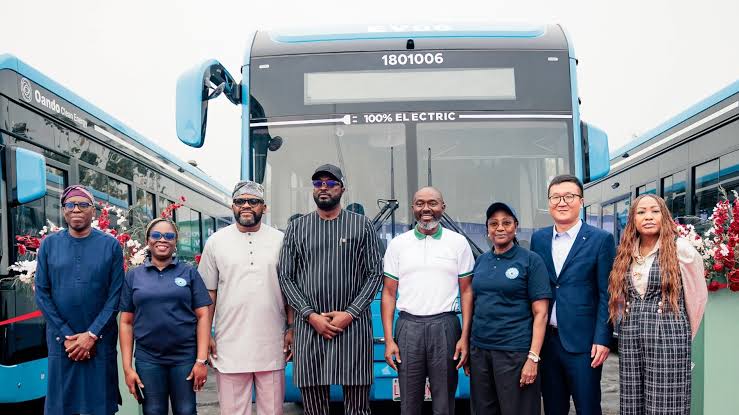
Oando Clean Energy Limited (OCEL) is scaling up its electric mass transit initiative in Lagos, deploying a new batch of electric buses after completing a successful two-vehicle pilot program.
In a statement released on Wednesday, the renewable energy arm of Oando Energy Resources confirmed that the new buses will enter service under the Lagos Metropolitan Area Transport Authority (LAMATA) starting in the fourth quarter of 2026. This expansion marks the transition from a proof-of-concept trial to full-scale rollout under OCEL’s ongoing e-mobility partnership with the Lagos State Government.
Data from the initial two-bus trial highlighted high reliability and operational efficiency. The pilot vehicles transported roughly 788,000 commuters across 433,000 kilometers with minimal downtime, displacing an estimated 216,000 liters of diesel. Between January and September 2026 alone, the buses logged over 212,000 passenger trips while maintaining a 73 percent average capacity utilization rate.
Speaking at the launch event, Lagos State Commissioner for Transportation Oluwaseun Osiyemi described the fleet addition as a tangible step toward cutting transit emissions, improving urban air quality, and advancing the state’s 2050 net-zero target.
LAMATA Managing Director Abimbola Akinajo emphasized that the program’s true benchmark will be service quality and the daily commuting experience for Lagos residents, rather than fleet size alone.
OCEL President Ademola Ogunbanjo noted that the initiative aims to prove that electric transit can operate reliably and sustainably within Nigeria’s local environment.
Beyond vehicle deployment, Ogunbanjo revealed that OCEL is establishing an end-to-end e-mobility value chain. This broader infrastructure includes charging networks, technical training, after-sales maintenance, a spare parts supply chain, and local vehicle assembly—an operation for which the company has recently secured licensing.