

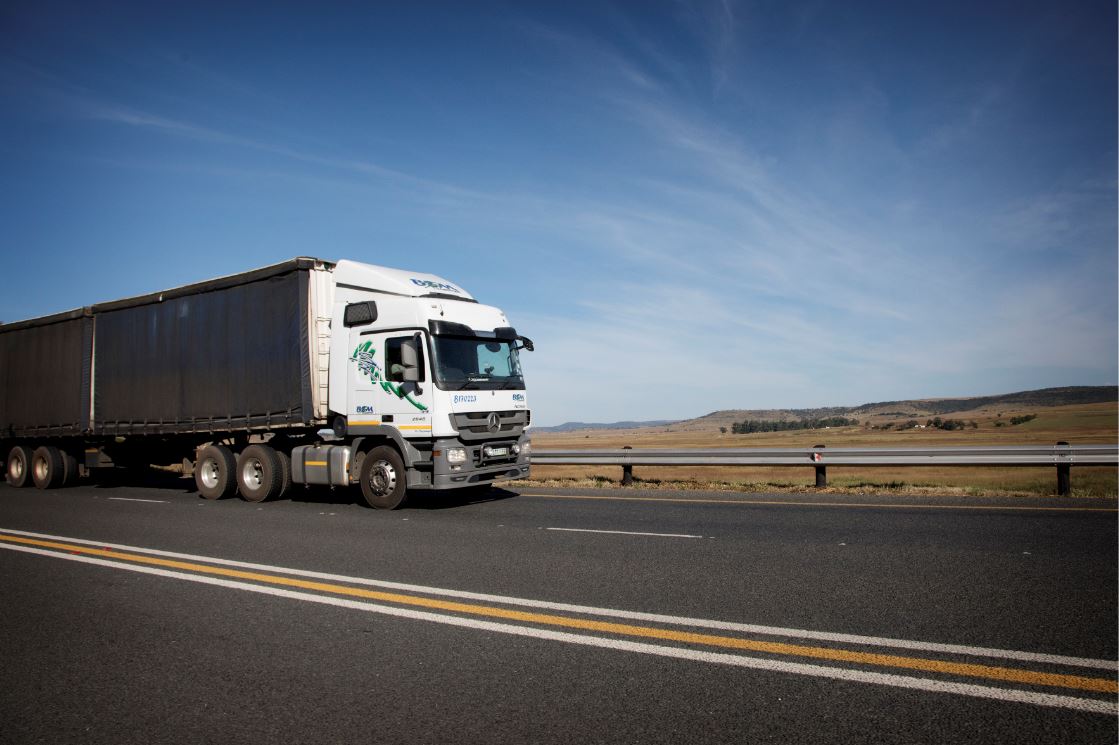
South Africa is approaching a new and expensive milestone in the movement of goods across its economy. National logistics expenditure is forecast to reach R1.156 trillion (US$70.00 billion) in 2026, with transport accounting for R683 billion (US$41.36 billion) of the total, as rising fuel expenditure, road freight rates and the continuing consequences of railway underperformance place additional pressure on businesses and commercial vehicle operators.
The figures, contained in GAIN Group's State of Logistics 2026 for South Africa, show that the national logistics bill is expected to increase by R147 billion (US$8.90 billion) from an estimated R1.009 trillion (US$61.09 billion) in 2025. Transport alone accounts for R117 billion (US$7.08 billion) of that increase, making it the principal driver of the projected acceleration.
The report presents a more complex picture than an industry struggling with expensive diesel. South Africa has progressively increased its dependence on road transport while freight rail volumes have declined, exposing more national freight activity to the costs of trucking. At the same time, vehicle ownership, labour, maintenance, insurance and financing have become increasingly expensive.
A national logistics bill growing faster than the economy
The projected 2026 logistics burden amounts to 14.6% of gross domestic product, compared with 13.2% in 2025 and the approximately 10–12% range that generally prevailed between 2009 and 2018. It is the highest ratio in the report's 2003–2026 series.
A higher logistics cost-to-GDP ratio is not, by itself, proof of worsening operational efficiency. Changes in economic output, freight demand, commodity mix and geography all influence the ratio. What is notable in South Africa's case is the simultaneous increase in the absolute logistics bill and its share of economic output since 2021.
The expanding logistics bill
The national logistics bill is projected to have increased by R510 billion (US$30.88 billion) since 2021. The report emphasizes that the economic concern is not all logistics expenditure, which is necessary for productive activity, but the additional cost created by unreliable infrastructure, inefficient operations and avoidable constraints.
Transport dominates national logistics expenditure
Transport remains the largest component of South Africa's logistics expenditure, representing almost six out of every ten rand spent on moving, storing and managing freight. Its forecast R683 billion (US$41.36 billion) cost includes fuel, labour, vehicle depreciation, maintenance, insurance and other transport-related expenditure.
Inventory carrying costs are estimated at R191.4 billion (US$11.59 billion), warehousing at R151.7 billion (US$9.19 billion), and management and administration at R130 billion (US$7.87 billion).
Where the money goes
The cost categories are interconnected. Unreliable freight transport can force businesses to hold additional stock, increasing inventory financing requirements and warehousing costs. Operational uncertainty can also increase the expenditure required to plan and coordinate freight movements.
Diesel remains the largest road freight expense
GAIN Group's analysis identifies fuel as the largest individual road freight cost component. It accounted for an estimated 43.4% of road freight expenditure in 2025, compared with 39.1% in 2015.
Aggregate road freight fuel expenditure is forecast to increase from approximately R188 billion (US$11.38 billion) in 2025 to R274 billion (US$16.59 billion) in 2026. The increase of approximately R86 billion (US$5.21 billion) reflects the sensitivity of commercial transport to diesel prices, although aggregate expenditure is also affected by freight activity and modelling assumptions.
The economics of road freight
The rising cost of vehicle financing also deserves attention. The report forecasts aggregate road freight capital costs at approximately 3.3 times their 2014 level, exceeding the roughly threefold increase in fuel expenditure over the same period.
For fleet owners, these developments reinforce the importance of vehicle utilization, preventive maintenance, appropriate truck specification and financing structures that reflect the productive life and revenue-generating capacity of commercial vehicles.
Road freight rates have outpaced inflation
South African road freight rates increased by approximately 82% between 2014 and 2025, compared with 68% for consumer price inflation and 53% for diesel prices. The divergence demonstrates that the cost of transporting goods by road is influenced by considerably more than movements in the price of fuel.
GAIN Group forecasts a cumulative 112% increase in road freight rates between 2014 and 2026, compared with 60% for rail freight rates over the same period.
Road freight rates versus inflation
The comparatively slower increase in rail freight rates does not automatically make rail the most economical option for every consignment. Reliability, access to terminals, cargo handling requirements, journey time and first- and last-mile costs remain central to the choice of freight transport mode.
The growing dependence on road transport
South Africa transported approximately 218.1 million tonnes of freight by rail and 484.5 million tonnes by road in 2014. By 2024, rail freight volumes had declined to 156.4 million tonnes while road freight increased to 506.6 million tonnes.
Rail consequently lost approximately 61.7 million tonnes of annual freight over the decade, a reduction of 28.3%. Road freight volumes increased by approximately 22.1 million tonnes, or 4.6%.
Ten years of road and rail freight
Average road freight haulage distance increased from 477 kilometres in 2014 to 547 kilometres in 2024. Over the same period, road freight activity measured in tonne-kilometres increased from approximately 231 billion to 277.2 billion.
Although road freight tonnage increased by less than 5%, the transport work performed by trucks increased by approximately 20%. The country's commercial vehicle fleets are consequently transporting goods over longer average distances, with implications for fuel consumption, maintenance requirements, vehicle replacement and infrastructure use.
The economic consequences of rail underperformance
GAIN Group estimates that the wider economic cost of South Africa's freight rail underperformance declined from R410.7 billion (US$24.87 billion) in 2022 to R180.8 billion (US$10.95 billion) in 2025.
The reduction suggests progress in addressing some of the railway system's most damaging failures, although the remaining burden continues to affect mining exports, transport costs and economic competitiveness.
The economic cost of rail underperformance
Of the estimated 2025 economic cost, R88.4 billion (US$5.35 billion) related to unachieved bulk mineral exports, principally coal and iron ore, while R92.4 billion (US$5.59 billion) represented the broader economic consequences of transport inefficiencies.
The latter included R46.2 billion (US$2.80 billion) in additional direct transport costs, with wider economic effects reflected through a multiplier. These figures should not be added indiscriminately to the national logistics bill because they include lost economic activity and effects extending beyond direct freight expenditure.
Railway reform and the participation of private train operating companies may support the recovery of freight volumes, but the commercial measure of success will be dependable freight services, improved export capacity and lower avoidable transport costs.
Freight demand is heading towards one billion tonnes
GAIN Group estimates national freight demand at 790.1 million tonnes in 2024 and forecasts approximately 1.019 billion tonnes by 2055. That represents approximately 229 million additional tonnes of annual demand, an increase of about 29%.
South Africa's freight capacity challenge
Meeting this additional demand through road haulage alone would increase pressure on commercial vehicle fleets, roads, fuel consumption and supporting infrastructure. The report identifies desirable rail freight volumes of approximately 250 million tonnes by 2035 and 320 million tonnes by 2055, although these are planning aspirations rather than committed capacity.
Road transport would remain indispensable for distribution, short-haul movements, time-sensitive consignments and first- and last-mile connections. Better rail services would allow trucks to be deployed where their operational advantages are strongest.
The R149.3 billion efficiency opportunity
GAIN Group models an improved logistics scenario in which suitable freight is shifted to rail, road transport operating efficiency improves and transport inefficiencies associated with port delays are reduced.
Under these assumptions, the report identifies R149.3 billion (US$9.04 billion) in potentially avoidable annual logistics expenditure in 2026. The national bill would decline from approximately R1.156 trillion (US$70.00 billion) to R1.0066 trillion (US$60.95 billion), with the logistics cost-to-GDP ratio falling from 14.6% to approximately 12.7%.
What improved freight efficiency could save
The savings estimate is a scenario rather than an immediately available pool of money. Its realization would depend on infrastructure reliability, freight allocation between modes, improved loading efficiency and the performance of commercial transport operations.
What the findings mean for fleet operators and financiers
For commercial fleet owners, the analysis places vehicle utilization at the centre of competitiveness. Trucks operating below their practical payload capacity, spending extended periods waiting for loads or returning empty impose ownership and labour costs that must be recovered over fewer productive kilometres.
Preventive maintenance and appropriate vehicle specification become more important as the cost of replacing equipment rises. Fleet operators must balance acquisition price, financing terms, fuel consumption, service support, uptime, residual value and route requirements rather than assessing individual costs in isolation.
For asset financiers and leasing companies, the report underscores the importance of the cash flows generated by transport assets. Contract quality, route utilization, operating margins and exposure to fuel price volatility can be as consequential as the security value of the vehicle itself.
Truck manufacturers, distributors and service providers face a market in which operating efficiency is increasingly important to purchasing decisions. Fuel-efficient powertrains, dependable aftersales support, tyre management, maintenance contracts and fleet management systems may deliver commercial benefits, although their value must be demonstrated against specific operating conditions.
For freight owners, the central strategic question is how road and rail can be combined to improve delivery reliability and reduce the total cost of distribution. Where rail services recover, long-distance bulk and suitable containerized movements may increasingly be allocated to rail, while road fleets concentrate on feeder services, regional distribution and consignments for which trucking remains the most competitive mode.
South Africa's projected R1.156 trillion (US$70.00 billion) logistics bill reflects the scale of the country's freight requirements as well as the costs imposed by structural weaknesses in its transport system. The report's most important distinction is between expenditure necessary to move a freight-intensive economy and expenditure that could be avoided through better use of infrastructure, vehicles and working capital.
Primary research: GAIN Group (Pty) Ltd, State of Logistics™ 2026 for South Africa, October 2026. Produced by GAIN Group and sponsored by Absa and the Western Cape Government Mobility Department. The original report credits GAIN Group as its institutional author. This feature is an independent Fleet Intelligence® editorial analysis.
Currency conversion: All US dollar equivalents are indicative, calculated using a uniform reference exchange rate of US$1 = R16.5157. Historical rand values have been converted at the same rate for presentation rather than at their respective historical exchange rates. USD equivalents are not independently reported by GAIN Group.
Data classification: National logistics cost figures generally use observed data through 2024, estimates for 2025 and forecasts for 2026. The long-term freight outlook and improved logistics scenario are projections. Graphics are editorial adaptations of the published research.
Original report: GAIN Group — State of Logistics | State of Logistics report portal