UNEP’s financing assessment finds that commercial motorcycle riders in African markets face annual borrowing rates of 45–90%, compared with 4–8% in China. The findings reveal a considerable credit divide that could determine how quickly Africa’s expanding electric motorcycle industry reaches commercial scale, despite the growing economic advantages of electric two-wheelers over petrol-powered alternatives.
The findings come from Capital 2 Mobilize: Financing the Electric Two- and Three-Wheeler Transition in the Global South, launched on 22 July 2026 and revisited in a UNEP technical feature in October. Developed under UNEP's Global Electric Mobility Programme, with funding from the Global Environment Facility, the assessment examines credit conditions and financing models across Africa, Asia and Latin America.
The assessment estimates that the transition will require approximately US$110 billion in cumulative capital between 2026 and 2035. The financing requirement is global rather than Africa-specific, but its findings are particularly relevant to African markets where commercial motorcycles provide livelihoods for millions of operators and conventional lenders frequently struggle to assess their creditworthiness.
A stark credit divide
UNEP reports that commercial motorcycle riders in African markets can face annual borrowing rates of 45–90%, compared with 4–8% in China. The difference reflects wider credit-market conditions, borrower risks, funding costs and the limited availability of established financing products for informal transport operators.
A motorcycle that is cheaper to operate may still be unaffordable when high interest charges absorb the savings that would otherwise accrue to its owner. For banks, the challenge is to distinguish genuine credit risk from uncertainty arising from limited borrower information and unfamiliar technology.
Annual borrowing rates for commercial motorcycle riders
Source: UNEP, Capital 2 Mobilize, 2026. The darker segments represent the cited ranges. The lighter segments extend to zero for scale. These are reported ranges, not market averages.
The Nairobi rider’s daily economics
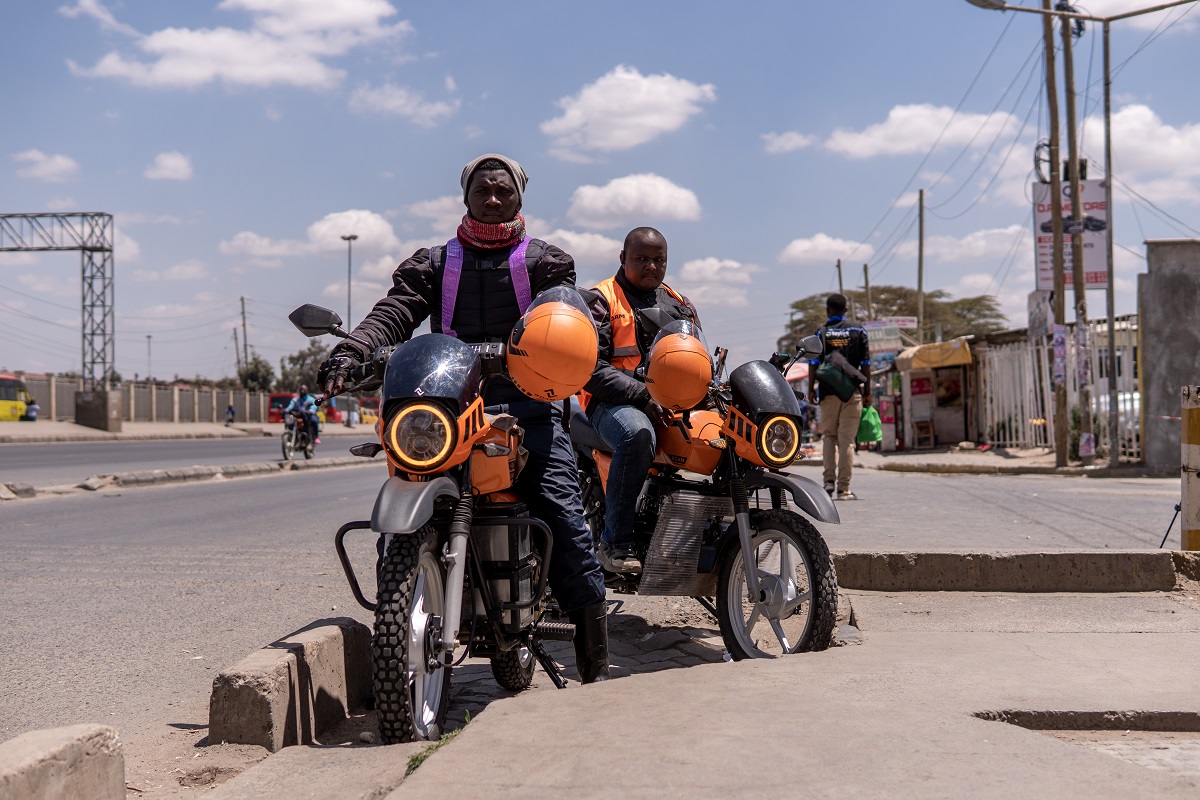
UNEP estimates that Nairobi motorcycle taxi riders typically earn US$10–15 a day, with petrol absorbing 40–60% of earnings. Electricity for an electric motorcycle can cost less than US$2 daily. Lower energy costs improve the economics of ownership, although financing instalments, maintenance, battery services and insurance must also be considered.
Petrol-spending range calculated from UNEP's reported daily earnings and fuel-spending shares. Bars are illustrative, with US$15 as the maximum scale. The figures are not a complete net-income comparison.
The financial case becomes more compelling as electric motorcycles accumulate higher daily mileage. Riders undertaking passenger trips, deliveries and cargo movements can benefit from lower energy expenditure, but the structure of their financing remains decisive. An expensive loan can consume much of the operating advantage that originally justified the investment.
Kenya's electric motorcycle market has nevertheless expanded rapidly. UNEP reports that electric two-wheeler sales exceeded 25,000 units in 2025, more than three times the previous year's level. The expansion has attracted vehicle manufacturers, battery-swapping operators and asset financiers seeking to serve commercial riders previously excluded from conventional vehicle lending.
A US$110 billion financing requirement
UNEP estimates that the global electric two- and three-wheeler transition will require approximately US$110 billion in cumulative financing between 2026 and 2035.
Annual financing requirements are projected to rise from US$6.6 billion to US$17.9 billion over the period. The figures cover the Global South and other markets within the assessment, rather than representing a dedicated financing facility for Africa.
Global electric two- and three-wheeler financing
Source: UNEP, Capital 2 Mobilize. The chart shows the two reported annual endpoints, not an assumed annual forecast series.
For commercial banks, the challenge is not simply to increase lending volumes, but to develop financing structures capable of managing the risks associated with unfamiliar vehicle technology, informal borrower income and uncertain resale values.
UNEP's assessment identifies 24 financing and policy interventions intended to address these constraints. They include credit guarantees, alternative underwriting, battery-performance information, buyback arrangements and vehicle-as-a-service models. The interventions represent a mixture of proposed mechanisms and approaches already being tested in different markets, rather than 24 completed UNEP-funded projects.
How de-risking can unlock bank finance
The financing structures proposed by UNEP seek to improve how lenders assess borrower income, vehicle performance, collateral and residual-value risks.
Cash-flow-based underwriting
Trip data, mobile-money receipts and vehicle utilization help establish repayment capacity.
Battery data and standards
Reliable battery information, warranties and product standards improve asset assessment.
Guarantees and buybacks
Guarantees and manufacturer commitments can share credit-loss and resale risks.
Vehicle-as-a-Service
Separating vehicle use from battery ownership can reduce the upfront acquisition cost.
Credit guarantees can reduce a lender's exposure to default, while cash-flow-based underwriting offers an alternative to formal payslips and conventional credit histories. Battery data and enforceable warranties can improve confidence in the value of financed assets. None of these mechanisms eliminates commercial risk, but each can address a different obstacle preventing mainstream lenders from entering the market.
Battery-as-a-service arrangements are particularly relevant to commercial riders because the battery represents a substantial component of the vehicle's purchase price. UNEP's reporting on Nairobi identified Powerhive's approach to retaining battery ownership, with Margaret Wawitima, the company's Marketing Lead, explaining that the model can reduce the initial motorcycle price by approximately 25%.
Roam's Kenya Country Manager, Habib Lukaya, has similarly identified upfront affordability as a significant constraint, even where riders recognize the operational advantages of electric motorcycles. The commercial viability of these arrangements therefore depends on both the financing terms and the reliability of the vehicle and energy services supplied throughout the repayment period.
Companies testing different approaches
UNEP's research identifies a range of companies developing or examining financing and operating models for electric two- and three-wheelers. Their approaches address different components of the commercial mobility value chain.
Asset-financing products for customers with limited access to conventional credit, including mobility assets.
Electric motorcycle deployment combined with battery-swapping infrastructure across African markets.
Electric motorcycle assembly and deployment in Kenya, including commercial rider ownership models.
Battery-as-a-service arrangements designed to reduce upfront vehicle acquisition costs.
Electric vehicle lending in India using alternative credit assessment and financing structures.
UNEP named AIZEN, iFood, M-KOPA, Revfin and Spiro for follow-up case studies. Roam and Powerhive appear in UNEP's Nairobi electric mobility coverage. Inclusion does not establish UNEP financial support or endorsement.
The financing problem extends beyond the rider. Motorcycle manufacturers require working capital for components and assembly, battery-swapping companies need substantial investment in batteries and charging infrastructure, and lenders require reliable information about vehicle performance and repayment behaviour.
These requirements help explain why an electric motorcycle industry can demonstrate strong demand while remaining dependent on relatively expensive or specialized sources of capital. Scaling the market requires financing products that accommodate daily and seasonal earnings without transferring excessive risk to borrowers.
For African commercial banks, the opportunity lies in financing productive transport assets whose operating economics can increasingly be measured. Yet technology alone cannot make an unaffordable loan sustainable. The decisive consideration is whether the vehicle generates sufficient income after operating costs to meet repayments and sustain the livelihood of its operator.
UNEP's assessment places this question at the centre of Africa's electric mobility transition. The manufacturers may be able to build the vehicles, and operators may be willing to adopt them, but commercial scale will depend on whether lenders can finance those vehicles at rates that reflect their productive capacity rather than the uncertainties of an unfamiliar market.
Research references: United Nations Environment Programme, Capital 2 Mobilize: Financing the Electric Two- and Three-Wheeler Transition in the Global South, launched 22 July 2026; UNEP electric mobility technical feature, October 2026; UNEP Nairobi electric motorcycle reporting; UNIDO Industrial Development Report 2026, Kenya case study.
UNEP assessment · UNEP technical feature · UNIDO Kenya case study