
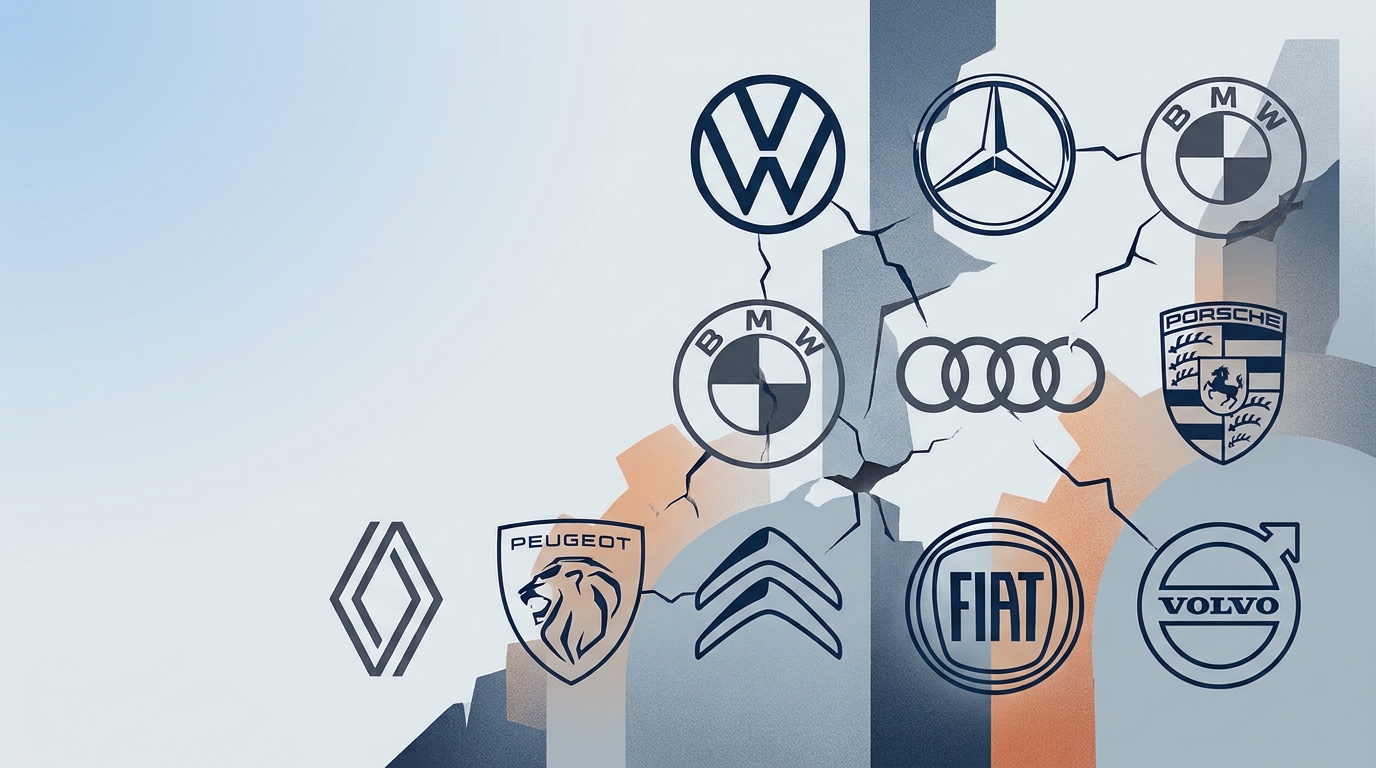
For more than a century, the European automotive industry stood as the crown jewel of the continent’s industrial might. Accounting for roughly 7% of the European Union’s gross domestic product and supporting nearly 14 million jobs, companies like Volkswagen, Mercedes-Benz, Stellantis, and BMW were not merely carmakers—they were the economic bedrock of nations.
Today, that bedrock is fracturing. Across Germany, France, Italy, Sweden, and the United Kingdom, every major European car group is trapped in a historic, multi-front crisis. Plunging profits, massive asset write-downs, bloated factory networks, and tens of thousands of job cuts have replaced decades of steady expansion. Since 2019, overall European automotive production has contracted by nearly a fifth, leaving Western European factories operating at just 70% capacity—a surplus equivalent to 2.5 million unbuilt vehicles a year.
What began as a bumpy transition to electric vehicles (EVs) has evolved into a deeper existential reckoning. European automakers are being squeezed simultaneously by cheaper, technologically superior Chinese competitors, punishing trade tariffs in the United States, uncompetitive domestic energy and labor costs, and the self-inflicted wounds of aggressive corporate consolidation.
The Collapse of the Global Export Engine
For the past fifteen years, Europe’s premium automakers operated on a reliable formula: build high-margin luxury and performance vehicles in Europe, and sell them in vast quantities to booming middle classes in China and North America. That business model has abruptly broken down.
In China—the world’s largest car market—domestic electric vehicle champions such as BYD, Geely, and tech-entrant Xiaomi have rapidly captured the premium and mass-market segments. Offering superior battery range, seamless in-cabin software, and aggressive pricing, Chinese brands have pushed European rivals to the margins. For German luxury giants that once relied on China for up to 40% of their global profits, the decline has been brutal. In the third quarter of 2026 alone, BMW’s Chinese deliveries plunged by nearly a quarter, while Volvo Cars saw its Chinese market share roughly cut in half.
At the same time, the Atlantic export corridor has been walled off by protectionism. Steep U.S. import tariffs—ranging between 10% and 27.5%—have severely penalized European manufacturers that rely on European assembly lines to supply American showrooms. Brands without massive U.S. manufacturing footprints, including Porsche, Volvo, and Jaguar Land Rover (JLR), have been forced either to absorb billions of dollars in tariff penalties or spend heavily to relocate production to North America.
A Continental Reckoning: How the Major Groups Are Suffering
No corner of the European auto sector has been spared, though the crisis has manifested differently across mass-market conglomerates and luxury marques.
- Volkswagen Group (VW, Audi, Porsche, Škoda, Seat): Europe’s largest automaker is undergoing the most painful restructuring in its postwar history. Hit by falling Chinese sales, severe German factory overcapacity, and a massive €6 billion impairment charge tied to Porsche, VW has slashed its profit outlook. To survive, the group is cutting up to 100,000 jobs—including 50,000 reductions approved in late 2026—while exploring the unprecedented closure of up to four German plants, halving its model lineup, and scrapping its flagship “Gamechanger” factory modernization program.
- Stellantis (Peugeot, Citroën, Fiat, Opel, Jeep, Maserati): Formed through the mega-merger of PSA and Fiat Chrysler, Stellantis swung to a staggering €22.3 billion net loss in 2025. The conglomerate was battered by massive EV supply-chain write-downs, bloated dealer inventories, and collapsing luxury shipments at Maserati. To stem the bleeding, Stellantis suspended its 2026 dividend, booked over €22 billion in business reset charges, and made the humbling decision to partner with Chinese startup Leapmotor to build and sell budget Chinese EVs through its own European dealerships.
- BMW Group (BMW, Mini, Rolls-Royce): Long viewed as the most resilient of the German luxury trio, BMW issued two consecutive profit warnings in 2026. As Chinese demand evaporated and price wars intensified, BMW slashed its core automotive profit margin forecast to between -0.5% and 0.5% and announced plans to eliminate 8,000 jobs in Germany by the end of 2027.
- Mercedes-Benz Group (Mercedes-Benz, AMG, Maybach): Facing weakening luxury demand in Asia and rising raw material costs, Mercedes-Benz cut its 2026 core profit margin guidance to just 2% to 3%. Management has responded by freezing employee bonuses, pressing staff to work longer weeks without additional pay, and quietly scaling back its near-term EV-only ambitions in favor of traditional hybrids.
- Renault Group (Renault, Dacia, Alpine): Renault posted a €10.9 billion net loss in 2025, weighed down by massive accounting write-downs on its longtime alliance partner Nissan, alongside debt restructuring and delays at its battery unit. While strong European demand for its budget brand Dacia and hybrid models has kept its core operating margins healthier than most peers at around 5.5%, the group remains heavily exposed to a stagnating European home market.
- Volvo Cars & Jaguar Land Rover (JLR): Europe’s mid-sized premium players have been hit hardest by trade friction. Volvo Cars swung to a 5.7 billion kronor (€513 million) net loss in Q3 2026 as revenue tumbled 23%, forcing it to cut 5,500 jobs globally and lean more heavily on hardware shared with its Chinese parent company, Geely. Meanwhile, Britain’s JLR saw annual profits collapse 99% to £14 million before swinging to a £244 million loss—battered by U.S. tariffs, a five-week cyberattack shutdown, and the temporary halting of Jaguar sales ahead of an all-electric brand relaunch. JLR is cutting 4,000 UK office roles and shifting Defender production to the United States to survive.
Domestic Pressures and Self-Inflicted Wounds
While foreign competition and tariffs explain the external shock, internal European structural flaws have prevented automakers from fighting back effectively.
First is the crippling cost of European manufacturing. Following the loss of cheap Russian pipeline gas, industrial electricity prices in Europe remain substantially higher than in the United States or China. Combined with Europe’s strict labor protections and high wages, building an entry-level electric car in Western Europe is largely unprofitable. Meanwhile, European consumers—facing inflation, the withdrawal of government EV purchase subsidies, and patchy charging infrastructure—have slowed their adoption of electric cars, leaving billion-dollar EV factories running far below capacity.
Second is a widespread quality crisis born of corporate cost-cutting. Over the past decade, conglomerates like Stellantis and Volkswagen aggressively consolidated their engineering, forcing distinct brands to share identical engines, transmissions, and software architectures while slashing development timelines from five years to two. When those shared components proved flawed—such as Stellantis’s troubled 1.2-liter PureTech engine or Volkswagen’s twin-clutch gearboxes and buggy software platforms—the fallout was catastrophic. Millions of vehicles across multiple brands required simultaneous warranty repairs, causing warranty costs at groups like Stellantis to nearly double to over 4% of automotive revenue and severely damaging hard-won reputations for European engineering reliability.
The Supply Chain Collapse: Tier-One Titans in Retreat
While headline news focuses on famous car badges, the most severe structural damage is occurring one tier below—among the massive component suppliers that engineer Europe’s transmissions, braking systems, sensors, and electronics. Caught in a “polycrisis” between shrinking carmaker orders, stalled European battery factories, and aggressive price undercutting by Chinese rivals like CATL and BYD, European suppliers have absorbed the worst of the financial shock.
According to the European Association of Automotive Suppliers (CLEPA), parts makers announced more than 104,000 job cuts across 2024 and 2025—a pace exceeding the worst layoffs of the COVID-19 pandemic—followed by nearly 19,000 additional cuts in the first half of 2026. Industry surveys indicate that roughly a quarter of European suppliers expect to post net losses in 2026, while three-quarters operate on profit margins below 5%, leaving them with almost no capital to fund next-generation R&D. CLEPA warns that up to 350,000 supplier jobs across Europe are at risk by 2030 if current trends continue.
Tier-1 supplier
- Robert Bosch: The world’s largest automotive supplier is eliminating roughly 22,000 jobs globally by the end of the decade—including 13,000 roles announced in late 2025 inside its flagship Mobility division—to close a €2.5 billion annual cost gap. In October 2026, Bosch announced a radical corporate overhaul, spinning off its Mobility unit and three other divisions into independent subsidiaries to cut bureaucracy and regain competitiveness.
- ZF Friedrichshafen: Historically dominant in complex multi-speed transmissions for combustion engines, ZF is cutting between 11,000 and 14,000 jobs in Germany by 2028 as part of a €6 billion cost-reduction program. Because electric cars do not require traditional gearboxes and European EV adoption has stalled, ZF was forced to scale back its electrification division and pivot capital toward plug-in hybrid systems.
- Continental & Schaeffler: Continental is eliminating more than 10,000 positions globally, shuttering historic German plants, and preparing to spin off its struggling automotive electronics division. Meanwhile, powertrain specialist Schaeffler is cutting nearly 4,700 jobs across Europe as demand for precision engine bearings and combustion components permanently contracts.
Pivoting for Survival
Faced with industrial hollowing-out, both corporate boards and European policymakers are executing a rapid strategic retreat.
In Brussels, heavy lobbying forced the European Commission to soften its rigid regulatory timeline. Regulators stepped back from an absolute 2035 ban on new combustion-engine sales, replacing it with a 90% carbon-reduction target that leaves room for plug-in hybrids and synthetic fuels, while granting automakers a multi-year averaging window to avoid billions in immediate emissions fines.
Inside the boardrooms, pride has given way to pragmatism. Legacy European brands are increasingly outsourcing the technology they failed to master in-house—whether through Volkswagen investing billions into American EV maker Rivian for software architecture, or Stellantis and Volvo relying on Chinese partners for affordable electric platforms.
Perhaps the most striking symbol of Europe’s industrial shift is what is happening inside its underutilized factories. With millions of square feet of idle assembly space and surging European military budgets, carmakers and suppliers alike are pivoting to defense manufacturing. Renault has partnered with defense contractor Thales to produce military drones, while Volkswagen and several tier-one suppliers have actively explored converting surplus German plants to build military hardware.
Europe’s carmakers and suppliers will not disappear, but the era of European automotive supremacy is over. The survivors of this decade will emerge smaller, leaner, and far more reliant on foreign technology—transforming from undisputed global leaders into regional competitors fighting to defend their own backyard.