
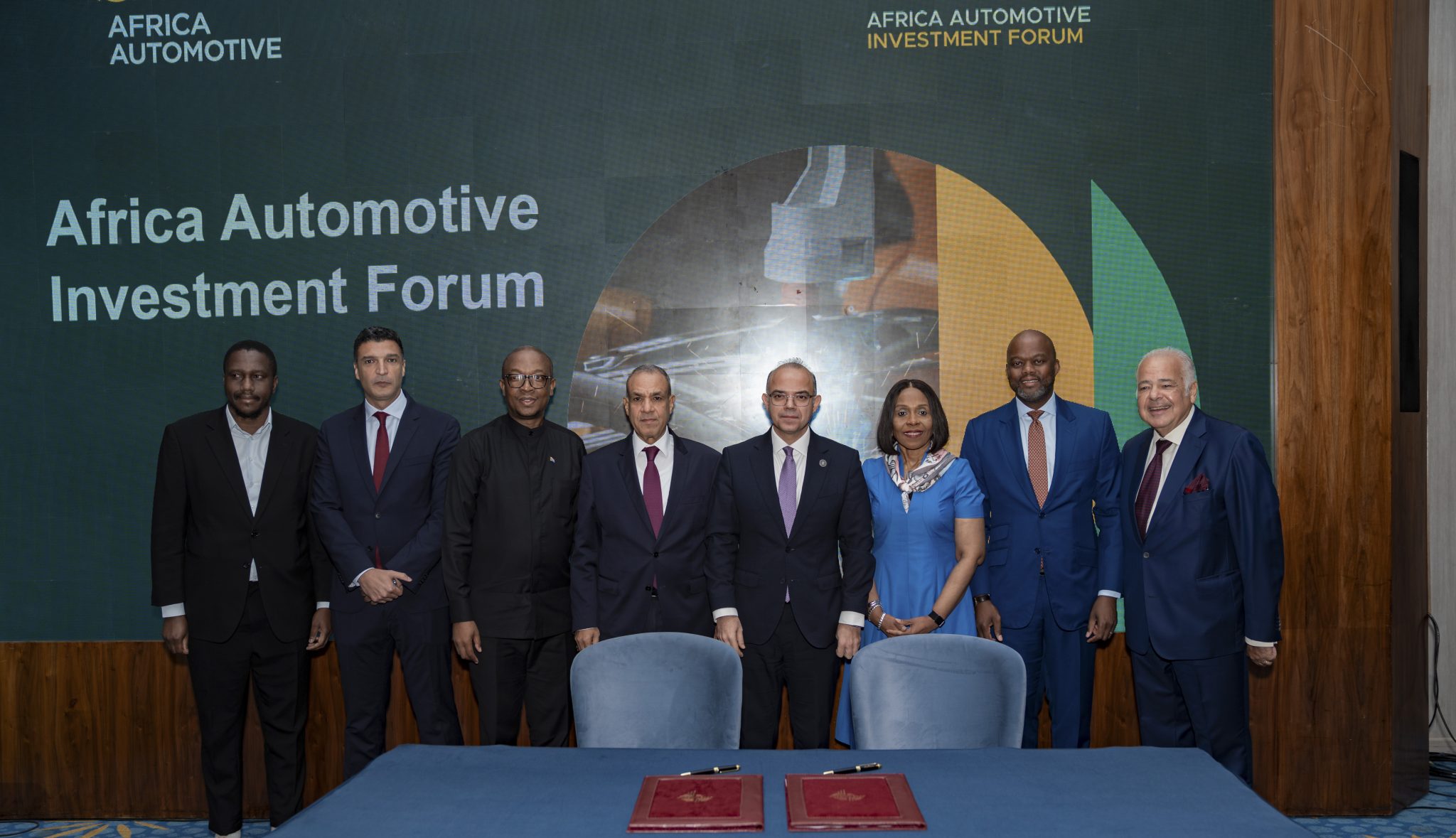
The African Export-Import Bank (Afreximbank) has reaffirmed its US$1 billion financing commitment to Africa's automotive industry, placing fresh emphasis on domestic vehicle manufacturing, automotive components, industrial partnerships and regional supply chains as the continent attempts to reduce its dependence on imported vehicles.
The commitment, highlighted in an October 19, 2026 announcement following the Africa Automotive Investment Forum in Egypt's El Alamein, comes with evidence that the financing programme has moved beyond its initial commitments. Afreximbank has disclosed that US$233 million has already been disbursed, equivalent to 23.3% of the US$1 billion facility, while identifying at least ten automotive investment opportunities with an estimated combined value of US$125 million.
The projects span brake systems, shock absorbers, exhaust systems, tyres, batteries and battery housings. Rather than concentrating exclusively on new vehicle assembly plants, Afreximbank is directing attention towards component manufacturers, engineering companies and regional suppliers without which automotive assembly operations struggle to develop substantial domestic value addition.
For a continent with a growing population, expanding urban economies and significant demand for passenger and commercial vehicles, the central difficulty has never been simply the absence of potential customers. It has been the inability of most African markets to support competitive vehicle manufacturing at scale, compounded by fragmented industrial policies, high production costs, limited vehicle financing and the continued availability of imported used vehicles.
Afreximbank's intervention attempts to address several of these constraints simultaneously, although the availability of financing alone cannot overcome the structural weaknesses that have historically limited automotive industrialisation.
"Investing in the African automotive ecosystem is not merely a financing opportunity, but a strategic imperative."Kanayo Awani — Executive Vice President, Intra-African Trade and Export Development, Afreximbank
Awani has argued that regional automotive production could stimulate manufacturing, generate skilled employment and reduce dependence on vehicle imports. She has also pointed to Africa's reserves of lithium, cobalt, manganese, nickel, copper, iron and steel as a potential foundation for deeper participation in automotive supply chains, including emerging electric-vehicle technologies.
Africa possesses several important inputs for automotive production but has yet to establish sufficiently integrated industrial systems to convert those resources into finished components and vehicles across multiple countries. Steel processing, metal forming, plastics, electronics, tyres, batteries, glass, electrical systems, engineering services and logistics must develop alongside final assembly.
The US$1 Billion Commitment and the Financing Gap
The distinction between a financing commitment and actual disbursement is important. The US$1 billion represents Afreximbank's stated financing envelope, while the US$233 million reflects funding reported as already disbursed. The bank has not provided a complete public breakdown of beneficiaries, repayment terms, country allocations or the division between vehicle manufacturing and component production.
The additional US$125 million in identified opportunities should not be treated as approved or disbursed financing. These are prospective investments requiring further development, financial structuring and commercial commitments. Their eventual implementation will depend on manufacturers securing customers, meeting technical specifications and demonstrating sufficient demand to justify production capacity.
Gainmore Zanamwe, Afreximbank's Director of Trade Facilitation and Investment Promotion, has emphasized the need for governments, manufacturers and financial institutions to work together to convert proposed investments into commercially viable projects. The bank has also identified project preparation, guarantees and equity financing as instruments alongside conventional lending.
Project preparation can help establish technical and commercial feasibility, guarantees can reduce risks that prevent private lenders from participating, while equity can support enterprises whose capital structures cannot sustain conventional borrowing during the early years of manufacturing.
For automotive component producers, financing is particularly difficult because substantial capital expenditure may be required before the first supply contract generates revenue. Machinery, tooling, certification, product testing and workforce development can require years of investment, while vehicle manufacturers generally demand consistent quality, delivery reliability and competitive pricing.
An Industry Concentrated in a Handful of Countries
Africa's automotive production remains highly concentrated despite decades of industrial policy interventions and assembly investments across different countries.
In his address to the Alamein forum, South Africa's Minister of Trade, Industry and Competition, Parks Tau, cited approximately 1.23 million vehicles produced across Africa, equivalent to about 1.3% of global production of 96.4 million vehicles. He also reported South African production of 618,077 vehicles in 2025.
The same address referred to Morocco reaching one million vehicles in December 2025, although it did not clearly distinguish production capacity from annual output. That figure should therefore not be combined with South Africa's annual production as though the two represented directly comparable measurements.
South Africa and Morocco nevertheless remain the continent's most established automotive production centres, supported by export-oriented manufacturing operations, established suppliers, industrial incentives and relationships with global manufacturers.
Egypt has developed a substantial vehicle assembly and component manufacturing base, while Algeria has pursued renewed domestic assembly investments. Elsewhere, Kenya, Nigeria, Ghana, Ethiopia and Rwanda have sought to develop vehicle assembly and electric mobility industries, although the scale and industrial depth of their operations vary considerably.
The difficulty for newer automotive markets is that assembly plants often begin with imported semi-knocked-down or completely knocked-down vehicle kits. Such operations can establish technical capabilities and provide a starting point for supplier development, but their economic contribution remains constrained when engines, transmissions, electronic systems and most other components continue to arrive from overseas.
From National Assembly Plants to Continental Supply Chains
One of the most consequential developments at Alamein was the agreement between the AfCFTA Secretariat and the African Association of Automotive Manufacturers (AAAM) to strengthen cooperation on the continent's automotive industrial strategy.
The agreement covers automotive rules of origin, customs procedures, trade facilitation, industrial standards, supplier development, investment mobilisation and emerging automotive technologies.
Rules of origin are especially important because they determine whether vehicles and components qualify for preferential trade treatment under the AfCFTA. Without commercially workable provisions, manufacturers could find themselves operating within a nominal continental free-trade area while continuing to face obstacles to sourcing components and selling finished vehicles across borders.
"Investors are not looking at 54 separate African markets. They are looking at one integrated opportunity."Tarek Mosaad — President, African Association of Automotive Manufacturers
Mosaad identified increasing local content through regional value chains, simplifying cross-border automotive trade and strengthening Africa's participation in future mobility technologies as principal priorities.
Governments have frequently sought to establish separate national assembly industries, sometimes competing for the same manufacturers while offering incentives to serve relatively small domestic markets. A more integrated system would allow component manufacturers to specialize and supply several assembly plants across different countries.
One country could develop competitive metal-forming operations, another could manufacture electrical systems, while established production centres undertake higher-volume vehicle assembly. Such arrangements would allow manufacturers to spread fixed investment costs across larger markets rather than duplicating entire supplier industries within individual national borders.
Egypt and South Africa Establish a Component-Manufacturing Partnership
The Alamein forum produced a commercial agreement illustrating the kind of regional industrial integration being promoted. South Africa's Malben Engineering and Egypt's El Araby Group signed a joint venture agreement to establish a platform for manufacturing automotive components for Egyptian, South African and wider African markets.
Malben brings more than five decades of experience in metal automotive component manufacturing and forming, while El Araby contributes an established Egyptian industrial and engineering platform. The partnership concentrates on industrial processes and components supporting vehicle assembly rather than simply adding another final assembly operation.
The announcement did not disclose the joint venture's capital expenditure, planned production capacity, ownership proportions or expected commencement of commercial production.
The forum also saw the establishment of an Egypt–South Africa Business Council intended to facilitate investment and trade across automotive manufacturing, mining, renewable energy and logistics infrastructure.
Vehicle Affordability May Determine Whether Manufacturing Succeeds
Although much of the Alamein discussion concentrated on factories and industrial supply chains, vehicle affordability remains one of the largest obstacles to developing an African automotive industry. A locally assembled vehicle does not automatically become affordable because it is manufactured within the continent.
Manufacturers must still recover investment costs, pay for imported components where local suppliers are unavailable, meet regulatory requirements and maintain viable distribution networks. The problem is particularly pronounced in commercial vehicles, where purchasing decisions depend on financing costs, vehicle reliability, fuel consumption, maintenance expenditure, residual values and the ability of the asset to generate revenue.
Financing a factory can increase vehicle production capacity without necessarily creating additional sales. For commercial fleet operators, the ability to purchase new vehicles depends on affordable leasing, hire purchase, asset finance and predictable transport revenues. Manufacturing finance and vehicle acquisition finance therefore need to develop together.
Transport companies may be willing to acquire new locally manufactured trucks, buses or vans where financing terms and operating economics are competitive. Without access to affordable credit, however, even vehicles with favourable lifetime operating costs may remain beyond the reach of smaller operators.
For governments seeking to establish domestic bus and truck manufacturing, public procurement can provide an initial market, particularly through urban transport, municipal services and public-sector fleet replacement. Such programmes need transparent procurement, reliable payment arrangements and sufficiently predictable demand to justify private investment.
Electric Mobility Creates a Second Industrial Opportunity
Africa's emerging electric mobility industry adds another dimension to Afreximbank's automotive strategy. The continent possesses important minerals used in batteries and electrical systems, but the economic benefits depend on how much processing and manufacturing takes place before they are exported.
The Democratic Republic of Congo is a major producer of cobalt and copper, while other African countries possess lithium, manganese, nickel and graphite resources. Battery manufacturing, however, requires reliable electricity, substantial capital, specialized skills, environmental controls, advanced production processes and dependable access to customers.
Citing International Energy Agency figures, Tau noted that electric car sales exceeded 20 million in 2025, representing approximately one-quarter of new car sales worldwide.
For Africa, the immediate industrial opportunities may differ by country and vehicle category. Electric buses, urban delivery vehicles, motorcycles and other commercially operated vehicles can benefit from predictable routes and centralized charging arrangements. These characteristics can make fleet electrification commercially attractive even where privately owned electric passenger cars remain relatively expensive.
Opportunities also exist in battery-pack assembly, charging equipment, body manufacturing, electrical components and vehicle conversion, although each requires sufficient production volumes and technical standards to become sustainable.
The Implications for Kenya and East Africa
For Kenya, the initiative raises questions about the future of domestic vehicle assembly and the country's ability to participate in regional automotive supply chains. Kenya has an established commercial vehicle assembly industry, supported by companies such as Associated Vehicle Assemblers, Kenya Vehicle Manufacturers and Isuzu East Africa.
Its industrial base also includes vehicle bodybuilders, component suppliers and an expanding electric mobility sector. The country's opportunity lies partly in its established commercial transport market and its position as a logistics gateway serving Uganda, Rwanda, South Sudan, eastern Democratic Republic of Congo and neighbouring economies.
Kenya nevertheless faces many of the same constraints confronting other emerging automotive manufacturing markets: limited production volumes, dependence on imported components, high financing costs and price competition from imported vehicles.
The AfCFTA framework could eventually allow Kenyan manufacturers and suppliers to serve a larger regional market, while sourcing competitively produced components from other African countries. Locally manufactured buses, trucks and vans would become more attractive if accompanied by competitive financing, dependable after-sales support and a sufficiently developed regional component supply network.
The announcements reviewed do not identify a specific portion of Afreximbank's US$1 billion facility allocated to Kenya or establish that Kenyan manufacturers have secured financing under the latest investment pipeline.
A Continental Target of Five Million Vehicles
Participants at the Alamein forum referred to African vehicle demand potentially reaching five million units by 2035, while South Africa's trade minister cited a continental production objective of approximately four to five million vehicles by the same year.
These are different measures: demand represents the market for vehicles, while production measures manufacturing output. Achieving one does not necessarily guarantee the other.
Reaching the production objective would require a major expansion of existing manufacturing capacity, supported by substantial investment in assembly plants, component factories, tooling, skills, logistics and industrial infrastructure.
The US$1 billion commitment is consequently better understood as an instrument for attracting and enabling larger investments than as sufficient capital to transform the continent's automotive industry by itself.
Afreximbank's involvement may reduce financing barriers and encourage industrial partnerships, but the eventual scale of investment will depend on whether governments create stable policy environments and manufacturers can demonstrate commercially sustainable demand.
The distinction between announced financing and actual industrial output will become increasingly important as the programme advances. The US$233 million already disbursed provides an initial measure of financial implementation; the more consequential evidence will come from factories entering production, components being supplied across African borders, and vehicles manufactured competitively for domestic and export markets.