
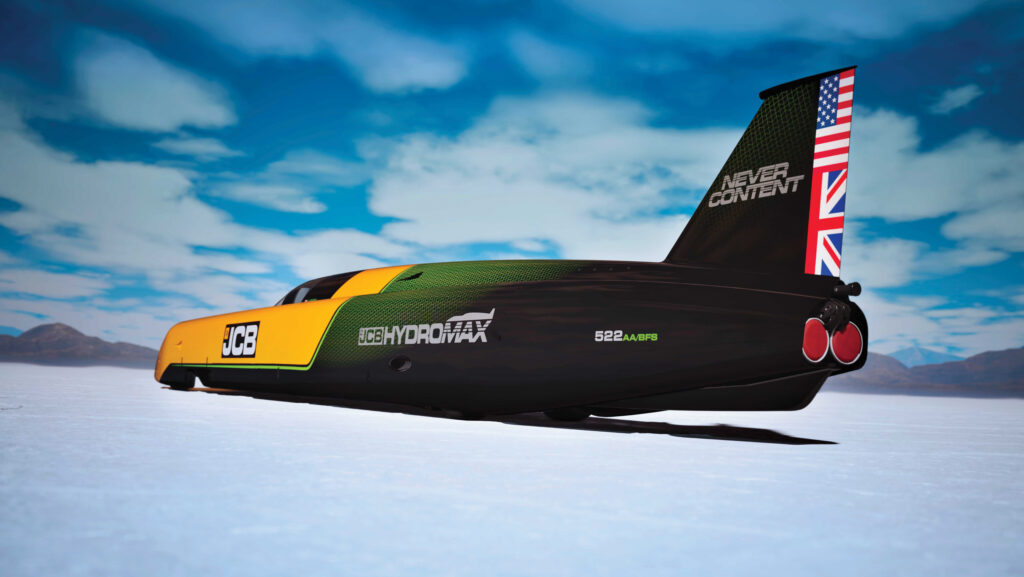
 British construction equipment manufacturer JCB has taken its hydrogen combustion technology to an extraordinary proving ground, setting a new world land speed record of 653.9 km/h with the hydrogen-powered JCB Hydromax at the Bonneville Salt Flats in Utah, United States.
The record is about considerably more than speed. Beneath the 9.75-metre Hydromax are two production-based JCB hydrogen combustion engines derived from the technology the company is developing to power construction and agricultural machinery.
Driven by Wing Commander Andy Green OBE, Hydromax recorded 644.7 km/h on its first run and 663.3 km/h on the return. The two runs, completed in opposite directions within the required period, produced an average of 653.9 km/h under Fédération Internationale de l’Automobile (FIA) rules.
Subject to final FIA ratification, that makes Hydromax the fastest hydrogen internal-combustion vehicle ever recorded.
It comfortably surpasses the previous FIA hydrogen-combustion benchmark of approximately 298.5 km/h, established by the BMW H2R in 2004. Hydromax also exceeded the roughly 487.6 km/h hydrogen fuel-cell benchmark, making it the fastest hydrogen-powered vehicle of any propulsion type.
From the digger to the desert
What gives the achievement particular relevance to the equipment industry is the technology behind it.
Hydromax uses two JCB hydrogen engines producing a combined 1,600 bhp. They were manufactured at the company’s engine facility in Foston, Derbyshire, UK, and are based on engines being developed through JCB’s £100 million hydrogen program.
JCB has taken a different path from many manufacturers pursuing zero and lower-carbon machinery. Rather than concentrating exclusively on batteries or hydrogen fuel cells, the company has invested heavily in adapting the familiar internal-combustion engine to run on hydrogen.
The strategy is aimed particularly at heavy-duty machinery where long operating hours, high power requirements and limited downtime can make large battery systems and lengthy charging periods difficult to accommodate.
For JCB, Hydromax is therefore an extreme engineering demonstration of technology intended for a much more practical destination: the construction site.
Twenty years after Dieselmax
There is also history behind JCB’s return to Bonneville.
In August 2006, the company brought JCB Dieselmax to the same salt flats and established a world diesel land speed record of approximately 563.4 km/h. Andy Green was behind the wheel then as well.
Twenty years later, JCB has returned with another experimental vehicle, this time using hydrogen combustion, and travelled more than 90 km/h faster than Dieselmax.
The parallel is significant. Dieselmax showcased JCB’s diesel-engine engineering at a time when the company was building its engine-manufacturing capabilities. Hydromax arrives as JCB attempts to establish hydrogen combustion as a credible successor to diesel in demanding equipment applications.
Green brings unique experience to the project. In addition to driving Dieselmax and Hydromax, he holds the outright world land speed record of approximately 1,228 km/h and remains the only person to have broken the sound barrier on land.
The Hydromax engineering program has been led by JCB Engineering Director Ryan Ballard. Before the latest record attempt, the vehicle had already reached approximately 592.8 km/h during the Southern California Timing Association’s Bonneville Speed Week, establishing another record in the Blown Gas Streamliner class.
Lord Bamford’s hydrogen bet
The project reflects the hydrogen strategy championed by JCB Chairman Lord Anthony Bamford, who proposed the land-speed project and has been one of the strongest advocates for hydrogen combustion within the construction equipment industry.
JCB’s argument is that heavy machinery presents different decarbonization challenges from passenger cars.
Excavators, loaders and other large machines can work intensively for many hours and frequently operate far from conventional charging infrastructure. Hydrogen combustion potentially offers rapid refueling and an operating model closer to the diesel equipment fleets already understand.
There are nevertheless significant hurdles.
Burning hydrogen produces no carbon dioxide from the hydrogen fuel at the tailpipe, but hydrogen combustion can produce nitrogen oxides (NOx) that require emissions control. The environmental performance of the technology also depends heavily on how the hydrogen is produced.
Cost, availability, transportation, storage and refueling infrastructure remain major questions if hydrogen is to become a mainstream equipment fuel.
Construction and mining operations could, however, offer an advantage. Equipment often works from centralized sites where dedicated fueling infrastructure can potentially be installed, rather than depending on a nationwide public refueling network.
The bigger race beyond Bonneville
The Hydromax record arrives as equipment manufacturers confront a much more important race: finding commercially viable alternatives to diesel.
Battery-electric equipment is gaining ground, particularly among compact machines and applications where vehicles can return regularly to charging points. Hydrogen fuel cells are being explored elsewhere, while renewable fuels and increasingly efficient conventional powertrains remain part of the technology mix.
JCB is making a sizeable bet that hydrogen combustion will have a place in that future, particularly at the heavier end of the equipment market.
At the same time, the company is expanding its manufacturing footprint. JCB is preparing to open a new $500 million factory in San Antonio, Texas, expected to employ around 1,500 people producing machinery for the US market.
Hydromax also continues a tradition of JCB using speed records to demonstrate engineering capability. Alongside Dieselmax, the JCB Fastrac established a tractor speed record of approximately 217.6 km/h in 2019, while the JCB GT reached approximately 116.8 km/h in 2014 to establish a backhoe-loader record.
A 653.9 km/h streamliner will obviously never resemble the operating environment of a construction machine.
But that is not really the point.
Twenty years ago, JCB went to Bonneville to demonstrate what could be extracted from diesel engineering. It has returned to the salt flats with a very different fuel and a very different message.
The speed record belongs to Hydromax. The real experiment is whether the hydrogen technology behind it can eventually challenge diesel where JCB’s machines actually work.
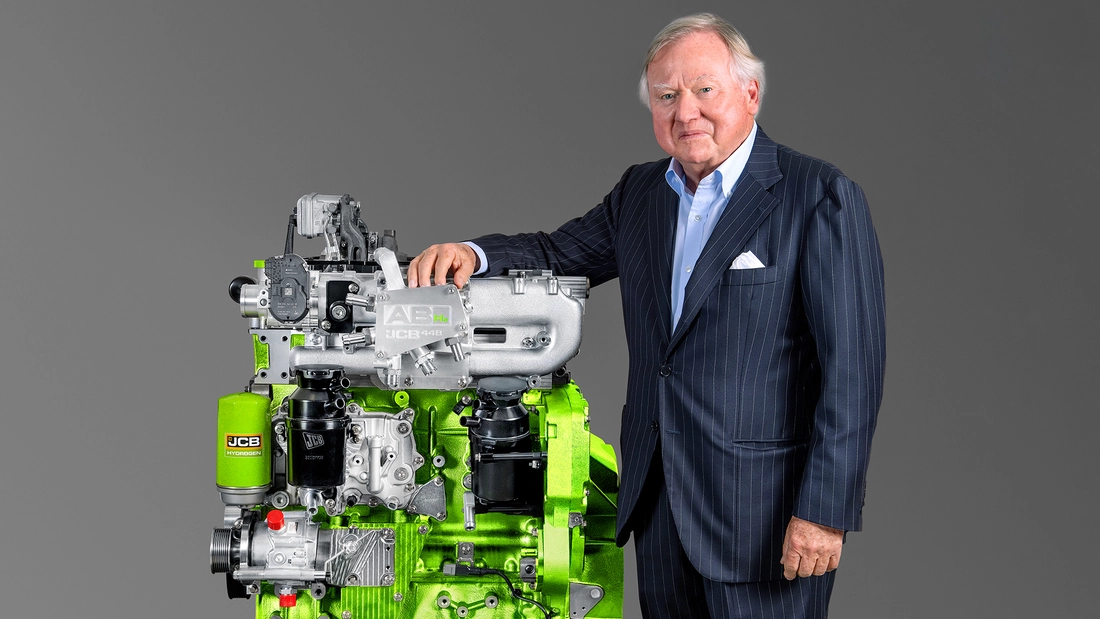
JCB has pursued hydrogen combustion as a potential alternative to diesel for construction and agricultural machinery, particularly in heavy-duty applications where machines operate for long hours and rapid refueling can be important. The Netherlands Vehicle Authority (RDW) was the first regulator to certify the engine, clearing it for sale in the Netherlands. Approvals subsequently covered Great Britain, Northern Ireland, Germany, France, Spain, Belgium, Poland, Finland, Switzerland and Liechtenstein.
In total, JCB said 11 licensing authorities had granted the necessary approvals by January 2025, while additional certifications were expected during the year.
The regulatory milestone was significant because JCB was attempting to move hydrogen combustion from an experimental technology into equipment that could eventually be purchased and operated commercially. By then, the manufacturer had already produced more than 130 evaluation engines. These were being tested in JCB backhoe loaders, Loadall telescopic handlers and generator sets, including trials under real-world operating conditions at customer sites.
JCB Chairman Lord Anthony Bamford, who has been a central advocate of the company’s hydrogen strategy, described the approvals at the time as an important step towards making hydrogen-powered construction and agricultural equipment commercially available.
JCB’s approach differs from hydrogen fuel-cell propulsion. Instead of converting hydrogen into electricity to power an electric motor, its technology burns hydrogen directly inside a specially developed internal-combustion engine.
The strategy is particularly relevant to the heavy-equipment sector because construction and agricultural machinery can present very different operating requirements from passenger vehicles. Excavators, loaders and telescopic handlers can work continuously for extended periods, often at sites where high-capacity electrical charging infrastructure is unavailable.
Hydrogen combustion potentially offers faster refueling and an operating model closer to conventional diesel equipment.
However, commercial adoption depends on considerably more than engine technology. The availability and cost of low-carbon hydrogen, transportation, on-site storage and refueling infrastructure remain important considerations. Hydrogen combustion can also generate nitrogen oxides, requiring appropriate emissions-control technology.
The January 2025 approvals were therefore best viewed as an important regulatory rather than commercial breakthrough. They removed one of the barriers standing between JCB’s engineering program and the eventual sale of hydrogen-powered machinery.
JCB subsequently went further. In May 2025, the company secured full European Union type approval for its hydrogen engine for non-road mobile machinery, extending approval across all 27 EU member states and other territories recognizing EU type approvals.
For the construction equipment industry, the significance of the 2025 developments was that hydrogen combustion had begun moving beyond prototypes and demonstrations into the regulatory framework required for commercially available machinery.
The larger question — for JCB and the equipment industry — remains whether the hydrogen supply and refueling ecosystem can develop quickly and economically enough to turn an approved engine into a widely adopted alternative to diesel.