 A bold and unprecedented logistical experiment is unfolding across the country’s major transport arteries. On Wednesday, September 23, 2026, two battery-electric commercial trucks quietly rolled out of Boksburg, charting a massive 4,000-kilometre loop across South Africa’s vital freight corridors.
Dubbed the Mzansi EV Truck Super Test 2026, this three-week independent demonstrator project is being watched closely by the global transport sector. It stands as the longest fully independent, publicly verified on-road test of production electric heavy vehicles on the continent. The primary mission is simple yet grueling: pressure-test South Africa’s logistics network to establish once and for all whether heavy e-mobility can survive the stark realities of local long-haul routes.
The Coalition Powering the Wheels
Unlike typical manufacturer-backed marketing stunts, the Mzansi Super Test is built on a diverse, independent ecosystem of global climate institutions and local logistics innovators.
The trial is led by a powerful coalition:
-
- The Lead Sponsor: Germany’s Kuehne Climate Centre (KCC), an organization funding the test to provide objective data for future fleet investors.
- The Organiser: flx EV, a forward-thinking e-mobility firm coordinating the logistics of the mammoth loop.
- The Telematics Brain: South African transport data specialist GoMetro, which has outfitted the test fleet with its proprietary ZAPPP telemetry platform to monitor second-by-second performance data.
- The Ironware Providers: SANY Africa and GHM Machinery, who supplied the two production vehicles being pushed to their limits.
- The Independent Verifiers: The global Smart Freight Centre (SFC), ensuring the generated metrics are scientifically rigorous.
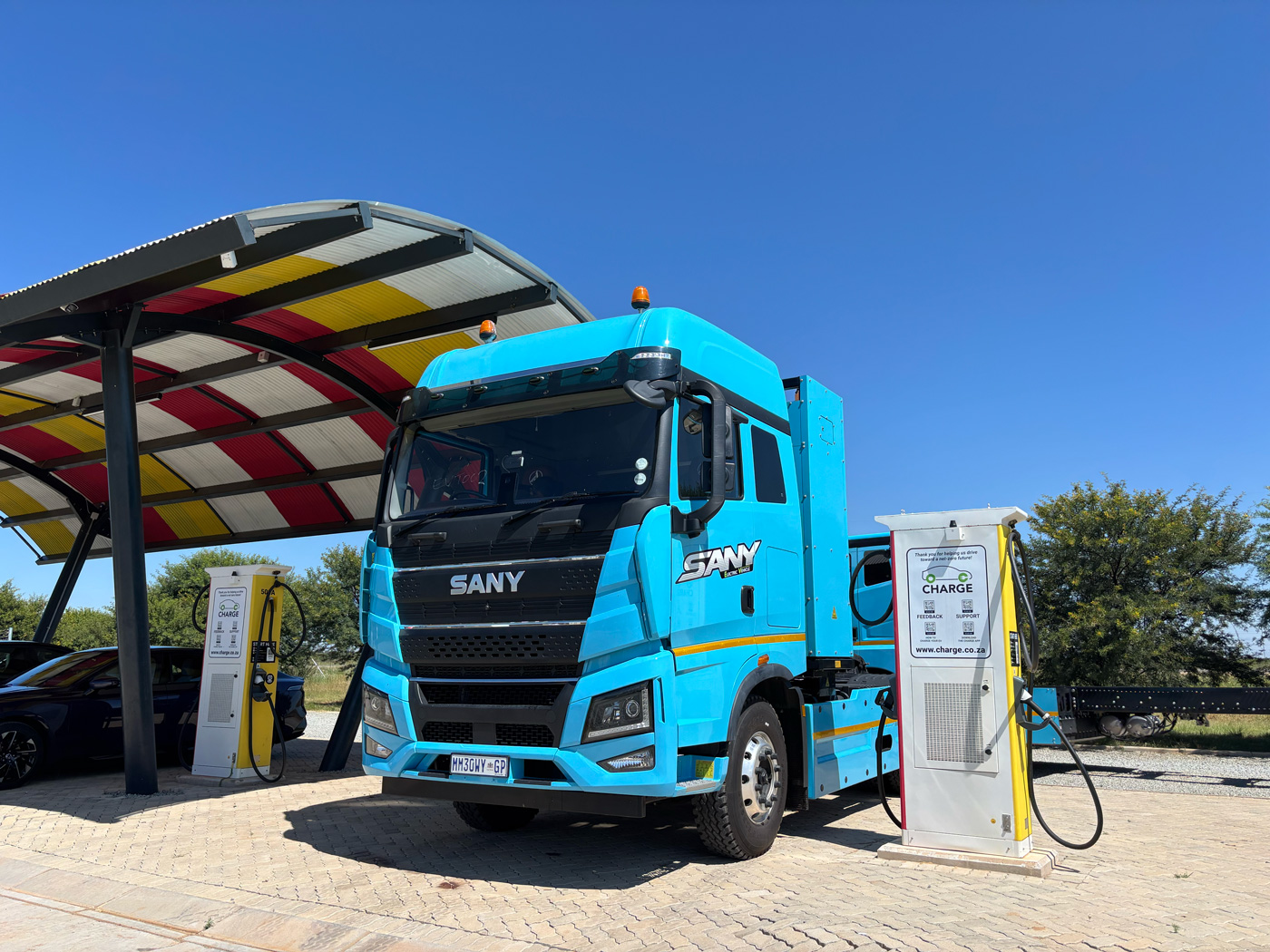
The physical stars of the show represent two very different tiers of transport: a massive 35-tonne 4×2 heavy truck tractor and a smaller, nimble eight-tonne rigid truck built for regional distribution.
Mapping Key Milestones
The journey is designed to replicate standard, punishing commercial routes, hugging portions of the N1, N2, and N3 highways. Following its launch in Boksburg, the fleet is actively navigating the vast, dry expanses of the Karoo along the N1 highway, bound for Cape Town. A major mid-point milestone will see the vehicles arrive in the Western Cape just in time for the Africa E-Mobility Week in Stellenbosch, which serves as the official destination platform for the first leg. There, engineers will present live telemetry to policy-makers and auto executives. Leaving Cape Town, the trucks will trace the coast through Gqeberha and East London, turn north up the N2 via Durban, and grind back up the N3 to conclude where they started in Johannesburg.
The Early Effect: A Grid Reality Check
Though only days into the test, the trial has already triggered its first major “effect”—a stark reality check for South Africa’s clean energy ambitions. As the SANY trucks traverse the highways, the limits of the country’s public charging grid have been instantly exposed. Justin Coetzee, founder of GoMetro, noted that South Africa’s existing highway charging stations were explicitly built for passenger cars. They lack the wide turning circles, physical clearances, and spatial layout required for a multi-tonne truck with a trailer to pull in comfortably.
Furthermore, standard public chargers are hitting power delivery roadblocks. When heavy trucks try to charge, they require sustained, massive power draws—frequently between 250kW and 450kW. The current passenger-centric infrastructure simply cannot cope with dual heavy loads, highlighting a friction point that organizers hope will spur targeted infrastructure investments.
Why South Africa Cannot Wait
The business implications of this 4,000km test stretch far beyond the logistics sector. They strike at the very heart of South Africa’s economic survival in a rapidly decarbonizing global market. The automotive and transport manufacturing industry is a cornerstone of the national economy, contributing roughly 23.8% of South Africa’s total manufacturing output. Crucially, around 67% of locally manufactured vehicles are exported, with the European Union and the United Kingdom accounting for the vast majority of those shipments. With those lucrative markets aggressively tightening emissions standards and imposing future bans on internal combustion engines, South Africa risks losing future model allocations and international investment unless it secures a place in the global EV supply chain.
Up until now, corporate freight operators have been hesitant to purchase multi-million Rand electric fleets due to range anxiety and a lack of localized data. By providing unassailable, verified data on real-world energy consumption under actual South African topographic conditions, the Super Test gives corporate boardrooms the exact empirical evidence they need to confidently fund the transition.
The definitive takeaway from the early data is clear: truck electrification requires its own entirely separate infrastructure layer. The private sector cannot rely on standard highway charging grids. True freight electrification will require heavy-duty, dedicated freight charging hubs strategically built along the N1-N3 corridors to sustain corporate supply chains.