




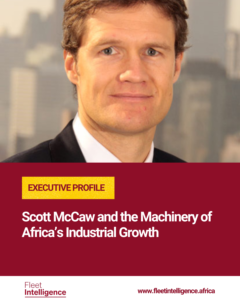
 Scott McCaw leads from a place that rarely draws attention but quietly determines whether some of Africa’s most important industrial systems function or stall. As Group Chief Executive Officer of Panafrican Equipment Group, he oversees a business that sits behind mines in West Africa, construction corridors in East Africa, and agricultural expansion zones across multiple markets. Its work is not visible in the way finished infrastructure is, but in the machinery that never stops long enough to be noticed.
McCaw is Canadian and trained in the discipline of finance and valuation rather than engineering or mining. He is a chartered accountant and chartered business valuator, and he studied business administration with a focus on finance and economics at Simon Fraser University. His foundation is numerical and analytical, shaped by the logic of capital allocation and risk rather than the physical immediacy of the machines his company now supports.
Before Africa, his career unfolded in the industrial backbone of North America. He worked in engineering and industrial distribution environments, including AMEC and Wajax, where the economics of equipment are defined by uptime, maintenance cycles, and the cost of failure in remote or demanding environments. These were not businesses built on visibility but on precision, where value is created in the gap between breakdown and repair, and where logistics is as important as engineering.
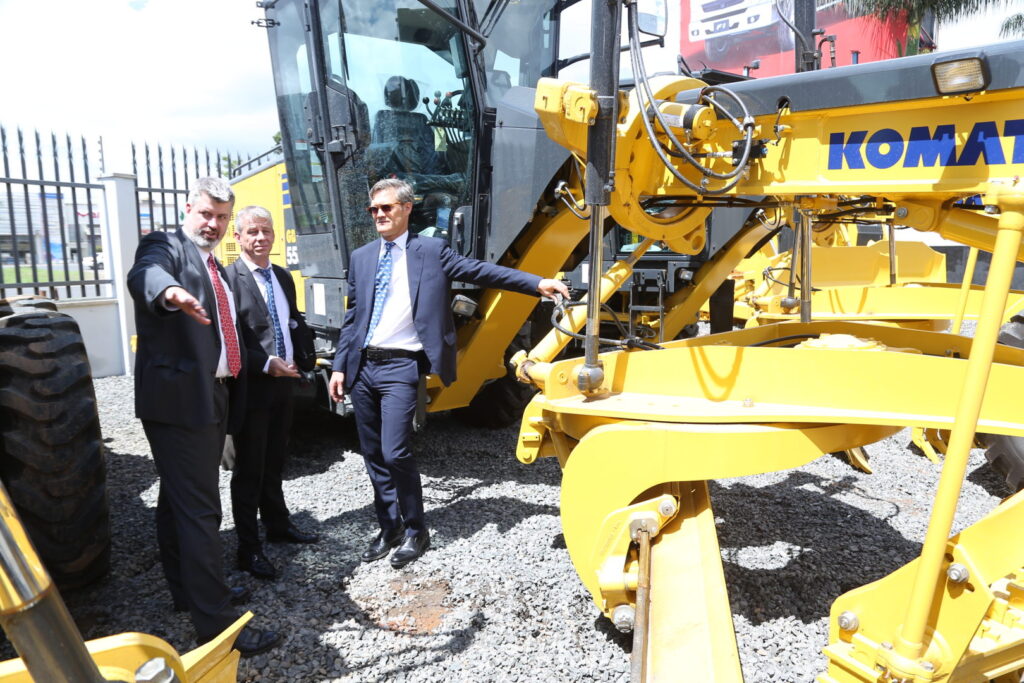
It represents major global original equipment manufacturers such as Komatsu, Wirtgen Group, and AGCO, but its role extends beyond distribution into long-term equipment lifecycle support. Its operations are structured around ensuring uptime for industrial clients in environments where reliability and rapid technical response are critical.
When McCaw moved into Africa’s industrial landscape, the scale and complexity of that logic changed. At Panafrican Equipment Group, he became responsible for expanding a platform that operates across Kenya, Tanzania, Uganda, Ghana, Nigeria, and Sierra Leone, with regional coordination that extends beyond any single national market. The company distributes and supports global equipment manufacturers including Komatsu, Wirtgen Group, and AGCO, but its real function is deeper than distribution. It is part of the maintenance architecture of African industrialization.
The operating reality McCaw stepped into is one where infrastructure is expanding faster than technical ecosystems. Mines, roads, and agricultural projects depend on heavy equipment that must function continuously in environments where supply chains are stretched and technical expertise is unevenly distributed. His response has been to build a model that treats after sales service not as support but as the core of the business.
Under his leadership, Panafrican has evolved from a collection of country operations into a more integrated regional system. Spare parts networks, technical teams, and training programs are increasingly structured across borders rather than confined within them. The logic is simple but demanding. Equipment should not wait for support to arrive from elsewhere. Support must already be present, embedded in the geography of use.
McCaw’s professional instincts are shaped by finance, and that discipline shows in how the company is structured. Capital allocation, asset utilization, and return on deployed resources are central to decision making. Heavy equipment is a high cost, high consequence asset class, and inefficiency is measured not in margins alone but in downtime. This creates a leadership style that is restrained, analytical, and focused on systems rather than individual transactions.
His approach also reflects a particular reading of African industrial growth. He sees not a single market but a series of overlapping cycles driven by mining investment, infrastructure development, energy expansion, and agricultural modernization. Each of these cycles demands equipment, but more importantly they demand continuity. Machines must be serviced, repaired, and optimized in real time across geographies where conditions vary widely.
Within this framework, the company has invested heavily in technical training and capability development. The emphasis is on building local expertise capable of sustaining complex machinery in the field. Technicians are not peripheral to the business model but central to it, forming the human infrastructure that allows mechanical infrastructure to function.
McCaw himself remains a low visibility executive. His presence in public discourse is limited, and his influence is expressed more through operational design than through narrative. The emphasis is not on describing growth but on building the conditions that make growth possible. In industries where equipment failure can halt entire production systems, this approach carries its own form of authority.
The result is a business that operates less like a distributor and more like an industrial support system. Panafrican Equipment Group functions as an embedded layer within Africa’s infrastructure economy, connecting global manufacturing systems to local operational realities that are often unpredictable and resource constrained.
At the centre of that system is Scott McCaw, a leader whose work anchors the background of Africa’s industrial expansion.