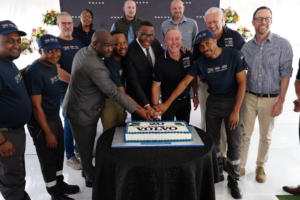
 Chery has officially inaugurated its manufacturing plant in Rosslyn, Pretoria, marking a major shift in its South African strategy from importing vehicles to producing them locally. The milestone underscores the Chinese automaker’s long term commitment to South Africa and positions the country as the cornerstone of its African manufacturing ambitions.
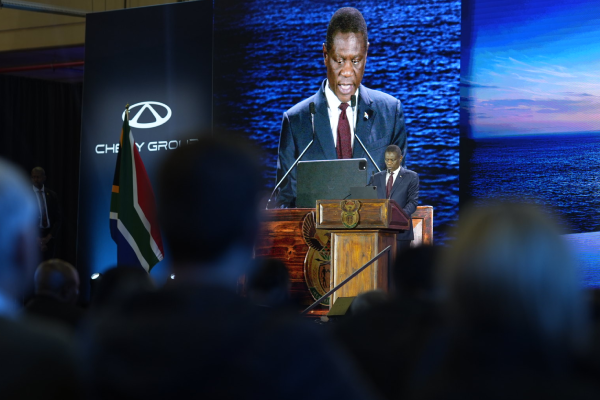
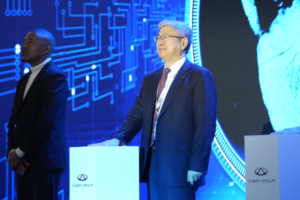
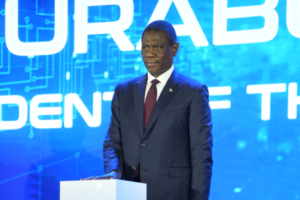
The opening ceremony attracted around 350 guests, including South African Deputy President Paul Mashatile, Gauteng Premier Panyaza Lesufi, Tshwane Executive Mayor Nasiphi Moya, Chinese Ambassador to South Africa Wu Peng, Chery Chairman Yin Tongyue, Executive Vice President Zhang Guibing, and Vice President Charlie Zhang.
For Chery, the Rosslyn investment represents far more than the acquisition of a production facility. It marks the company’s evolution from an importer serving the South African market to a manufacturer investing directly in the country’s industrial future.
Speaking at the launch, Chairman Yin Tongyue said the project embodies Chery’s global philosophy of “In Somewhere, For Somewhere, Be Somewhere,” emphasizing that the company seeks to become an integral part of every economy in which it invests.
He said the transition from importer to manufacturer demonstrates Chery’s intention to become a permanent industrial partner, contributing to South Africa’s manufacturing capability, employment, and long term economic growth.
 The company also views the investment as an opportunity to deepen economic cooperation between China and Africa through industrial partnerships and localized production.
Originally established in 1963, the Rosslyn facility ranks among South Africa’s oldest automotive manufacturing plants and has played an important role in the country’s automotive sector for decades.
Chery plans extensive upgrades to the plant’s production systems, infrastructure, and utilities ahead of the start of manufacturing, which is scheduled for the middle of 2027.
During the initial production ramp up in the second half of 2027, the company expects to manufacture approximately 15,000 vehicles.
A key element of the investment is employment continuity. Chery will retain all 692 existing workers while creating close to 3,000 additional direct and indirect jobs across manufacturing, logistics, supplier development, and supporting services.
Addressing the gathering, Gauteng Premier Panyaza Lesufi welcomed the investment, describing it as an important vote of confidence in South Africa’s automotive industry.
He praised Chery’s commitment to manufacturing excellence, localization, skills development, innovation, and sustainability, while noting that retaining the existing workforce reflects the company’s intention to build a lasting presence in the country.
Alongside production, Chery has begun implementing an ambitious localization strategy designed to increase the proportion of locally sourced components.
The company is already assessing Tier 1 suppliers as it works toward meeting its localization targets by 2028.
Its longer term objective extends beyond vehicle assembly. Chery intends to transform Rosslyn into an integrated automotive hub incorporating research and development, supplier development, logistics, engineering capability, and workforce training.
Ultimately, South Africa is expected to become the company’s African headquarters for manufacturing, exports, research and development, and regional operations.
Supported by an expanding dealer network and a rapidly growing product range, Chery believes the investment will enable it to surpass annual sales of 100,000 vehicles in South Africa over time.
Deputy President Paul Mashatile described the new plant as another milestone in South Africa’s industrial development, saying the investment reflects confidence in the country’s future.
He added that the facility should ultimately be measured not only by the vehicles it produces, but also by the opportunities it creates for workers, suppliers, communities, and the broader South African economy.
The Rosslyn project also marks Chery’s first attempt in Africa to establish an integrated industrial ecosystem rather than simply assemble vehicles.
The company plans to build a complete automotive value chain encompassing manufacturing, supplier development, raw material integration, renewable energy initiatives, recycling, and broader sustainability programmes.
Its wider African strategy spans passenger vehicles, commercial vehicles, agricultural machinery, robotics, renewable energy, mineral development, and circular economy initiatives.
By expanding beyond vehicle production, Chery hopes to stimulate industrial growth across Southern Africa while strengthening regional supply chains.
Chery says environmental sustainability and social investment will form part of its long term presence in South Africa.
Globally, the company has committed US$12 million to education initiatives through its partnership with UNICEF since 2023, with South African science, technology, and innovation education among the priority areas.
The company also announced a new biodiversity partnership with the International Union for Conservation of Nature (IUCN), focusing on ecosystem restoration, biodiversity conservation, and community livelihoods across priority landscapes in South Africa.
Since entering South Africa in 2021, Chery has established itself as one of the country’s fastest growing automotive brands.
This year it ranks as South Africa’s second largest passenger vehicle brand by sales.
The company reported passenger vehicle sales growth of 29 percent year on year, while continuing to increase its market share.
Its Tiggo 4 Pro emerged as South Africa’s best selling passenger vehicle during 2025.
Chery’s South African portfolio has expanded considerably and now includes six brands serving different market segments.
The core Chery brand is complemented by OMODA, JAECOO, Jetour, iCAUR, and LEPAS, offering conventional petrol vehicles alongside hybrid and fully electric models.
OMODA has sold more than 20,000 vehicles since its South African launch in 2023 and now markets the C5, C7, and C9, together with plug in hybrid SHS models.
JAECOO entered the market in 2024 with the J7, J5, and J7 SHS hybrid.
Jetour also launched in 2024 and achieved a notable milestone when its T2 became the first Chinese branded vehicle to win the South African Car of the Year award in May 2026.
Electric mobility is also gaining traction. iCAUR entered the market in 2026 with the fully electric V23, attracting more than 300 customer orders during its first month.
LEPAS, introduced the same year, targets the premium SUV segment with petrol, hybrid, and battery electric models.
Established in 1997 and headquartered in Wuhu, China, Chery has grown into one of the world’s fastest expanding automotive groups.
The company operates in more than 130 countries and has remained China’s leading passenger vehicle exporter for 23 consecutive years.
Its rapid global expansion has also been reflected in international rankings. Chery climbed to position 233 on the 2025 Fortune Global 500 list, recording the fastest rise among global automakers.
During the first half of 2026, the group exported 944,000 vehicles, an increase of 71.5 percent compared with the previous year and the first Chinese automaker to exceed 900,000 exports within six months.
By May 2026, Chery had accumulated more than 19.6 million vehicle users globally, including approximately 6.6 million customers outside China.
Closing the ceremony, Chairman Yin Tongyue reaffirmed the company’s commitment to South Africa, describing the country as central to Chery’s global expansion strategy and emphasizing that the Rosslyn investment represents a long term partnership rather than a short term commercial venture.