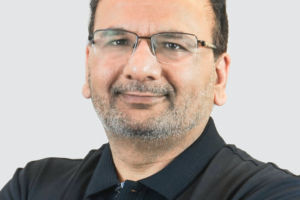
Ali Maamri and AIDA by CREA: Inside Algeria’s Automotive Industrial Reinvention
His career began in connected fleets. It now runs through automotive electronics, local manufacturing and the supplier networks becoming increasingly important to Algeria’s next industrial chapter.
This Fleet Intelligence® profile follows Maamri’s progression from connected fleets into automotive manufacturing, while examining the wider role of AIDA by CREA in identifying Algerian industrial capability and connecting it with the requirements of vehicle manufacturers.

How Ali Maamri Moved from Fleet Technology into the Automotive Supply Chain
IDENET’s evolution from connected-vehicle systems into wiring harnesses and automotive electronics says as much about Maamri’s industrial instincts as it does about the changing opportunity around Algeria’s vehicle industry.
Ali Maamri did not enter automotive manufacturing through the conventional route of vehicle distribution or assembly. His starting point was the information produced by vehicles in service: their movement, utilisation, operating behaviour and the data needed by fleet operators to manage them more effectively. IDENET grew out of that connected-fleet environment, supplying technology to customers for whom vehicle visibility, fuel use, security, uptime and operating efficiency had immediate commercial consequences. Over time, however, the company began moving closer to the vehicle itself, and what started as a technology business gradually became an industrial one.
The shift into wiring harnesses and electronic systems was more than diversification. It moved IDENET from analysing signals generated by vehicles to manufacturing part of the physical infrastructure through which those signals travel. A wiring harness is largely invisible to the customer, yet it is one of the fundamental systems inside a modern vehicle, carrying electrical power and information between sensors, switches, control units and an expanding array of electronic functions. The more connected and electronically complex vehicles become, the more important the engineering, testing and traceability behind those systems become as well.

From a technology company to an industrial supplier
IDENET now describes an industrial footprint extending across specialised production and engineering activities, including flexible manufacturing lines, laboratories, testing and traceability systems. The company has also moved into printed circuit boards and automotive electronics, widening its position beyond conventional harness assembly. That matters because Algeria’s automotive localisation programme increasingly requires suppliers capable of contributing engineering and process capability, not merely labour-intensive assembly.
The company’s entry into the Stellantis supplier ecosystem gave that strategy a larger commercial anchor. IDENET was among the Algerian companies identified during the early development of the local supply base around the FIAT plant at Tafraoui. For a domestic technology business, supplying into the production system of a global automotive group brings a different level of discipline: specifications must be repeated across large volumes, defects have to be prevented rather than simply corrected, production has to be traceable and components must arrive in sequence with an assembly system that cannot afford interruption.
IDENET’s IATF 16949 certification is therefore significant not as a corporate badge but as evidence of the operating standards demanded by the automotive industry. The certification framework is built around process control, continuous improvement, defect prevention and traceability — precisely the capabilities that distinguish an industrial supplier from a company that can merely manufacture a part. It also helps explain the language that increasingly surrounds IDENET’s operations: prototyping, bills of materials, industrialisation, tooling, workstations, circuit definition and controlled series production.
The next step is higher up the value chain
The commercial opportunity now extends beyond the first localisation contracts. As Algeria’s vehicle production volumes increase, domestic suppliers have a larger base against which to justify tooling, automation and engineering investment. IDENET has also signalled an interest in wider African and international programmes, which would expose the business to a more exacting form of competition. Export supply is ultimately earned through quality, cost, delivery and engineering capability rather than through the policy advantages of being local.
The timing is important because the vehicle itself is changing. Electrification, advanced driver-assistance systems, connectivity and software-defined architectures are increasing both the volume and sophistication of electrical content. Traditional low-voltage harnesses are being joined by high-voltage systems, faster data networks, intelligent connectors and more complex electronic modules. A supplier that entered the industry through wiring therefore has a natural route into higher-value systems, provided it keeps pace with the technology and quality requirements of the OEMs it wants to serve.
That is the more interesting way to understand Maamri’s trajectory. He did not build a factory first and discover technology later; he came from technology, learned the economics of vehicles through the fleets that operated them and then moved progressively closer to the industrial systems inside the vehicle. The distance between fleet data and the factory floor, in his case, has turned out to be less a break in direction than the next stage of the same journey.
AIDA by CREA: Turning Industrial Capability into an Automotive Supplier Map
AIDA is the bridge between Algeria’s automotive ambitions and the industrial companies that may be able to supply them.
The initiative operates within the Conseil du Renouveau Économique Algérien (CREA) and is focused on making domestic manufacturing capability more visible to vehicle manufacturers. Rather than treating localisation as a simple list of company names, the work maps what Algerian businesses can actually produce: products, equipment, industrial processes, certifications and the areas in which those capabilities may correspond with automotive requirements.
That distinction is important. An existing manufacturer does not automatically become an automotive supplier. OEM participation requires audits, validation, process discipline, traceability, cost competitiveness and, in many cases, additional investment. AIDA’s role is therefore best understood as creating the industrial intelligence layer before qualification begins — helping reduce the distance between an OEM requirement and a local company that may already possess part of the capability needed to meet it.
For Ali Maamri, whose own business moved from fleet connectivity into automotive electronics and wiring systems, the platform extends the same logic beyond IDENET. The objective is no longer only to build one capable supplier, but to make Algeria’s wider industrial base easier for vehicle manufacturers to understand, assess and engage.
Algeria’s Automotive Revival Is Moving Beyond the Assembly Line
The country’s automotive story is being rewritten around manufacturing depth, local suppliers and larger production volumes rather than the headline number of vehicles assembled.
The easiest way to describe an automotive industry is by counting vehicles as they come off an assembly line. It is also one of the least revealing measures of industrial strength. A factory can produce tens of thousands of vehicles while creating comparatively little value beyond its gates if most of the vehicle arrives from abroad. The deeper measure lies in the industrial system around the plant — stamping, plastics, tyres, batteries, wiring, electronics, glass, seats, filtration, lubricants, engineering, logistics and the many suppliers whose output ultimately determines how much of each vehicle is genuinely produced within the country.
That distinction is especially important in Algeria, where the current automotive cycle follows an earlier period of rapid assembly expansion whose local industrial contribution was widely questioned. The framework that emerged after 2022 places greater weight on manufacturing investment and progressive local integration, and the market is now being rebuilt around the idea that an assembly plant should act as an anchor for a wider supplier economy rather than as the end point of the industrial process.

Tafraoui has changed the scale of the market
Stellantis has become the most visible anchor of that strategy. The FIAT plant at Tafraoui, near Oran, began production in December 2023 and has since moved quickly beyond its initial volumes. Stellantis reported output of 17,000 vehicles in 2024 and 53,000 in 2025, while the introduction of body-in-white and paint operations in 2025 moved the facility materially deeper into vehicle manufacturing. The company is targeting around 90,000 vehicles in 2026 and has announced a pathway towards annual capacity of 135,000 units by 2028.
Those numbers matter beyond Stellantis because volume changes the economics of every supplier around the plant. A company investing in tooling or dedicated production for 10,000 vehicles faces a very different commercial calculation from one supplying a programme approaching 100,000 units. Larger and more predictable demand makes it easier to justify automation, quality systems, engineering teams and local material sourcing, while also increasing the likelihood that a supplier can spread its fixed costs across several vehicle programmes.
The Grande Panda programme illustrates the direction of travel. Stellantis has been moving the model into deeper CKD production with progressively higher local integration, while expanding the number of Algerian companies involved in supplying the plant and its aftermarket network. By early 2026, FIAT said it was working with 13 Algerian suppliers for Tafraoui and another 13 supplying locally manufactured aftermarket parts, with further industrial partnerships being added around areas such as stamped components.
Why the supplier base matters more than the headline
The importance of those companies lies in the economic activity they create outside the assembly plant. A local tyre producer, wiring supplier, battery manufacturer or stamping business retains more of the vehicle’s value inside Algeria while building engineering and management capabilities that can be applied elsewhere in the economy. It also shortens the supply chain. Automotive production is built around carefully sequenced deliveries, and a capable domestic supplier can reduce shipping time, inventory requirements, foreign-exchange exposure and disruption risk while supporting just-in-time production more effectively than a distant source.
Algeria’s geography strengthens the proposition. Its northern industrial corridor sits immediately across the Mediterranean from the European automotive system, with relatively short maritime links to southern Europe, a sizeable domestic market and an industrial base that already spans metals, plastics, chemicals, cables, tyres, batteries and other relevant sectors. If domestic suppliers can meet international standards consistently, the country has the ingredients to become not only a manufacturing location for its own vehicle market but a participant in the wider Euro-Mediterranean supply chain.
A broader manufacturing base is beginning to form
The industrial landscape is also becoming less dependent on a single manufacturer. Opel confirmed in 2026 that it was taking steps towards local vehicle production and signed a memorandum of understanding covering engine localisation with AGM Holding. Engine manufacturing would take the conversation materially deeper than final assembly because it requires a broader technical and supplier base, while creating opportunities for components, machining, testing, logistics and engineering around one of the most complex systems in the vehicle.
For Algeria, the strategic value of a second major automotive anchor lies in the opportunity it creates for suppliers to serve more than one OEM. A domestic component company whose tooling and workforce depend entirely on one vehicle manufacturer remains exposed to that company’s production cycle. A supplier able to serve several manufacturers has a stronger basis for scale, investment and eventual export competitiveness.
That is why local-content percentages, although important, should not become the final measure of success. A component is not valuable merely because it is made locally; it becomes industrially significant when it can be produced repeatedly, at the required quality and cost, in volumes that make the business sustainable. Algeria’s automotive revival will therefore be judged less by the number of factory announcements than by whether its local suppliers can improve productivity, invest in engineering, meet global standards and eventually win programmes outside the domestic market.
The shift is already visible. The conversation is moving from whether Algeria can assemble vehicles to how much engineering, manufacturing knowledge and supplier value can be retained around them. That is a much more demanding benchmark, but it is also the one that determines whether an automotive sector becomes an industry.
Building the Supplier Ecosystem Behind Algeria’s Next Industrial Chapter
Maamri’s work now reaches beyond IDENET into a larger question: how Algeria identifies, qualifies and connects its domestic manufacturers to the needs of global vehicle producers.
Building one automotive supplier is a company challenge; building a supplier ecosystem is a national industrial challenge. Vehicle manufacturers need to know what a country can produce, local companies need to understand what an OEM actually requires, and both sides need enough technical information to determine whether an industrial relationship is possible before the much harder work of qualification, tooling, validation and commercial negotiation can begin.
Maamri’s role has increasingly expanded into that territory. Through his work within the Conseil du Renouveau Économique Algérien, he has become involved in the effort to identify Algerian companies whose existing industrial capability could be relevant to automotive manufacturing. It places him between two communities that do not always naturally find one another: global manufacturers searching for reliable local sources and domestic industrial companies that may possess useful machinery, materials or engineering expertise without yet being part of an automotive supply chain.

The value of knowing what already exists
Industrial capability is often hidden in plain sight. A plastics business supplying appliances may already operate processes relevant to vehicle interiors; a cable company may have production expertise that can be adapted to automotive wiring; a metalworking firm may own presses or machining equipment capable of producing vehicle parts but have no established relationship with an OEM. In each case, the obstacle may not be the absence of industrial capability but the absence of a structured way of making that capability visible to the companies that could use it.
The AIDA initiative within CREA addresses that problem by mapping manufacturers through what they can actually do — their products, equipment, processes, certifications and potential relevance to automotive programmes — rather than simply compiling a directory of company names. Maamri has publicly referred to hundreds of product families and thousands of industrial references identified through the work. Those numbers are important as a map of possibility, but they should not be confused with a count of fully qualified automotive suppliers, because an OEM programme requires audits, testing, validation, traceability, cost competitiveness and often further capital investment before a local producer can become part of the production system.
The aftermarket can become an industrial ladder
Algeria already has useful capabilities in batteries, filters, tyres, lubricants, plastics and other vehicle-related products, and the aftermarket offers a particularly important route into deeper manufacturing because demand is generated by the installed vehicle fleet rather than only by new assembly volumes. Components such as filters, batteries, brake parts, tyres and fluids require replacement throughout the life of a vehicle, giving domestic manufacturers a market in which to build volume, improve process discipline and strengthen quality systems before pursuing more demanding OEM programmes.
That creates an industrial ladder. Not every aftermarket producer will become a Tier-1 or Tier-2 automotive supplier, but a broad domestic parts industry increases the pool of companies from which such suppliers can emerge. Stellantis’s own localisation programme reflects this distinction, with one group of Algerian suppliers supporting vehicle production and another supplying locally manufactured parts into the aftermarket network.
Policy, volume and competition are beginning to align
The policy environment is moving in the same direction. Algeria has been developing a national reference framework for the integration of vehicles, buses and motorcycles, giving the government and industry a more structured basis for identifying components that can be manufactured domestically and for measuring the actual depth of local content. The value of that framework will depend on execution, because successful automotive clusters are not created by regulation alone; they depend on technical standards, logistics performance, access to finance, tooling investment, skilled labour, reliable energy and the confidence to make investments that may take years to pay back.
Production scale is therefore central to the story. Stellantis’s path towards 135,000 vehicles of annual Tafraoui capacity creates a much larger market for qualifying suppliers, while Opel’s move towards local production could widen that market further. Multiple manufacturers are particularly important because they allow domestic suppliers to spread fixed costs across several programmes and reduce their dependence on the production decisions of a single customer.
IDENET offers a useful example of what that progression can look like. It began outside conventional automotive manufacturing, developed a technology base, moved into industrial production, secured automotive quality certification and entered an international OEM supply ecosystem. The larger significance of Maamri’s work around AIDA is whether similar pathways can be created for many more Algerian companies, including businesses that today do not necessarily think of themselves as automotive suppliers.
There is a wider African lesson in this. Much of the continent’s automotive debate still concentrates on attracting assembly plants, and assembly is undeniably important because sufficient vehicle volume creates the economics on which local suppliers depend. But the larger industrial prize lies beneath the assembly line: the engineers, tooling specialists, quality professionals, component manufacturers, logistics companies and industrial managers whose capabilities remain useful even as individual models and manufacturers change.
A factory can create employment; a supplier ecosystem can create an industrial class. That is ultimately why the mapping work around Algeria’s automotive sector matters. Its success will not be measured by the size of a database but by the number of domestic companies that become qualified suppliers, build exportable products and win business on the strength of their engineering, quality and competitiveness. For Maamri, that makes the journey increasingly larger than IDENET itself: from understanding vehicles through their data, to manufacturing what goes inside them, and now to helping make the capabilities of an entire industrial economy visible to the companies deciding where the next generation of automotive value will be created.