
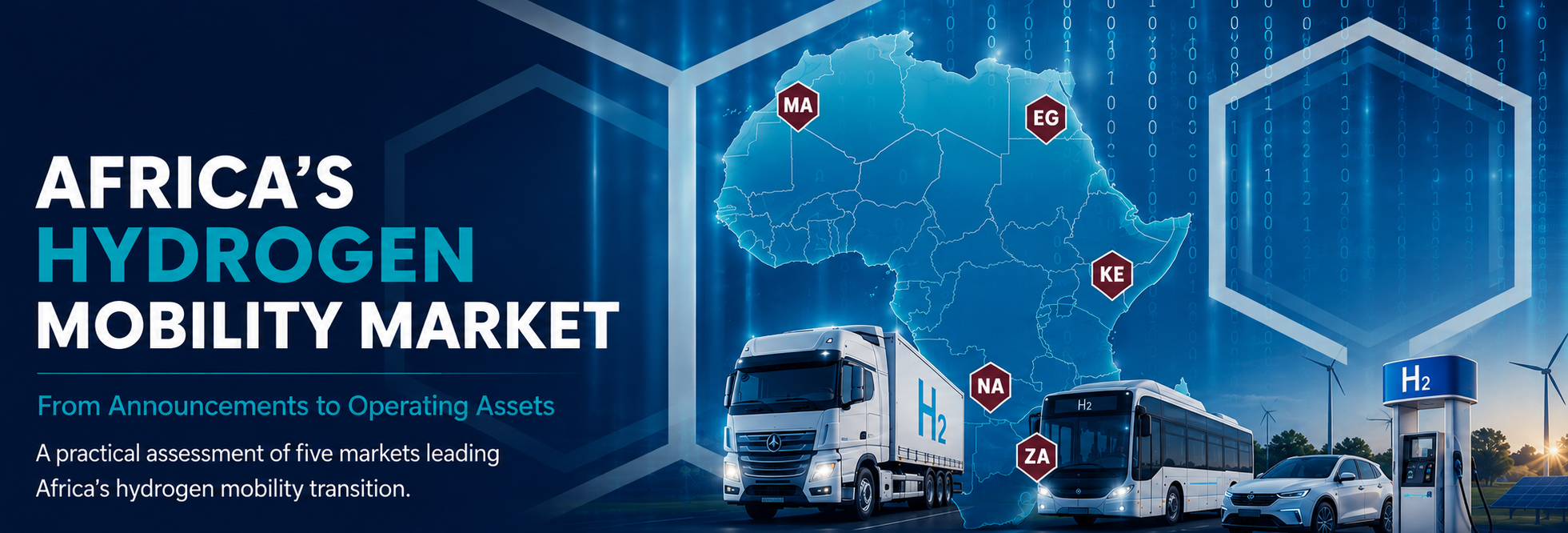
Hydrogen is still a marginal transport fuel in Africa. But the market is becoming more tangible around heavy trucks, mining equipment, buses, railways, ports and industrial fleets — precisely the applications where utilisation, payload, range and refuelling time can matter more than they do in ordinary passenger-car use.
Africa does not yet have a mass hydrogen-vehicle market. What it increasingly has is a set of concentrated commercial test beds in which hydrogen is being produced, dispensed and consumed by working transport assets.

Executive dashboard
Market assessment
Africa’s hydrogen narrative has historically been dominated by announcements of very large future production projects. Mobility exposes the gap between that ambition and what is actually operating. The International Energy Agency estimates that Africa used about 3.1 million tonnes of hydrogen in 2024, equal to roughly 3% of global hydrogen demand, but only around 6,000 tonnes came from low-emissions production. Most African hydrogen still serves industry, especially ammonia production, rather than transport.
Against that backdrop, the transport market remains tiny. There is no hydrogen-vehicle population in Africa comparable with the scale being reached by battery-electric motorcycles, buses and passenger vehicles. Most African hydrogen vehicles are still demonstrators, trial assets or very small specialist fleets.
What has changed is the quality of the evidence. Namibia now has an operating renewable-to-hydrogen-to-vehicle chain around Walvis Bay. South Africa has locally engineered refuelling infrastructure and one of the world’s most ambitious hydrogen mining demonstrations behind it. Egyptian manufacturer MCV has moved from prototype development into commercial export, with 35 hydrogen buses beginning regular service in Austria during 2026. Morocco has added protected intellectual property around removable hydrogen storage, while Kenya has formally kept hydrogen within its long-term transport decarbonisation pathway even as battery-electric mobility advances faster in the near term.
The African hydrogen-mobility proposition is becoming narrower, but that may make it more credible. Passenger cars increasingly look secondary. The stronger use cases are heavy, energy-intensive and highly utilised commercial assets operating in places where fuel demand can be concentrated.
Market maturity
Operating ecosystem
Local green-hydrogen production, fixed and mobile refuelling, dual-fuel vehicles, a hydrogen bus, rail trials and a harbour-vessel programme are converging around Walvis Bay.
Advanced demonstration
Deep research capability, platinum resources, hydrogen-production experience, refuelling technology and heavy-equipment trials — but still limited commercial fleet scale.
Manufacturing
MCV is manufacturing fuel-cell buses for export, with 35 units entering scheduled passenger service in Austria during 2026.
Pre-commercial
Large hydrogen-production ambitions are accompanied by NamX’s patented removable-capsule vehicle concept, currently targeted for later commercialisation.
Ecosystem stage
Hydrogen appears in long-term transport policy and industry dialogue, but there is little evidence yet of a material operating hydrogen fleet or public refuelling network.
Recent developments
Fleet Intelligence® deployment tracker
| Country | Asset / programme | Key data | Status | Why it matters |
|---|---|---|---|---|
| Namibia | Cleanergy Hydrogen Dune | 5 MWp solar; 5 MW electrolyser; 5.9 MWh battery | Operating | Creates a local production-to-mobility hydrogen chain. |
| Namibia | Dual-fuel road trucks | Hydrogen + diesel combustion | Operating / pilot | Potential transition pathway where hydrogen stations remain sparse. |
| Namibia | Hydrogen bus | Demonstration / learning platform | Demonstration | Shows the full renewable-power-to-vehicle chain locally. |
| Namibia | TransNamib locomotive | Six-month test; ~50 return trips | 2026 trial | Tests reliability, maintenance, fuel consumption and economics on a real freight corridor. |
| Namibia | Harbour vessel | Dual-fuel hydrogen propulsion | Development | Creates additional hydrogen demand around a port cluster. |
| South Africa | Mobile H₂ refuelling station | Built around 42 international and South African standards | Operational demo | Locally engineered enabling infrastructure for future fleet trials. |
| South Africa | nuGen mining truck | 2 MW powertrain; 290 t payload | Completed pilot | Demonstrated hydrogen propulsion in one of the hardest vehicle duty cycles. |
| Egypt | MCV C127 fuel-cell bus | 35 buses entering Austrian service; ~7 kg H₂/100 km in route testing | Commercial export | African-made hydrogen vehicles are operating in scheduled revenue service. |
| Morocco | NamX HUV | 5 kg fixed H₂ tank + 3 kg in six removable capsules; 800 km claimed range | Pre-commercial | Attempts to address the station-density problem through removable storage. |
| Kenya | Hydrogen mobility ecosystem | 30% EV + hydrogen road-vehicle ambition by 2050 | Policy stage | Hydrogen remains a future option rather than an operating fleet market. |
Namibia — key facts
Namibia’s advantage is not that it has the continent’s largest hydrogen project. It is that Walvis Bay is beginning to connect production, storage, dispensing and several forms of transport demand within the same geography.
Cleanergy Solutions Namibia’s Hydrogen Dune combines a 5 MWp solar installation over roughly 6.5 hectares, a 5 MW off-grid electrolyser and 5.9 MWh of battery storage. The Namibia Green Hydrogen Programme says the facility is intended to supply hydrogen for trucks, port equipment, railway applications and small ships.
The mobility question is not simply whether hydrogen can be produced cheaply in theory. Fleets require daily availability, predictable quality, storage, dispensing pressure, trained personnel, maintenance procedures and enough demand to keep expensive infrastructure utilised. A modest operating plant generates those answers in a way that a pre-FID export project cannot.
CMB.TECH’s approach in Namibia is not the same as a conventional hydrogen fuel-cell truck. The system modifies combustion engines so that hydrogen can displace part of the diesel used. Earlier company testing reported carbon-dioxide reductions of 18.3% in the World Harmonised Transient Cycle and 21.6% in the World Harmonised Stationary Cycle.
This is not zero-emission transport, and the environmental outcome depends on hydrogen substitution and engine calibration. But from a fleet-transition perspective, dual fuel addresses a practical problem: the truck retains the ability to operate if hydrogen is unavailable. That reduces the chicken-and-egg problem between vehicle deployment and station rollout.
For early African heavy-fleet adoption, the ability to consume hydrogen without becoming entirely dependent on hydrogen may be commercially more important than theoretical purity. It allows fuel demand to develop before infrastructure is complete.
TransNamib’s six-month locomotive trial is structured around roughly 50 return journeys on the Walvis Bay–Windhoek corridor. The operator says it will evaluate fuel consumption, reliability, operational efficiency, maintenance requirements and overall cost effectiveness, as well as hydrogen storage, handling, refuelling, staff training and safety procedures.
That makes this more valuable than a one-day demonstration. Rail operators will be able to judge whether hydrogen-diesel conversion changes fuel cost, locomotive availability and maintenance burden under Namibian conditions. A decision on expansion is expected after the evaluation period.
For African rail, the question is not whether hydrogen can move a locomotive. It is whether a converted locomotive can deliver acceptable cost, reliability and availability without the capital burden of electrifying an entire route.
Cleanergy also plans hydrogen use in maritime applications through a dual-fuel harbour vessel. If road trucks, off-road equipment, railway locomotives and small vessels all draw hydrogen from one production and distribution system, the station gains multiple sources of demand. That is potentially a more credible infrastructure model than building public passenger-car stations and hoping a vehicle population appears.
South Africa — key facts
South Africa remains the continent’s deepest hydrogen research market. Its advantages include platinum-group metals, the long-running Hydrogen South Africa programme, industrial hydrogen experience, universities and research centres, major fleet operators and a policy framework that explicitly includes heavy-duty trucks, shipping, aviation and rail.
In February 2026, the country convened its first Cabinet-approved Inter-ministerial Committee on the Hydrogen Economy. The stated aim is to improve coordination across the Hydrogen Society Roadmap, Green Hydrogen Commercialisation Strategy and related programmes — an acknowledgment that fragmented policy implementation had become a constraint.
On 30 April 2026, the government formally handed over a mobile hydrogen refuelling station at North-West University’s Potchefstroom campus. The station had been completed in February 2025 through collaboration between HySA Infrastructure and Toyota South Africa Motors and is intended to support fuel-cell vehicle demonstration, technology localisation, training and system integration.
The facility is reported to address 42 international and South African standards. More important for the market, it gives local developers a platform for testing hydrogen dispensing and vehicle integration without first waiting for a national network of permanent stations.
Anglo American’s nuGen truck remains Africa’s landmark hydrogen heavy-equipment experiment. The converted ultra-class haul truck used a hydrogen-battery hybrid powertrain rated at 2 MW and was designed to carry a 290-tonne payload. At launch, Anglo American indicated that converting one haul truck could displace approximately 900,000 litres of diesel per year.
Mining remains particularly relevant because haul trucks can dominate fuel consumption at open-pit operations. Anglo American has said haul trucks may account for up to 80% of diesel emissions at an open-pit mine. Their operating pattern also favours centralised refuelling: the vehicles work continuously within a defined site, consume very large quantities of energy and repeatedly return to known locations.
The key lesson from South Africa is not that the technology failed. It is that successful demonstration does not automatically produce commercial scale. A fleet operator still has to justify acquisition cost, hydrogen price, refuelling infrastructure, specialist maintenance, asset residual value, uptime and operational risk against diesel and battery-electric alternatives.
The most meaningful South African development now would be a recurring commercial deployment — buses, trucks, mining equipment or another high-utilisation fleet consuming hydrogen every day — rather than another isolated demonstration vehicle.
Egypt — key facts
Egypt’s hydrogen-mobility significance increasingly lies in manufacturing. Cairo-based MCV has developed the C127 fuel-cell bus and is supplying vehicles into European public transport rather than waiting for a large domestic hydrogen-bus market to emerge first.
Ballard announced a multi-year supply agreement with MCV for 50 FCmove-HD+ fuel-cell engines totalling about 5 MW. An initial order covered 35 engines, with deliveries scheduled across 2025 and 2026.
In June 2026, ÖBB Postbus began introducing 35 MCV C127 hydrogen buses into regular service in Carinthia, Austria. The first vehicles entered operation in the Villach region, with further deployment planned on regional and intercity routes during the year. Dedicated hydrogen-refuelling infrastructure forms part of the project.
Before deployment, the bus was tested on a 98 km ÖBB route. Ballard reported hydrogen consumption of around 7 kg per 100 km, an average speed of roughly 43 km/h, a maximum route altitude of 1,731 metres, and ambient temperatures down to -5°C. Separate Alpine testing reached altitudes above 2,000 metres and gradients of up to 15%.
This is materially different from an African prototype appearing at an international show. Egyptian-built hydrogen buses are now entering scheduled revenue service for a European operator. That places an African manufacturer inside the global commercial fuel-cell vehicle value chain, even though several high-value components — including the fuel-cell module — are imported.
It also produces real operating evidence around hydrogen consumption, cold-weather performance, route gradients and fleet refuelling that can inform future deployments elsewhere.
Egypt may become important to African hydrogen mobility through manufacturing before it becomes important through domestic fleet demand. That is a meaningful industrial-development pathway in its own right.
Morocco — key facts
Morocco’s largest hydrogen ambitions remain upstream, including major proposed green-hydrogen, ammonia and e-fuels projects. Mobility is much less mature, but the NamX project is notable because it attacks the infrastructure problem from the vehicle side.
The NamX HUV concept combines a fixed compressed-hydrogen tank carrying 5 kg with six removable capsules carrying another 3 kg in total. The company claims up to 800 km of total range. The capsule system is intended to allow refuelling away from conventional fixed hydrogen stations.
In May 2026, NamX announced that European patent No. 4511247 had been granted for its removable hydrogen-capsule technology. Its current commercial material indicates targeted vehicle delivery in the fourth quarter of 2028, with indicative pricing from €75,000 for the GT version and €95,000 for the higher-performance GTH version.
Those dates and prices should still be treated as company targets rather than evidence of an established production programme. But the concept is strategically relevant: both NamX’s removable storage and Namibia’s dual-fuel combustion approach are responses to the same problem — how to deploy hydrogen mobility before station density exists.
Kenya — key facts
Kenya remains at a much earlier stage of hydrogen mobility. Battery-electric motorcycles, buses and passenger vehicles have a clearer commercial path today, while hydrogen remains mainly a policy, industrial and energy-system option.
Kenya’s long-term low-emission development strategy nevertheless explicitly anticipates a transition from fossil fuels toward electric and hydrogen-fuelled vehicles, with 30% of all road vehicles targeted to be electric or hydrogen-powered by 2050. That is a long-horizon combined target, not a specific hydrogen mandate.
Industry engagement is also becoming more visible. In May 2026, AHK Eastern Africa hosted a Bosch green-hydrogen industry event in Nairobi that included mobility among the potential applications and covered both fuel-cell and hydrogen internal-combustion technologies.
Kenya’s electricity mix gives it a potentially useful starting point. Geothermal generation provides a comparatively stable renewable-power source, while the country also has wind, hydro and solar resources. In theory, that can support electrolytic hydrogen without relying exclusively on intermittent solar or wind production.
The commercial sequencing remains uncertain. Large industrial users may need to anchor hydrogen production before transport becomes a meaningful offtaker. For mobility, the most credible first applications would likely be captive or semi-captive fleets — buses, heavy commercial vehicles, specialised equipment or logistics operations — rather than passenger cars requiring nationwide station coverage.
Kenya should be described as an emerging hydrogen ecosystem, not yet as a hydrogen-vehicle market. The trigger to watch is the first bankable fleet project tied to a dependable source of hydrogen.
Commercial logic
The viability of hydrogen depends heavily on duty cycle. The infrastructure economics of a passenger car that refuels occasionally are completely different from those of a mine operating dozens of heavy machines around the clock or a bus fleet returning every night to the same depot.
Large energy demand, high utilisation and centralised operations allow one site to support substantial hydrogen offtake.
Hydrogen becomes more relevant when range, payload and turnaround time materially affect route productivity.
Hydrogen or dual-fuel conversion may compete with diesel where full route electrification is capital intensive.
Trucks, cargo equipment, locomotives and vessels can aggregate several high-volume users at one logistics hub.
Fixed routes and predictable return-to-base patterns allow refuelling infrastructure to be concentrated and highly utilised.
Hydrogen does not need to beat batteries everywhere. It needs to outperform them in a sufficiently valuable set of operating conditions.
Technology pathways
Fleet economics
Hydrogen vehicle discussions often focus on range and refuelling speed. Fleet operators ultimately buy economics and uptime. A commercially viable deployment has to answer a wider set of questions.
The delivered price of hydrogen at the depot or worksite, not the theoretical cost at the electrolyser.
Compression, storage, dispensing and safety systems must be amortised over enough daily fuel throughput.
Fuel supply, maintenance capability and parts availability must support the vehicle’s required operating hours.
Acquisition, fuel, maintenance, payload, downtime and residual value determine whether hydrogen creates economic value.
This is why captive fleets are strategically important. They concentrate demand, make infrastructure utilisation easier to predict and allow operators to compare hydrogen against diesel or batteries over controlled routes and duty cycles.
Competitive landscape
The hydrogen market cannot be assessed in isolation. Battery-electric technology is advancing faster across African motorcycles, passenger vehicles, urban buses and light commercial vehicles. Every improvement in battery cost, energy density, charging speed and local charging infrastructure raises the threshold hydrogen must beat.
Hydrogen’s comparative case strengthens as vehicle energy demand increases and the operational penalty of very large batteries becomes more material. That can include payload loss, charging dwell time, grid limitations or the need to operate long routes without lengthy stops.
This does not make hydrogen automatically superior in heavy transport. It means the technology is increasingly being forced into the segments where its characteristics have the best chance of creating measurable operational value.
What to watch next
Actual fuel going into working vehicles is more meaningful than announced production capacity.
Delivered fleet fuel cost is the foundation of any credible total-cost-of-ownership calculation.
Kilometres, operating hours, payload moved and uptime determine whether the technology fits the duty cycle.
Low-throughput hydrogen infrastructure is expensive. High and predictable throughput changes economics.
Operator purchase orders matter much more than prototypes, memoranda and demonstration announcements.
The strongest proof will be an operator buying the second hydrogen fleet after running the first one.
Hydrogen is unlikely to become a universal replacement for diesel across African mobility. Battery-electric technology has already established a stronger near-term position in many light- and medium-duty applications.
But specialisation does not make hydrogen irrelevant. It makes the investment test clearer. The most credible African opportunities are increasingly clustered around mining, heavy freight, railways, bus depots, ports and specialised equipment — applications where hydrogen can be linked to concentrated, high-volume demand.
Production, storage, dispensing and several transport applications are being connected around one logistics hub.
Technical capability is established. The next test is a recurring commercial fleet rather than another isolated demonstration.
Egyptian-built hydrogen buses entering scheduled European service demonstrate an African industrial role in the value chain.
Research and analysis: Fleet Intelligence®. Information reflects government, operator, manufacturer, project-developer and international-energy disclosures reviewed up to 21 August 2026. Operating projects, trials, commercial deployments and pre-commercial concepts are deliberately identified separately.