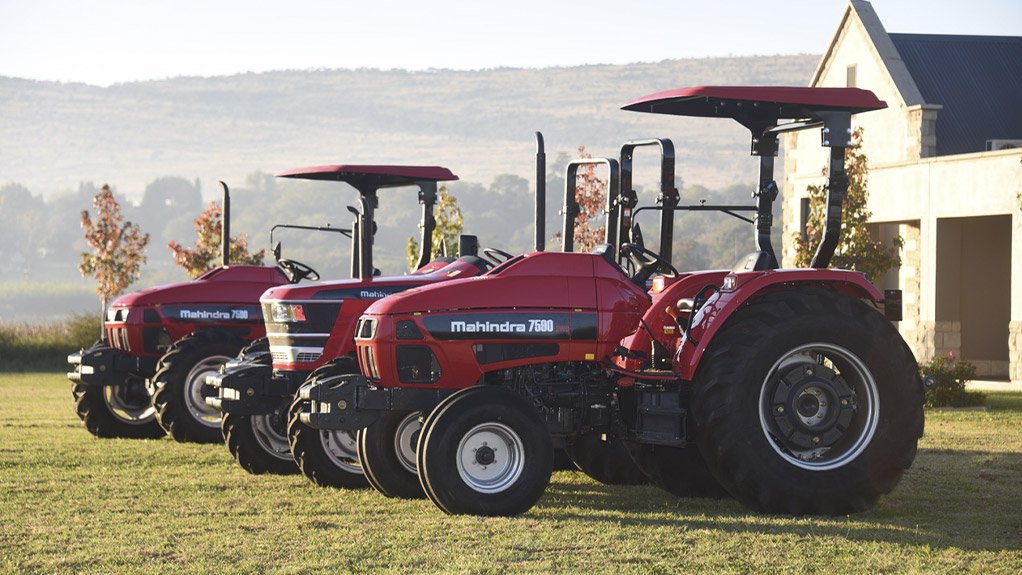
South Africa's agricultural machinery market entered the final quarter of 2026 under renewed pressure after reported tractor sales declined for a fifth consecutive month in September, reflecting a combination of weaker replacement demand, rising farming costs and caution over weather conditions ahead of the summer crop season.
Figures published by the South African Agricultural Machinery Association (SAAMA) show that 623 tractors were sold in September, compared with approximately 758 units during the corresponding month in 2025, an 18% year-on-year decline. Sales over the first nine months of 2026 were approximately 9% below the comparable period a year earlier. The figures are commonly discussed in the context of South Africa's agricultural machinery industry, although SAAMA reporting covers the wider Southern African market.
The September outcome continued a deterioration that became more pronounced during the middle of the year. Sales had opened 2026 on firmer ground, increasing by approximately 13% in January, while February recorded 669 units, around 5% above the same month in 2025. By July, monthly sales had dropped to 517 tractors, a decline of approximately 31% year on year. August brought a modest recovery to 606 units, although that total remained about 13% below the previous year's level.
The sequence suggests that farmers have become increasingly reluctant to commit capital to new machinery, despite the continuing need to maintain and renew agricultural equipment fleets. Tractors are long-lived assets, and decisions to replace them depend not only on expected crop income but also on financing costs, the age and condition of existing machines, the price of imported equipment and the availability of technical support.
Production costs and a changing weather outlook
Arthur Bezuidenhout, Chairman of SAAMA, has described the market as difficult for agricultural machinery suppliers, with farmers prioritizing the funding of their coming production season over major equipment purchases. Although maize prices have recently offered some support, higher input costs and uncertainty about weather conditions have encouraged a more conservative approach to capital expenditure.
Wandile Sihlobo, Chief Economist of the Agricultural Business Chamber of South Africa (Agbiz), Presidential Envoy on Agriculture and Land, and Senior Research Fellow at Stellenbosch University, has identified the combined effects of rising fuel and fertilizer costs, concerns over potential El Niño-related drought conditions and the normalization of machinery demand following earlier periods of strong investment.
The cost pressures have been linked by market analysts to international fuel and supply-chain disruptions associated with the U.S.–Iran conflict. For grain producers, higher diesel and fertilizer costs directly affect the cash required for land preparation, planting and crop management. They can also make the purchase of a new tractor more difficult to justify when the immediate priority is securing inputs for the next harvest.
The weather outlook adds another layer of risk. Farmers entering the 2026–2027 summer production season face uncertainty about rainfall conditions, with possible El Niño development raising concerns about the performance of maize and other summer crops. A forecast is not a realized drought, but the possibility of a poor season can influence investment well before the first planting decisions are made.
A market adjusting after years of heavy investment
The current contraction follows an unusually strong period of tractor investment and a subsequent cycle of adjustment. Annual tractor sales reached 9,181 units in 2022, before easing to 8,380 in 2023 and 6,444 in 2024. The market recovered to 7,668 units in 2025, an increase of approximately 19% on the preceding year.
These figures help explain why a slowdown in replacement purchases can occur even when farming activity remains substantial. Machinery acquired during earlier years of strong farm earnings may still have considerable working life remaining. Farmers facing tighter margins can defer replacement, increase maintenance expenditure and continue operating existing tractors rather than undertake new borrowing.
South Africa's preceding harvest conditions also complicate the market picture. The Crop Estimates Committee projected the 2025–2026 summer grain and oilseed crop at approximately 21.7 million tonnes, around 6% above the previous season. A relatively favourable harvest does not automatically translate into stronger equipment sales when farmers expect higher production costs or less favourable rainfall in the following year.
Bennie van Zyl, General Manager of TLU SA, has similarly drawn attention to the pressure on agricultural profitability and the difficulty of financing machinery purchases amid uncertainty over yields, commodity prices and operating margins. The challenge for producers is to maintain access to modern agricultural technology without taking on capital commitments that could weaken their ability to finance the next season.
Combine harvesters show a different monthly pattern
The September figures were not uniformly negative across agricultural machinery categories. Twelve combine harvesters were sold during the month, compared with eight in September 2025, representing a 50% year-on-year increase. Cumulative combine harvester sales for the first nine months of 2026 were approximately 1% higher than in the corresponding period of the previous year.
That contrast requires caution. The monthly increase represents only four additional machines, and combine harvesters are purchased in much smaller volumes than tractors. A small change in deliveries can therefore produce a large percentage movement without necessarily indicating a sustained improvement in the wider agricultural equipment market.
Implications for manufacturers, distributors and equipment finance
For tractor manufacturers and their Southern African distributors, the downturn affects more than the number of machines leaving showrooms. Lower replacement demand can lengthen inventory holding periods, increase the cost of dealer finance and alter the balance between new equipment sales and revenue generated from maintenance, replacement parts and workshop services.
Equipment financiers face a similar adjustment. A tractor purchase must be supported by the expected earning capacity of the farm or agricultural contracting business, while loan repayments must remain manageable through seasonal fluctuations in agricultural income. Where crop prices, fuel costs and rainfall expectations become less predictable, both lenders and borrowers may adopt more conservative assumptions.
Farmers retaining machinery for longer may generate additional demand for repairs and components, although higher service expenditure is not necessarily sufficient to offset weaker new equipment sales. For distributors, technical capability, parts availability and field support become particularly important when customers are seeking to extend the productive lives of their existing fleets.
SAAMA expects full-year tractor sales to finish approximately 10% below their 2025 level. Applied to the reported 2025 total of 7,668 units, that would imply annual sales of roughly 6,900 tractors, although this is a calculation based on the association's percentage outlook rather than an official forecast expressed in units.
The final quarter will test whether farmers' caution persists as planting progresses and rainfall patterns become clearer. The September result shows that the agricultural machinery market is entering that period with weaker demand than a year earlier, notwithstanding the preceding recovery in equipment purchases and a relatively productive recent harvest.