

The transfer of Case IH management to CFAO Mobility Kenya brings one of the world's oldest agricultural machinery brands into the country's established automotive distribution infrastructure. Beyond the corporate restructuring, the move raises important questions about agricultural productivity, machinery financing, the economics of tractor ownership and Kenya's longstanding struggle to mechanize farming beyond large commercial estates.
NAIROBI, KENYA — For much of Kenya's agricultural history, the tractor has represented both the promise and the limitations of mechanization. On the large wheat farms of Narok, the expansive agricultural estates of the Rift Valley and the commercial sugarcane fields of western Kenya, mechanized cultivation has been part of farming for generations. Across much of the country's smallholder economy, however, cultivation remains dependent on human labour, animal traction and machinery hired for a few days during the planting season.
It is against this uneven agricultural landscape that CFAO Group has transferred management of its Case IH agricultural equipment business in Kenya to CFAO Mobility Kenya Limited, effective 1 October 2026.
Announced on 6 October, the internal restructuring places the American-origin agricultural machinery brand within the distribution, technical support and aftersales organization that already handles some of Kenya's most recognizable automotive and commercial vehicle brands.
For CFAO, the move extends an established mobility business into the agricultural machinery market. For Case IH, which has operated within the group's Kenyan business since 2014, it offers access to a wider service organization and established distribution infrastructure. For farmers and agribusinesses, the significance will depend less on the change in corporate management than on whether it improves the availability, reliability and lifetime operating costs of agricultural equipment.
Arvinder Reel, Managing Director of CFAO Mobility Kenya, described the transition as an extension of the company's established role in Kenya's transport economy.
“Case IH is a natural extension of our business and our commitment to providing solutions that help our customers perform better. We have traditionally helped Kenya move people and goods; with Case IH, we can also help power the farms, businesses and agricultural enterprises that feed and drive our economy.”Arvinder Reel — Managing Director, CFAO Mobility Kenya
Reel placed particular emphasis on aftersales support, an area in which agricultural equipment distributors face some of their most consequential commercial challenges.
“Agricultural machinery is a productivity asset, and our responsibility is to ensure that customers receive the support they need throughout the life of their machines. Parts availability, technical expertise and responsive aftersales service are fundamental to customer success,” he added.
The statement reflects an important distinction between selling agricultural equipment and sustaining a mechanized farming operation. A tractor may remain in productive service for decades, but its commercial usefulness depends on the availability of replacement components, trained mechanics, appropriate implements and the ability to complete agricultural operations within narrow seasonal windows.
The commercial opportunity is substantial, although Kenya's agricultural mechanization challenges extend far beyond the supply of tractors.
According to the Kenya National Bureau of Statistics' 2026 Economic Survey, agriculture, forestry and fishing accounted for 23.2% of the country's gross domestic product in 2025. The sector grew by 3.1% that year, underlining its importance to national economic performance, household incomes and food security.
Kenya's National Agricultural Mechanization Policy, published in March 2024, acknowledges a persistent dependence on traditional farming methods. The estimates above describe the distribution of agricultural power sources, rather than the proportion of farms owning tractors. Nevertheless, they illustrate the considerable distance between Kenya's agricultural ambitions and the mechanization available to much of its farming population.
A century-old machinery heritage enters a new distribution arrangement
The Case IH name carries a manufacturing history considerably older than Kenya's modern agricultural economy.
Its origins reach back to 1842, when Jerome Increase Case established a threshing machinery business in Racine, Wisconsin, in the United States. Five years later, Cyrus McCormick founded the McCormick Harvesting Machine Company in Chicago, building on the development of mechanical harvesting technology.
The two industrial lineages eventually converged through a series of acquisitions and reorganizations. McCormick's business became part of International Harvester in 1902, while the Case enterprise developed its own agricultural machinery operations. In 1985, the agricultural equipment businesses of Case and International Harvester were brought together under the Case IH identity.
Among the brand's important subsequent developments were the Magnum tractor range introduced in 1987 and the Maxxum series launched in 1989, products that helped establish Case IH's position in modern agricultural machinery markets. The brand is now part of CNH, the multinational equipment manufacturer.
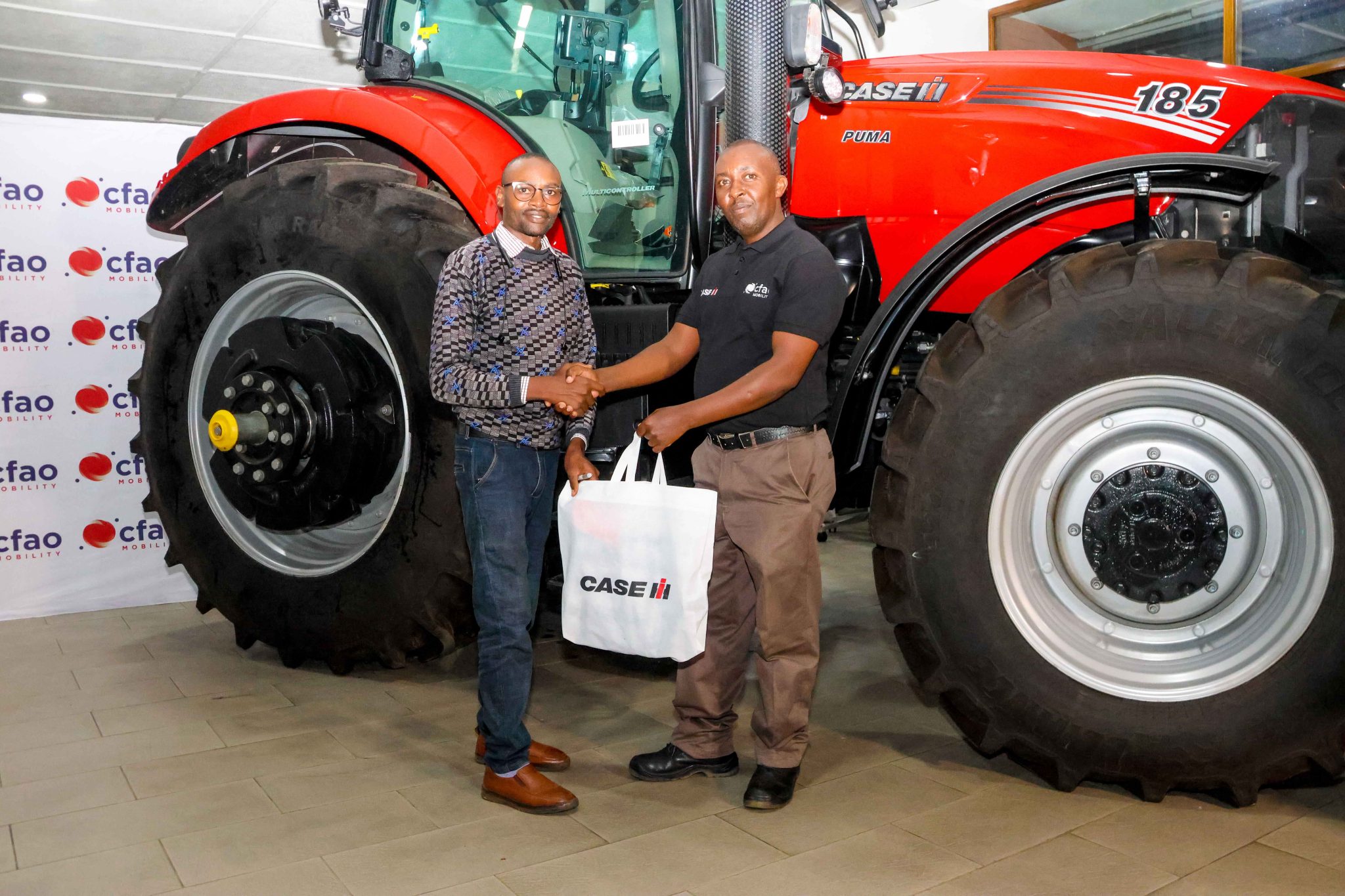
Across Africa, Case IH has developed a presence in commercial agricultural markets, including South Africa, where its equipment and distribution operations have served large-scale farming enterprises. Its agricultural machinery heritage is particularly relevant to mechanized grain production, high-horsepower field operations and specialized commercial farming.
The brand's Kenyan presence under CFAO dates to 2014. Over the subsequent twelve years, the company established relationships with agricultural enterprises, contractors and farmers in the country's principal agricultural regions.
The Kenyan Case IH portfolio now extends from 55-horsepower tractors to machines rated at 700 horsepower, covering a considerable range of agricultural requirements. The lower end of that range addresses relatively modest mechanization needs, while the larger machines are designed for extensive commercial farming operations requiring substantial field capacity.
The portfolio also includes implements and precision farming technologies, reflecting the evolution of agricultural mechanization beyond conventional land preparation.
The October restructuring does not represent the arrival of a new manufacturer in Kenya, nor does it constitute an acquisition of Case IH by CFAO Mobility Kenya. It is a transfer of management responsibility within the existing CFAO Group structure, intended to consolidate agricultural equipment operations within a larger distribution and aftersales organization.
CFAO's agricultural investment had already been developing before the transfer. In February 2026, the group announced a new Case IH agricultural machinery showroom in Mnazi Mmoja, Mombasa, extending its commercial presence on the Kenyan coast. The investment suggested an intention to deepen its agricultural equipment business beyond its established customer base.
Kenya's long and uneven journey towards mechanization
Kenya's experience with agricultural mechanization predates independence. Tractors and other mechanized equipment became established on colonial-era commercial farms, particularly in areas devoted to wheat and other large-scale field crops. Their use was concentrated in agricultural enterprises with sufficient acreage, capital and access to technical services to sustain mechanized operations.
After independence, successive governments attempted to extend the benefits of mechanization to African smallholder farming through machinery services, agricultural engineering programmes, equipment testing, technology development and support for farmer organizations.
These interventions produced institutions and technical capabilities, but they did not eliminate the structural differences between large commercial farms and smallholder agriculture.
The government's 2024 mechanization policy documents this history, including agricultural mechanization services, machinery testing facilities, agricultural technology development centres, smallholder equipment programmes and later private-sector initiatives.
It also acknowledges the consequences of continued subdivision of agricultural land. As farm holdings become smaller and more fragmented, the economics of purchasing and operating machinery become increasingly difficult.
A tractor that can cultivate hundreds of hectares annually on a large commercial farm may spend much of its productive life idle when owned by a household farming only a few hectares. The capital cost remains substantial even when annual utilization is low. Maintenance, tyres, fuel, insurance, transport and depreciation must still be recovered from a relatively small amount of agricultural work.
The problem is compounded by seasonality. During land preparation and planting, demand for machinery can become concentrated within a few weeks. Outside those periods, utilization may fall sharply unless the equipment can undertake transport, harvesting, construction-related work or agricultural operations in different regions.
Consequently, expanding tractor ownership is not necessarily equivalent to expanding economically sustainable mechanization.
Kenya's agricultural policy has increasingly recognized the importance of mechanization services, equipment sharing, local machinery adaptation and private investment. These approaches seek to separate access to agricultural machinery from the requirement that every farmer purchase a machine outright.
For equipment distributors such as CFAO Mobility Kenya, this distinction has considerable commercial implications. Agricultural contractors, farmer cooperatives and mechanization service providers can become important customers alongside large commercial estates. A contractor operating equipment across multiple farms may achieve substantially higher annual utilization than an individual smallholder, making machinery investment and financing more commercially viable.
The distributor's responsibility consequently extends beyond supplying the equipment to ensuring that the machinery remains operational during the periods when farmers need it most.
From public tractor hire to commercial machinery services
The history of public machinery services illustrates why the private distribution and service model is receiving renewed attention.
Kenya established an agricultural mechanization service in 1947, initially concentrating on soil conservation and land development. In 1965, the government introduced a Tractor Hire Service to encourage mechanized wheat production and improve access to equipment. The tractor hire and plant hire operations were combined in 1981 to form Agricultural Mechanization Services.
Following devolution, responsibility for many of these services passed to county governments. According to the 2024 mechanization policy, the system had 115 farm tractors and 78 items of plant machinery distributed across 24 stations at the time of devolution. The government subsequently acknowledged that many county machinery services had experienced declining operational effectiveness because of inadequate funding, management weaknesses and maintenance difficulties.
The same policy identifies private agricultural enterprises and machinery contractors as important participants in expanding mechanization. It cites commercial operations including West Kenya Sugar, Butali and Kabras, alongside large agricultural enterprises such as Kakuzi and Del Monte, as examples of mechanized agricultural systems. It also documents pilot Agri-Huduma mechanization hubs serving maize production in Uasin Gishu and rice farming in Busia.
These arrangements illustrate the government's interest in moving beyond publicly owned tractor fleets towards commercially operated mechanization services.
Government policy and the financing challenge
The National Agricultural Mechanization Policy provides a direct policy context for CFAO's latest restructuring.
Its objectives include expanding access to appropriate agricultural machinery, encouraging local manufacturing and distribution, improving equipment quality assurance, developing technical skills and increasing private investment in mechanization services.
The policy also recognizes the high cost of agricultural equipment and credit as constraints on adoption. It proposes financing incentives, dedicated agricultural mechanization credit facilities and revolving funds to support machinery services. These are policy commitments and proposed interventions, rather than evidence that all the financing mechanisms are already operational.
For commercial equipment distributors, the financing challenge is closely connected to the structure of Kenya's farming economy.
A large commercial wheat producer may be able to finance a tractor against established farming revenues and predictable acreage. A smallholder maize farmer, whose income depends on seasonal harvests and fluctuating commodity prices, faces a very different financial position.
Agricultural contractors occupy an important middle ground. By providing ploughing, planting, spraying, harvesting and transport services to multiple farmers, they can distribute the cost of machinery across a larger customer base.
However, financing such enterprises requires lenders to understand machinery utilization, maintenance expenditure, seasonal cash flow and the residual value of agricultural equipment. Conventional vehicle financing structures do not always correspond neatly with agricultural production cycles.
This creates potential opportunities for partnerships between equipment distributors, banks, leasing companies, agricultural cooperatives and machinery service operators.
CFAO Mobility Kenya already operates in markets where the availability of technical support and the preservation of asset value influence customers' purchasing and financing decisions. Its experience with commercial vehicles may therefore offer useful capabilities for agricultural machinery distribution.
The company has not, however, announced a specific new Case IH financing programme as part of the October transition. Nor has it disclosed additional tractor sales targets, new service-centre investments or a timetable for extending specialist agricultural machinery support to every existing CFAO Mobility outlet.
Those details will be important in determining the eventual commercial impact of the restructuring.
From tractors to agricultural equipment ecosystems
Agricultural mechanization increasingly encompasses considerably more than the tractor itself.
For commercial grain producers, machinery requirements may include precision planters, sprayers, combine harvesters and equipment for residue management. Sugarcane production involves specialized land preparation, harvesting and haulage operations, while horticultural enterprises may require compact tractors, irrigation equipment and machinery adapted to relatively intensive cultivation.
The growing sophistication of agricultural equipment also changes the technical requirements placed on distributors.
Modern machinery may incorporate electronic control systems, satellite guidance, sensors and computerized diagnostic equipment. Maintaining such machines requires technicians trained in mechanical systems as well as electronics, hydraulics and software-supported diagnostics.
These developments make aftersales investment increasingly important. An expensive tractor without reliable technical support can become a stranded agricultural asset, particularly when repairs are delayed by imported parts or a shortage of qualified technicians.
CFAO Mobility Kenya's existing business spans Toyota, Volkswagen, Mercedes-Benz, Hino, Sinotruk, Yamaha and Suzuki, alongside tyres, replacement parts and certified pre-owned vehicles. The addition of Case IH places agricultural equipment alongside a portfolio already serving passenger transport, commercial logistics and industrial customers.
There are potential commercial connections between these activities. Agricultural enterprises require tractors and implements for production, trucks for moving crops and inputs, utility vehicles for estate operations and maintenance support for equipment operating in demanding environments.
The opportunity for CFAO is to serve a larger proportion of the agricultural enterprise's equipment requirements through an established commercial organization.
Whether these capabilities translate into a genuinely integrated agricultural service offering will depend on investment in specialist facilities, personnel, parts inventories and machinery support arrangements.
The African market beyond Kenya
The restructuring also takes place within a wider African agricultural equipment market in which the conditions for mechanization vary considerably between countries.
South Africa has a long-established commercial agricultural machinery market, supported by large-scale farming operations, specialized dealers and an established agricultural engineering sector. Countries such as Zambia and Zimbabwe also have histories of mechanized commercial agriculture, while many East African markets remain characterized by smaller farms and greater dependence on hired equipment.
Case IH's established presence in South Africa and its broader international machinery portfolio provide a basis for serving different categories of African agricultural enterprise. Its Kenyan operation, however, must contend with the country's distinctive combination of fragmented landholdings, commercial agricultural estates, seasonal production and uneven access to machinery finance.
The brand's range of equipment, extending to high-horsepower tractors, offers opportunities in commercial agriculture. But the larger opportunity for mechanization in Kenya may lie in developing economically sustainable services for farmers who cannot justify purchasing machinery individually.
That market requires appropriately sized equipment, dependable local maintenance, competitive hire rates and financing arrangements capable of supporting machinery contractors through agricultural production cycles.
It also requires attention to soil conditions, land fragmentation and the suitability of machinery for different farming systems. Mechanization that increases costs or contributes to soil degradation without corresponding productivity gains offers little long-term benefit.
An established brand under a new operating structure
CFAO Group Kenya Chairman and Country Delegate, Ambassador Dennis Awori, described the transition as part of the group's response to the country's agricultural development needs.
“This transition reflects CFAO's commitment to responding to the evolving needs of Kenya's economy. Agriculture is a critical sector for the country's growth, employment and food security, and bringing Case IH under CFAO Mobility strengthens our ability to support farmers, agribusinesses and the wider agricultural value chain.”Ambassador Dennis Awori — Chairman, CFAO Group Kenya and Country Delegate
The group has assured existing Case IH customers that orders, business relationships and points of contact will remain unchanged. The existing sales and technical teams will also continue serving customers, preserving the experience developed during the brand's twelve years within CFAO's Kenyan operations.
The continuity is commercially important. Agricultural equipment relationships frequently extend over many years, with customers relying on distributors for technical advice, replacement components, maintenance and the eventual renewal of machinery fleets.
For CFAO Mobility Kenya, the immediate responsibility is to maintain that continuity while establishing the operational advantages promised by the restructuring.
The longer-term opportunity is considerably larger. Kenya's agricultural economy requires more reliable access to mechanization, stronger equipment maintenance systems and financing models that reflect the commercial realities of farming. Government policy recognizes these requirements, but their realization depends heavily on private investment and the development of viable agricultural machinery service businesses.
Case IH enters its new management arrangement with an established international manufacturing heritage, an existing Kenyan customer base and the backing of a diversified distribution group.