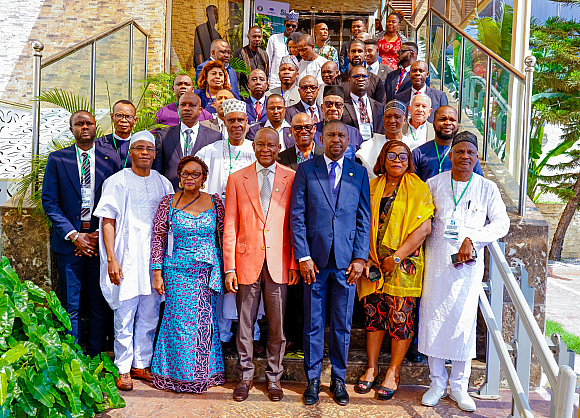
Group Photo:ECOWAS Regional Automotive Industry Development Forum, convened by the ECOWAS Commission’s Directorate of Private Sector and Industry in Abuja, Nigeria, from 4–6 August 2026.
The ECOWAS Commission is seeking to accelerate the development of a regional automotive manufacturing industry as West Africa confronts a sizeable gap between its existing vehicle assembly capacity and actual production.
More than a decade after the ECOWAS Regional Automotive Policy Framework was adopted, implementation remains uneven among Member States. The ECOWAS Commission says Nigeria has made the most measurable progress, followed to a lesser extent by Ghana, Côte d’Ivoire and Senegal.
The numbers illustrate both the challenge and the opportunity.
West Africa currently has seven vehicle assembly plants operating at Semi-Knocked Down (SKD) level, with combined installed capacity exceeding 100,000 vehicles annually. Yet actual production remains below 10,000 units a year, putting capacity utilisation at less than 10 percent.
Meanwhile, the region imports more than 450,000 vehicles annually, predominantly used vehicles and grey imports.
Closing that gap was a central issue at the ECOWAS Regional Automotive Industry Development Forum, convened by the ECOWAS Commission’s Directorate of Private Sector and Industry in Abuja, Nigeria, from 4–6 August 2026.
The three-day meeting examined progress under the Regional Automotive Policy Framework, barriers to implementation and measures required to develop a more integrated automotive manufacturing ecosystem.
One of the immediate benchmarks is the Framework’s 2028 target of producing 50,000 locally assembled vehicles annually.
The forum brought together governments, regulators and the private sector, including Nigeria’s Minister of State for Industry, Trade and Investment, Senator John Owan ENOH, and ECOWAS Commissioner for Economic Affairs and Agriculture, Dr. Kalilou SYLLA.
Also represented were Ministries responsible for Industry and Trade, Customs administrations, standards and quality assurance institutions, national automotive councils and agencies, vehicle manufacturers and assemblers, manufacturers’ associations, Chambers of Commerce, development partners, financial institutions and officials of the ECOWAS Commission.
Dr. SYLLA said building an automotive industry should be viewed as a broader industrialization opportunity rather than simply increasing the number of vehicles assembled within the region.
“The automotive industry presents an important opportunity for West Africa’s industrial transformation. Its potential extends far beyond vehicle assembly. A competitive automotive industry can stimulate component manufacturing, support ancillary industries, promote technology transfer and innovation, create skilled employment, strengthen SMEs and deepen regional value chains,” he said.
“The scale of the opportunity is enormous. What we need is a predictable and coherent policy and regulatory environment that gives investors the confidence to make long-term decisions.”
Senator ENOH said transforming West Africa into an integrated and self-sustaining automotive manufacturing hub would require greater regulatory harmonization, consistent policies and an investment environment capable of supporting long-term private capital.
Nigeria also used the forum to make a significant regional commitment.
“As part of Nigeria’s concrete commitment to support this collective effort, Nigeria formally commits to opening its national automotive quality infrastructure, including our three National Automotive Testing Laboratories in Enugu, Lagos and Zaria, as well as our 22 Mechatronics Skills Training Centres, to all ECOWAS Member States as Regional Centres of Excellence for vehicle homologation, quality testing and capacity building,” Senator ENOH announced.
The private sector reinforced the importance of policy certainty.
Chief Dr. Innocent CHUKWUMA, Chairman and Founder of Innoson Vehicle Manufacturing Company Limited, said investment would depend heavily on whether governments can create a predictable regional operating environment.
“Investor confidence thrives where policies are stable, implementation is consistent and regional integration is genuine. If ECOWAS can provide a predictable policy environment, harmonized regulations and actively support local manufacturing, private sector investment will follow, regional value chains will flourish and West Africa will emerge as a globally competitive automotive hub,” he said.
For ECOWAS, the challenge now is implementation.
With more than 100,000 units of installed annual assembly capacity but fewer than 10,000 vehicles currently being produced, the region already possesses some of the physical foundation required for expansion.
At the same time, annual imports exceeding 450,000 vehicles indicate the scale of the addressable market if regional manufacturers can become more competitive.
The Abuja forum concluded with Member States, industry leaders and development partners renewing commitments to coordinate automotive policies, harmonize regulations, establish regional production networks and mobilize investment.
The road to the 2028 target will therefore depend not simply on adding assembly capacity, but on whether ECOWAS Member States can translate a decade-old regional policy into production, component manufacturing, investment, jobs and functioning cross-border automotive value chains.