
 There is a particular kind of leadership that does not announce itself with noise or spectacle. It does not arrive in the form of ribbon-cuttings or factory inaugurations. It is not measured in quarterly headlines or immediate disruptions. Instead, it exists in a quieter register; one defined by conversations that stretch across ministries, boardrooms, and regional secretariats; by frameworks that take years to mature; and by agreements that only reveal their significance long after they are signed. Victoria Backhaus-Jerling belongs to this category of leadership.
As Chief Executive Officer of the African Association of Automotive Manufacturers (AAAM), she occupies a space that is at once technical and political, diplomatic and industrial. Her work sits in the invisible layers of Africa’s automotive transformation, where policy can become investment, and investment, if aligned correctly, becomes industry.
To understand her role is to understand something more fundamental about Africa’s automotive future: it is not being built in a single place, or by a single actor, or even at a single speed. It is being assembled, unevenly, deliberately, and sometimes painfully, across multiple countries, institutions, and competing national priorities.
And in the middle of that complexity, AAAM tries to do something deceptively simple: bring coherence to fragmentation.
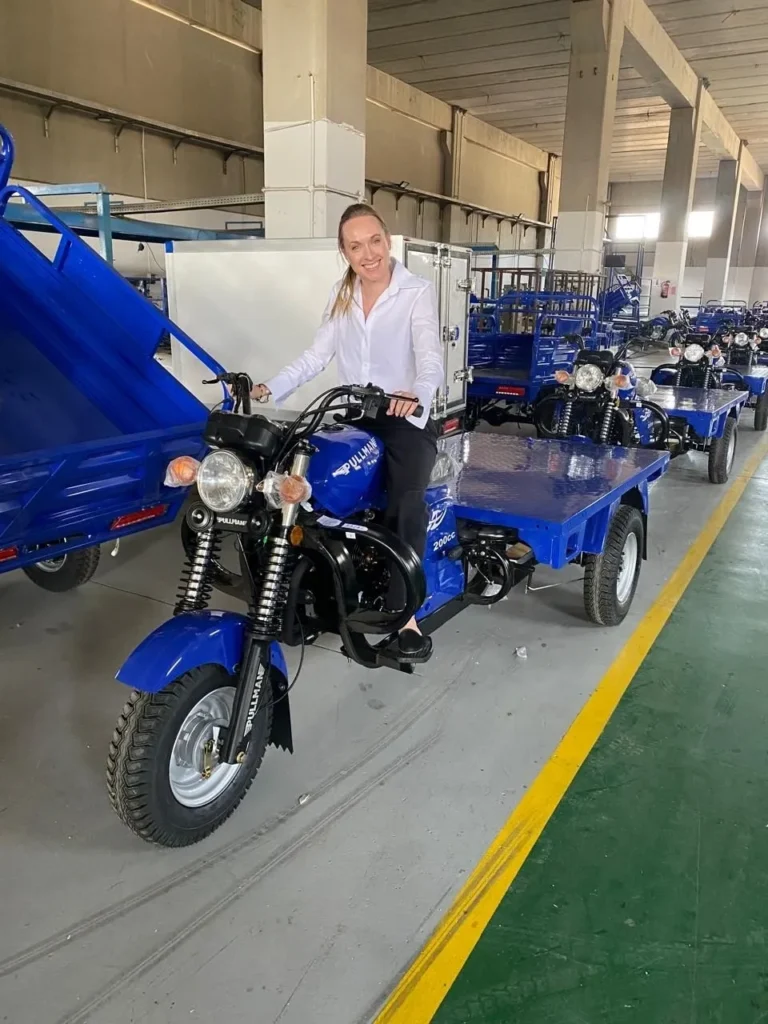
Last year, Victoria Backhaus-Jerling concluded a successful four-day visit to Egypt, where she engaged with AAAM members and key industry stakeholders to deepen collaboration in one of North Africa’s most dynamic and high-potential automotive markets. “It’s important for AAAM to remain close to our members and all stakeholders to ensure that we are collectively driving meaningful change in the industrialization of the automotive industry in Egypt,” says Victoria. During the visit, she met with leading companies including Nissan Motor Egypt, Stellantis, General Motors, EGA, EEI, INDE, BluEV, Autocool, GB Auto, El Teriak, Mansour, ESI Elsewedy, and Aboul Fotouh. AAAM continues to champion regional value chain development and industrial growth, with Egypt playing a strategic role in Africa’s automotive future.s a mosaic that has not yet been fitted together.
In South Africa, decades of industrial policy have created a globally integrated manufacturing base, deeply embedded in OEM supply chains. In Morocco, export-oriented automotive clusters have turned the country into a competitive production hub linked to Europe. Egypt is expanding its industrial footprint with renewed momentum. Meanwhile, countries such as Kenya, Nigeria, Ghana, Côte d’Ivoire, and others are at earlier stages assembling policy frameworks, attracting assembly investments, experimenting with incentives, and testing the boundaries of local content requirements.
Each of these trajectories is real. Each is meaningful. Yet they often evolve in isolation from one another. This is the structural tension that defines Africa’s automotive sector: it is active, but not yet unified; ambitious, but not yet coordinated. AAAM exists precisely in that gap.
It is not a manufacturer. It does not produce vehicles. Instead, it works on the preconditions of production, those less visible but absolutely decisive elements such as tariff structures, rules of origin under the African Continental Free Trade Area (AfCFTA), industrial incentives, and cross-border regulatory alignment. Under Victoria Backhaus-Jerling’s leadership, this work has taken on an increasingly clear philosophical centre: Africa does not need more isolated automotive projects. It needs a system.
And systems, unlike projects, require alignment.
Backhaus-Jerling did not arrive at AAAM by accident. Her professional journey runs through one of the most influential automotive policy ecosystems in the world: Germany.
At the German Association of the Automotive Industry (VDA), where she led the South African Project Office, she operated at a critical intersection between European OEM strategy and African industrial ambition. A role defined more by translation of corporate strategy and public policy, between global production systems and emerging market realities.
It is here that her perspective on Africa’s automotive challenge was sharpened.
Because what she saw, repeatedly, was not a lack of interest in industrialization. It was a lack of synchronization between the actors needed to make it real. Governments operate on political cycles. OEMs operate on product cycles. Investors operate on return cycles. Development finance institutions operate on mandate cycles. Suppliers operate on cost cycles.
Industrialization, however, only works when these cycles align long enough to sustain investment.
This is the problem she now spends her time trying to solve.
AAAM is often described in simple terms as an industry association. In practice, it functions more like a coordination mechanism for an industry that does not yet fully exist at continental scale.
It engages directly with governments, the African Union, regional economic communities, and the AfCFTA Secretariat to shape automotive policy frameworks that can support investment and enable cross-border value chains.
But beneath that formal mandate lies a more ambitious objective: to help construct an integrated African automotive ecosystem. Not a collection of national industries loosely connected by trade agreements, but a genuinely interlinked production network—where components manufactured in one country can flow seamlessly into assembly lines in another, and where regional demand can sustain industrial scale.
Backhaus-Jerling often returns to this idea in different forms. “We are not building isolated industries,” she has said in various policy forums. “We are building an ecosystem that must function as one.” The challenge, of course, is that ecosystems do not respond to intention alone. They require infrastructure, trust, regulatory coherence, and above all, predictability. And predictability is precisely what emerging markets struggle to guarantee.
The African Continental Free Trade Area (AfCFTA) is often described as a turning point in Africa’s economic trajectory. In automotive terms, it represents something even more specific: the possibility of scale.
For decades, Africa’s automotive markets have been too fragmented to support large-scale manufacturing beyond a handful of hubs. AfCFTA changes the theoretical size of the market. But theory is not enough.
The real work lies in implementation, particularly in technical areas such as rules of origin, tariff schedules, and local content thresholds. These are not glamorous topics. They do not typically make headlines. Yet they determine whether a vehicle assembled in one African country can be sold competitively in another without losing its “African” status under trade rules.
AAAM’s role in this space has been to engage in the painstaking work of alignment—helping policymakers, industry actors, and trade negotiators translate continental ambition into operational frameworks. It is slow work. It is technical work. And it is absolutely central to whether Africa’s automotive industry becomes fragmented or integrated.
If there is a recurring tension in Backhaus-Jerling’s framing of Africa’s automotive future, it is not industrial capacity or policy ambition. It is affordability. Across much of the continent, vehicle ownership is constrained not by supply, but by financing structures. High interest rates, limited access to long-term credit, and underdeveloped automotive financing ecosystems mean that even locally assembled vehicles struggle to compete with imported used vehicles on price accessibility.
This creates a structural paradox. Industrialization is being pursued in environments where effective demand is constrained. Backhaus-Jerling has consistently drawn attention to this gap—not as a secondary concern, but as a central variable in industrial planning.
Because without accessible financing, demand remains suppressed. Without demand, scale is impossible. Without scale, manufacturing is not competitive. And without competitiveness, industrialization remains aspirational rather than operational.
It is a chain reaction that links banks to factories, and credit policy to assembly lines.
Perhaps the most defining aspect of Backhaus-Jerling’s role is not what she does, but how she must do it.
She operates in a system where no single actor controls the outcome. Governments set policy direction, but cannot guarantee investment. OEMs bring capital and technology, but require policy certainty. Development finance institutions can de-risk investment, but cannot create demand. Suppliers can build capacity, but only if the ecosystem is stable enough to justify expansion.
Her role, then, is not to lead in the traditional hierarchical sense. It is to orchestrate alignment among actors who are structurally misaligned by design. It is a form of leadership that depends less on authority and more on credibility, persistence, and the ability to hold multiple timelines in tension at the same time.
Africa’s automotive sector is not in its final form. It is still in its formative stage shaped as much by what is not yet built as by what already exists. Assembly plants exist. Policy frameworks are improving. Trade agreements are evolving. Investment interest is growing. But the connective tissue between these elements is still under construction.
That is where AAAM’s work sits. And that is where Victoria Backhaus-Jerling’s leadership becomes most visible, not in isolated outcomes, but in the gradual construction of coherence. It is slow work. It is technical work. It is often invisible work. But it is also the kind of work that determines whether an industry remains fragmented or becomes foundational.
And in that sense, what is unfolding is not just the development of an automotive sector. It is the patient construction of an industrial system that Africa has never fully had at continental scale. Still incomplete. Still evolving. Still negotiating its own form. But unmistakably, and increasingly, taking shape.