




The CFAO African Art Award is a continental cultural initiative established in August 2025 by Toyota Tsusho Corporation in partnership with its group company CFAO. Conceived as a structured platform for emerging contemporary artists across Africa, the programme reflects a deliberate effort to extend corporate engagement beyond commerce into cultural production and long term creative ecosystem development.

At the centre of the initiative is a clear philosophical framing articulated by CFAO leadership. As Richard Bielle, Chairman and Chief Executive Officer of CFAO, stated: “Art is not an accessory to society; it is one of the ways in which societies reflect, question and project themselves into the future. With more than 170 years of presence across the African continent, it is natural for CFAO to engage alongside artists and communities. Through THE TOYOTA TSUSHO CFAO African Art Award, we want to support the diversity of contemporary practices emerging from Africa and help carry these voices and the Continent’s cultural radiance far beyond its borders.” He further situates the initiative within CFAO’s broader strategic identity, noting that it is “at the heart of our purpose, With Africa For Africa, which guides our actions toward building a sustainable future in Africa.”
This framing positions the award not as a standalone philanthropic gesture but as part of a longer institutional narrative in which CFAO’s commercial history in Africa is extended into cultural participation. The emphasis on “reflection, questioning, and projection” places art within a developmental and societal discourse rather than purely aesthetic value, suggesting an intention to link cultural production with broader ideas of future building on the continent.
The award is anchored in collaboration with the Palais de Lomé in Togo, which serves as a key exhibition platform. From its inception in 2025, the programme was structured to combine selection, exhibition, and acquisition, creating a multi stage pathway that moves artists from regional recognition into international visibility. The model reflects an increasingly common approach among global corporations operating in Africa, where cultural initiatives are designed as systems of circulation rather than single event prizes.
The inaugural edition, completed in 2026, brought together a wide field of artists selected through international curatorial networks. Approximately one hundred artists from across the continent were first identified, followed by a shortlist of twelve, before five laureates were ultimately selected by a jury. The process was designed to ensure both geographic diversity and conceptual breadth, reflecting the heterogeneity of contemporary African art practice.
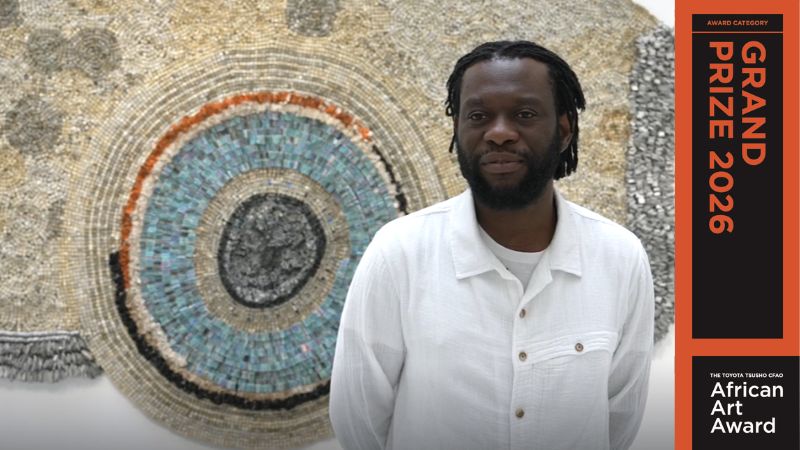
The Grand Prize was awarded to Zimbabwean artist Moffat Takadiwa. His practice is widely recognized for its use of discarded consumer and industrial materials, which are transformed into densely layered sculptural surfaces. The awarded works continue this approach, constructing intricate compositions from found objects that interrogate systems of consumption, waste, and value creation. The visual density of his work reflects a broader commentary on material circulation in post industrial and post colonial contexts, where discarded objects become both archive and critique.
Among the other laureates, Gosette Lubondo from the Democratic Republic of the Congo was recognized for her photographic practice that constructs staged environments within abandoned architectural spaces. Her awarded works explore memory and absence by reactivating unused or derelict interiors, producing images that sit between documentary observation and fictional reconstruction. These compositions engage with questions of historical continuity and spatial memory, particularly in contexts where built environments carry layered political and social histories.
Other selected artists included Unathi Mkonto from South Africa, whose work engages spatial composition through layered visual and conceptual structures influenced by architectural thinking. Katlego C L Twala from Botswana, trained in realist painting traditions, presents figurative works that interpret contemporary life through precise technique and narrative clarity. Ethiopian artist Tizta Berhanu contributes expressive figurative painting that explores identity, interiority, and spiritual reflection through symbolic use of form and colour. Together, these practices demonstrate the curatorial intention of representing a wide spectrum of methodologies rather than a singular aesthetic trend.
The awarded works are scheduled to be exhibited in a traveling international programme beginning at the Palais de Lomé in Togo, followed by presentations in Japan and France. This multi site exhibition model reinforces the award’s ambition to position African contemporary art within multiple cultural geographies, extending its reach into established global art institutions and audiences.
In its structure and framing, the CFAO African Art Award reflects a broader evolution in corporate cultural engagement in Africa, where long established multinational companies are increasingly constructing platforms that combine recognition, circulation, and institutional partnership. In this case, the emphasis on supporting diversity of practice and expanding global visibility aligns directly with the CEO’s articulation of art as a societal force, situating the initiative within a longer horizon of cultural and developmental intent.