
SBM Bank Kenya has entered into a vehicle financing partnership with Global Motors Centre Limited, the Kenyan distributor of China’s Jetour automotive brand, offering loans covering up to 95% of the purchase price of selected sport utility vehicles, with repayment periods extending to six years.
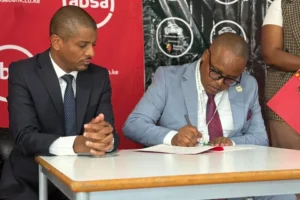
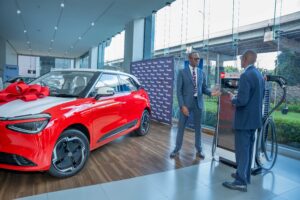
The agreement, signed on 26 October 2026 at the Jetour showroom in Nairobi, covers the Jetour Dashing, X70 Plus, T2 and T1 models. It also incorporates comprehensive motor insurance and financing arrangements for insurance premiums.
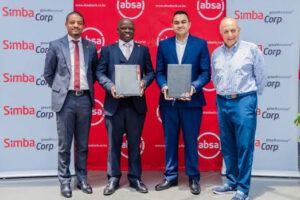
The memorandum of understanding was signed by Eric Wambua, Director of Corporate and Institutional Banking at SBM Bank Kenya, and Abdallah Zubedi, Director of Global Motors Centre Limited.
Under the arrangement, qualifying customers can acquire a new Jetour SUV with an initial contribution of 5% of the purchase price, subject to the bank’s credit assessment and financing conditions.
The facility targets individual customers, professionals, business owners and corporate organizations seeking to acquire vehicles without committing the full purchase price upfront.
For Global Motors Centre, the agreement adds another financial institution to its vehicle distribution network, following an earlier partnership involving Equity Bank and sister company TransAfrica Motors.
The latest development also brings into focus the growing competition among Kenyan financial institutions to finance Chinese vehicles, particularly as newer automotive brands seek to establish themselves against manufacturers with longer operating histories in the country.
SBM Bank expands its vehicle financing portfolio
Speaking during the signing, Eric Wambua said the agreement was intended to reduce the financial barriers associated with acquiring new vehicles.
“By offering up to 95 per cent financing alongside integrated bancassurance, we are removing major financial hurdles for professionals, business owners and corporate entities, enabling them to upgrade their fleets or personal vehicles under highly flexible terms,” Wambua said.
The inclusion of insurance premium financing is an important feature of the arrangement.
Comprehensive motor insurance is ordinarily a requirement for vehicles purchased through asset financing, particularly where the vehicle serves as security for the loan.
Financing the insurance premium can reduce the amount a customer must provide at the point of acquisition, although the additional borrowing also becomes part of the customer’s financing obligations.
For business customers, the ability to spread acquisition costs over 72 months could support vehicle replacement programmes while preserving working capital for other operational requirements.
However, the bank has not disclosed the interest rates, arrangement fees or detailed eligibility requirements applicable specifically to the Jetour financing scheme.
Those terms will determine the total cost of borrowing and the commercial attractiveness of the arrangement.
Global Motors Centre builds a wider financing network
For Global Motors Centre, the SBM agreement follows a financing partnership announced in July involving Equity Bank Kenya, Global Motors Centre and TransAfrica Motors.
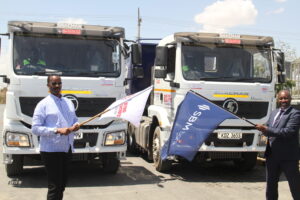
That earlier agreement was signed in Mombasa and introduced financing arrangements covering both Jetour passenger vehicles and FAW commercial vehicles.
Under the July arrangement, eligible customers were offered up to 100% financing for new Jetour SUVs, while qualifying FAW truck buyers could access financing of up to 95%, with repayment periods extending to 72 months.
The partnership brought together Ali Zubedi, Managing Director of TransAfrica Motors, and Kagiso Moloi, Commercial Director at Equity Bank Kenya.
Beatrice Nyambura, Head of Asset Finance at Equity Bank Kenya, was also involved in the commercial vehicle financing initiative.
TransAfrica Motors is an established assembler and distributor of FAW commercial vehicles in Kenya, while Global Motors Centre handles the Jetour passenger vehicle franchise.
The two businesses operate in different vehicle segments but share an interest in developing financing arrangements that support sales to both private customers and commercial operators.
The SBM agreement extends that approach by introducing an additional lender for the Jetour portfolio.
Abdallah Zubedi said the partnership would make new vehicle acquisition more accessible by bringing financing and insurance services into the purchasing process.
“Such partnerships ensure that Kenyans can acquire new vehicles seamlessly, affordably, and fully supported by reliable financing and insurance structures from day one,” he said.
The commercial significance is that customers considering a Jetour purchase now have access to competing financing arrangements through different banks.
For the distributor, multiple financing partners may also improve the likelihood of completing a sale where a customer’s borrowing profile does not satisfy the requirements of one particular lender.
Equity offers 100%. SBM offers 95%. Which is the better deal?
On the published financing percentages, Equity Bank’s earlier Jetour arrangement offers a higher potential loan-to-value ratio than SBM Bank’s newly announced facility.
A customer qualifying for 100% financing could, in principle, acquire a vehicle without contributing an initial deposit toward its purchase price.
Under SBM’s 95% arrangement, the same customer would ordinarily need to contribute at least 5%.
For a vehicle costing KSh5 million, that represents an initial contribution of KSh250,000 under SBM’s advertised structure.
However, the financing percentage alone does not establish which bank offers the more affordable loan.
Interest rates, processing fees, insurance costs, repayment schedules and the method used to calculate interest can materially affect the total amount paid over the financing period.
A loan covering 100% of the purchase price may require less initial capital but leave the borrower financing a larger principal amount.
Conversely, a 95% facility could prove less expensive over its lifetime if it carries a sufficiently lower interest rate or more favorable charges.
Neither partnership announcement provides enough information to make a definitive comparison of the total borrowing costs for an identical Jetour model.
The advertised maximum financing percentages also remain subject to individual credit approval.
For prospective customers, the meaningful comparison is therefore not simply between 95% and 100% financing, but between the total repayment obligations under the two facilities.
Chinese vehicle distributors turn to bank financing
The Jetour agreements illustrate how financing is becoming an important competitive instrument for Chinese automotive brands entering the Kenyan market.
For decades, Kenya’s new vehicle market has been dominated by Japanese and European manufacturers supported by established dealership networks, aftersales operations and relationships with financial institutions.
Chinese manufacturers are increasingly competing in passenger vehicles, pickups, trucks, buses and electric mobility.
Their distributors must address not only vehicle pricing and specifications but also the practical considerations influencing purchasing decisions.
These include access to credit, spare parts availability, maintenance support, warranties and the expected resale value of vehicles.
For lenders, financing a relatively new automotive brand requires an assessment of the vehicle’s value as collateral, the strength of the distributor’s aftersales network and the likely resale market should the borrower default.
A vehicle with a well-established secondary market may be easier for a bank to value and recover than one whose long-term resale performance remains uncertain.
The willingness of multiple banks to offer high loan-to-value financing for Jetour vehicles is therefore commercially significant.
It indicates that the distributor has secured financing relationships capable of supporting sales without requiring buyers to provide the substantial initial deposits sometimes associated with vehicle acquisition.
However, the agreements do not, by themselves, establish how many Jetour vehicles have been financed, the default experience of borrowers or the residual values achieved in Kenya’s used vehicle market.
Those measures will become more important as the brand’s local vehicle population grows.
Jetour’s position in Kenya
Jetour is a Chinese automotive brand associated with the Chery automotive group, with a product range concentrated on sport utility vehicles.
Its Kenyan portfolio includes the Dashing, X70 Plus, T1 and T2, giving Global Motors Centre models positioned across different SUV categories.
The Dashing and X70 Plus address customers seeking family and everyday passenger vehicles, while the T1 and T2 adopt more rugged SUV styling.
The brand competes in a market where buyers increasingly compare equipment levels, vehicle size, warranty coverage and purchase prices across manufacturers.
Financing arrangements can influence those comparisons by changing the amount of money required at acquisition and the monthly repayment burden.
For corporate customers, the decision is more complex.
Businesses purchasing vehicles for management transport, field operations or other company duties must consider fuel consumption, maintenance costs, downtime, insurance and disposal values alongside financing terms.
A lower deposit may improve immediate cash flow without necessarily reducing the total cost of operating the vehicle.
That distinction becomes particularly important when companies acquire several vehicles under a single financing arrangement.
A changing relationship between banks and vehicle distributors
The two Jetour financing agreements also demonstrate how vehicle distributors are using banking partnerships to support market expansion.
Rather than leaving customers to arrange credit independently after selecting a vehicle, distributors increasingly seek arrangements that connect vehicle selection, financing and insurance within the same purchasing process.
This can shorten the time between a customer’s initial inquiry and delivery, provided the financing application is approved.
For banks, such partnerships provide access to customers already considering the acquisition of a specific asset.
The distributor supplies the vehicle and supporting documentation, while the bank evaluates the borrower’s repayment capacity and provides the financing.
The arrangement can benefit both parties without necessarily involving exclusive financing rights.
There is no indication that the SBM agreement replaces the earlier Equity Bank partnership.
Instead, Global Motors Centre appears to be developing a wider network of financial institutions supporting its vehicle sales.
This is consistent with a distribution strategy in which access to credit becomes part of the commercial offering alongside vehicle specifications, warranties and aftersales services.