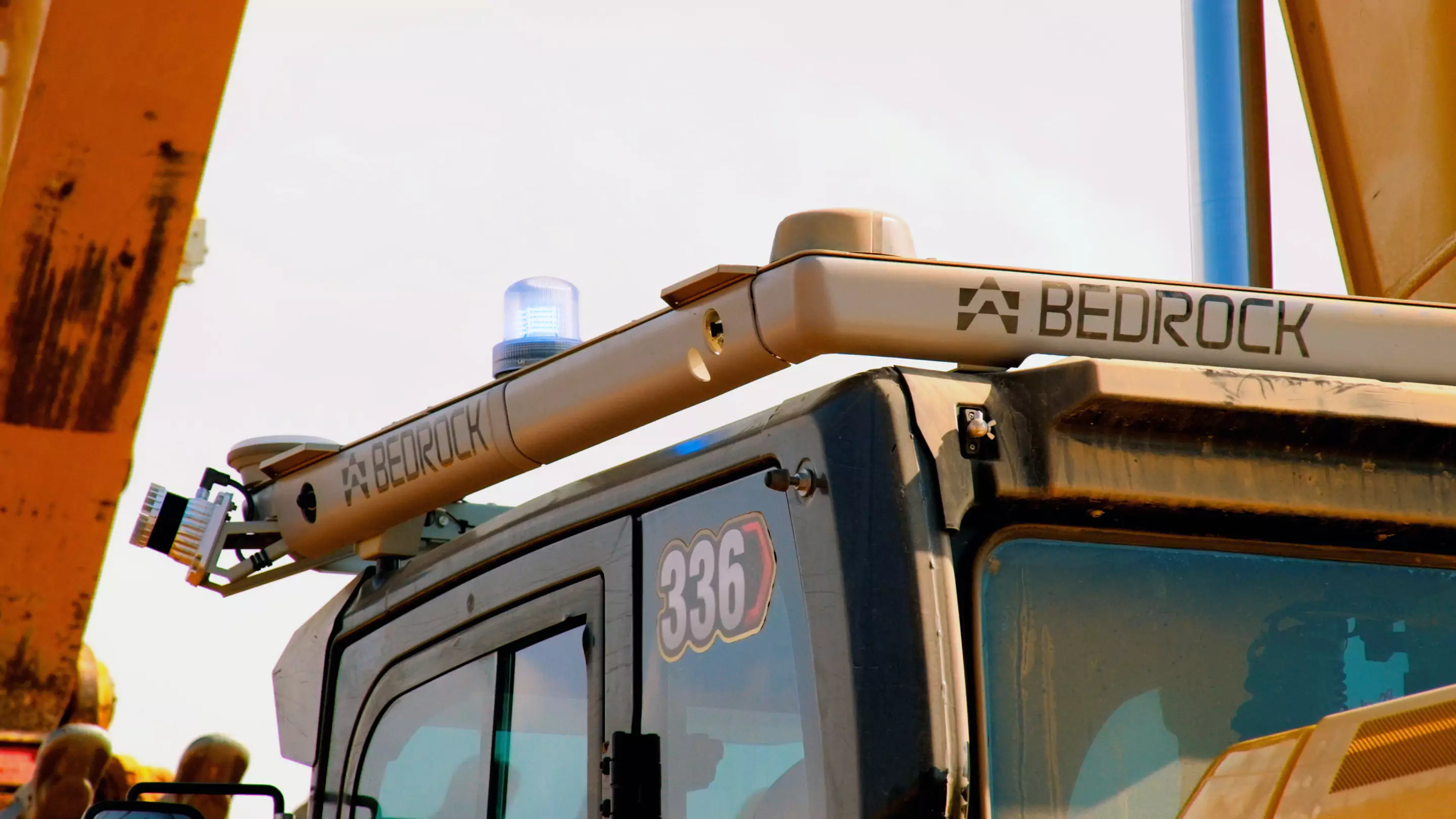
Bedrock Robotics has raised US$600 million in Series C financing at a US$4.1 billion valuation, accelerating the commercial deployment of autonomous construction equipment following the introduction of driverless excavators on active infrastructure projects in the United States.
The investment, announced on 26 October 2026, was co-led by CapitalG and Emergence Capital, with participation from new investors US Innovative Technology Fund, Bessemer Venture Partners and Temasek.
Existing investors, including NVIDIA, 8VC, Georgian, Valor Equity Partners, Xora, Eclipse and Perry Creek Capital, also participated in the financing.
The latest round brings Bedrock’s cumulative funding to nearly US$1 billion since its establishment in 2024. The company’s valuation has more than doubled from US$1.75 billion in February 2026, when it raised US$270 million in Series B financing.
The investment follows Bedrock’s transition from supervised testing to commercial autonomous excavation in August, when excavators equipped with its technology began undertaking paid earthmoving operations on active construction sites.
Founded by engineers with backgrounds in autonomous driving and robotics, Bedrock develops systems that allow existing construction machinery to operate without an onboard driver.
Its initial commercial product, Bedrock Operator, is a retrofit system incorporating sensors, onboard computing and artificial intelligence software. The technology enables excavators to perceive their surroundings, plan movements and execute assigned excavation tasks autonomously.
Unlike equipment manufacturers developing purpose-built autonomous machines, Bedrock’s system can be installed on existing excavators without permanent mechanical modifications.
The company says installation can be completed within a day, allowing contractors to introduce autonomous capabilities without immediately replacing their existing equipment fleets.
Autonomous excavators enter commercial construction
Bedrock’s first commercial deployments began in August 2026, following approximately a year of supervised testing on active construction sites.
The initial projects included a water treatment facility in Nevada undertaken with Sundt Construction, a large earthmoving operation in Texas involving Champion Site Prep, and a 1.2 million-cubic-yard civil construction project with Zachry Construction Corporation.
These deployments established the company’s ability to undertake excavation work on operational construction sites rather than in controlled demonstration environments.
Bedrock’s technology allows a site manager to establish the initial work plan, after which the machine uses its onboard systems to perform assigned excavation operations.
The company says its excavators can operate alongside conventional machinery and construction personnel without requiring the entire worksite to be isolated.
Its safety system is designed to stop the excavator automatically when a person or unauthorized object enters a designated proximity zone.
The commercial deployments remain an early test of how autonomous equipment performs across different construction environments, particularly where terrain, site conditions, equipment movements and work schedules change frequently.
For contractors, the principal commercial considerations include machine utilization, operating costs, project scheduling and the availability of experienced equipment operators.
Excavators are among the most widely deployed machines in civil construction, with applications spanning earthmoving, trenching, foundations, road construction and infrastructure development.
Their utilization frequently determines the progress of subsequent construction activities, particularly on projects requiring extensive ground preparation.
Haydon joins expanding contractor network
Bedrock’s latest commercial expansion includes a partnership with Haydon, an employee-owned construction company headquartered in Tempe, Arizona.
Haydon is deploying Bedrock-equipped machinery on a remote construction site in Texas, where the technology will support autonomous earthmoving operations.
The contractor intends to evaluate further applications across building and heavy civil projects, including advanced manufacturing facilities, transportation infrastructure, water and wastewater projects, data centres and healthcare facilities.
The partnership also provides for testing more advanced excavation activities, including trenching and the automation of larger machine models.
Katie Haydon, the company’s chief executive officer and chair, said the technology could improve site productivity while reducing pressure on existing construction crews.
“For us, the biggest win is a safer, more predictable job site,” Haydon said.
She added that autonomous equipment could allow experienced employees to accomplish more during regular working hours while improving operational safety.
Bedrock has also expanded its contractor relationships to include Wagner Construction in Minnesota, Smith Trucking Company in Florida, B&S Site Development in Virginia, Native Excavating in Colorado, Clarkson Construction in Missouri and C.W. Matthews in Georgia.
Selected projects involving ArchKey Solutions in Arkansas are also among its newly announced commercial engagements.
The company says its customer base has more than doubled since 2025, although it has not disclosed the total number of machines operating commercially or the revenue generated from its autonomous excavation services.
Former Waymo engineers lead development
Bedrock was founded in 2024 by a team whose experience includes autonomous vehicle development at Waymo, the self-driving technology company owned by Alphabet.
Its co-founder and chief executive officer, Boris Sofman, previously led Waymo’s autonomous trucking programme and earlier co-founded Anki, a consumer robotics company.
Chief Technology Officer Kevin Peterson and Vice President of Engineering Ajay Gummalla also previously worked at Waymo.
Another co-founder, Tom Eliaz, serves as Vice President of Engineering, bringing software engineering experience from companies including Segment and Twilio.
The founders have applied technologies developed for autonomous road vehicles to the operating conditions of construction equipment, where machines must undertake complex physical tasks in changing environments.
Bedrock’s approach combines machine perception, motion planning and equipment control, allowing the system to respond to obstacles and other conditions encountered during excavation.
The company is also expanding its operational leadership as it prepares for larger commercial deployments.
Amy Jones Satrom has joined as Vice President of Operations, bringing experience from Amazon, Nuro and Uber.
Lando Juarez has been appointed General Counsel after serving as Head of Legal for Uber’s Autonomous Mobility and Delivery business.
The appointments reflect the operational requirements of deploying autonomous machinery across multiple contractors, equipment fleets and construction sites.
Boris Sofman said the company’s immediate priority is to establish autonomous excavation as a dependable commercial service.
“We have proven that fully autonomous excavators can perform real work of value alongside the crews and workflows already in place on job sites,” he said.
“The next challenge is delivering that capability to more contractors as a dependable part of how projects get built.”
A new market for construction equipment autonomy
The emergence of retrofit autonomous equipment introduces another approach to construction machinery automation, alongside systems developed directly by established equipment manufacturers.
Manufacturers including Caterpillar, Komatsu and Volvo Construction Equipment have invested in autonomous and remotely operated machinery, particularly for mining, quarrying and selected construction applications.
Bedrock’s technology differs in its emphasis on adapting machinery already operating within contractors’ fleets.
That distinction could become commercially important for companies managing mixed fleets of equipment from different manufacturers.
Construction contractors typically acquire machinery through outright purchases, equipment financing, leasing and rental arrangements, often retaining machines for several years.
A retrofit system potentially allows fleet operators to introduce autonomous functionality during an existing machine’s operating life, although its commercial attractiveness will depend on installation costs, compatibility, maintenance requirements and the productivity achieved in service.
Bedrock has not publicly disclosed the commercial pricing of its retrofit technology or detailed comparative operating-cost data from its initial deployments.
The company also has not established whether its autonomous systems can be deployed economically across all excavator classes or equipment brands.
Its longer-term development programme extends beyond excavators to bulldozers, wheel loaders and dump trucks.
The objective is to develop systems capable of coordinating different categories of construction equipment across the same worksite, allowing machines to undertake complementary tasks with reduced direct human intervention.
Those capabilities remain development objectives rather than established commercial operations.
Implications for African construction and mining fleets
Although Bedrock’s current commercial operations are concentrated in the United States, its technology is relevant to equipment-intensive industries across Africa.
Road construction, mining, quarrying, large-scale housing development and industrial infrastructure projects rely heavily on excavators, loaders, bulldozers and earthmoving trucks.
Many contractors operate machinery fleets acquired from multiple manufacturers, creating potential demand for technologies that can be installed without replacing entire equipment inventories.
In mining, autonomous haulage and remotely operated equipment are already established in selected international operations. Construction sites, however, present different challenges because work areas, excavation requirements and interactions between machines and personnel can change frequently.
The application of retrofit autonomy in African markets would depend on equipment compatibility, technical support, operating conditions, financing arrangements and the availability of personnel capable of supervising and maintaining autonomous systems.
There is currently no announced Bedrock commercial deployment in Africa.
The company’s immediate expansion remains focused on the United States, where its new financing will support additional machines, field operations and contractor partnerships.
For construction equipment owners and financiers, the development raises questions about how autonomy will influence machinery productivity, equipment valuations, maintenance contracts and the economic life of existing assets.
Bedrock’s commercial deployments provide an early opportunity to measure those effects in operating conditions, rather than relying exclusively on controlled demonstrations.
The US$600 million investment gives the company substantial resources to expand those deployments while developing the operational systems required to support autonomous machinery across a growing contractor network.