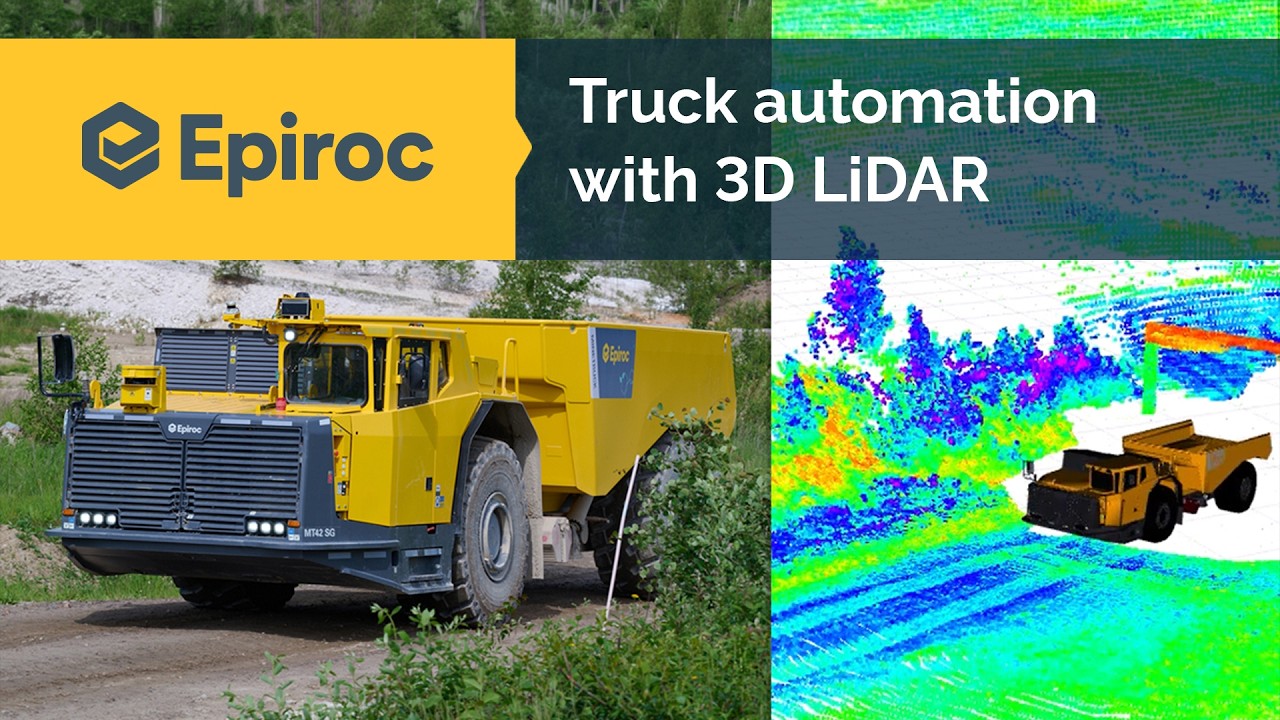
Swedish mining equipment manufacturer Epiroc has developed an autonomous haulage system that allows underground mining trucks to continue operating on the surface without switching to a separate automation platform, addressing a longstanding technical challenge in the automation of mine transport operations.
Announced on 3 September 2026, the development extends Epiroc’s Deep Automation technology beyond underground workings through the integration of three-dimensional light detection and ranging (3D LiDAR), enabling autonomous trucks to navigate, map their surroundings and identify obstacles as they move between underground production areas and surface facilities.
The technology is intended to support continuous automated hauling and dumping cycles, particularly at mines where trucks transport ore or waste material from underground workings to surface discharge points.
Previously, differences between underground and surface operating environments presented considerable difficulties for autonomous navigation. Underground equipment operates within relatively defined tunnels and ramps, while surface conditions introduce changing weather, open spaces and fewer fixed references for vehicle positioning.
Epiroc’s new system addresses these differences through a common navigation and obstacle-detection architecture, allowing trucks to maintain automated operation across both environments.
Johannes Mutamba, Global Product Manager for Deep Automation – Trucks at Epiroc’s Underground division, said the long operating distances associated with mine haulage made trucks a suitable starting point for the technology.
“Trucks are the natural starting point for this technology, given their long operating distances and the fact that their operating cycles often extend from underground production areas to surface dumping locations,” Mutamba said.
He added that the common automation platform could eventually be extended to other types of mining machinery, allowing equipment operating above and below ground to be managed through increasingly integrated systems.
The technology was demonstrated publicly in June 2026 during Epiroc World Expo, where a battery-electric mining truck operated autonomously and detected obstacles placed in its path, stopping automatically to demonstrate its safety functions.
Robert Lundh, Automation Specialist at Epiroc’s Underground division, explained that the transition from conventional two-dimensional sensing to 3D LiDAR had improved the system’s ability to interpret different operating environments.
“Surface environments present unique challenges compared to underground operations due to fewer positioning references and changing weather conditions,” Lundh said.
The development builds on earlier improvements to Deep Automation, including three-dimensional visualization of underground ramps and automated traffic coordination across multiple mine levels.
In January 2026, Epiroc reported progress from trials at Agnico Eagle’s Odyssey mine in Canada, where Deep Automation was being developed to coordinate autonomous trucks operating on complex underground ramps. The system allows vehicles to manage meeting and passing arrangements at designated locations, reducing the risk of congestion in narrow mine passages.
Ghislain Couture, Superintendent of Automation at Odyssey mine, said the trials had demonstrated progress towards more efficient and safer autonomous underground haulage operations.
Epiroc has also expanded automation compatibility across its underground equipment range, including the Minetruck MT54 S and MT65 S, while developing related capabilities for Scooptram underground loaders.
For African mining operators, the technology offers a potential means of extending autonomous haulage beyond underground production areas without requiring separate vehicle-control systems for surface operations. This could be particularly relevant at deep-level mines where material must travel considerable distances through underground ramps before reaching surface handling facilities.
However, Epiroc has not announced a completed commercial deployment of the new underground-to-surface capability at an African mine, nor has it disclosed a fleet-wide productivity improvement, installation cost or confirmed timetable for international commercial rollout.
The company has demonstrated the technology’s ability to operate across both environments, but the available announcements do not establish that manual intervention has been eliminated at every mine entrance or that the system has received unrestricted approval for all operating conditions.
Commercial adoption will also depend on mine-specific safety assessments, communications infrastructure, equipment compatibility and integration with existing traffic management systems.
Epiroc’s technical specifications indicate that Deep Automation can operate over suitably configured Wi-Fi, LTE/4G and 5G networks, provided mines maintain the communications coverage, network capacity and safety controls required for autonomous operations.