Special Report: Automated Haulage Systems and the Future of Mining
How Zambia Became the Testing Ground for Mining's Biggest Battery
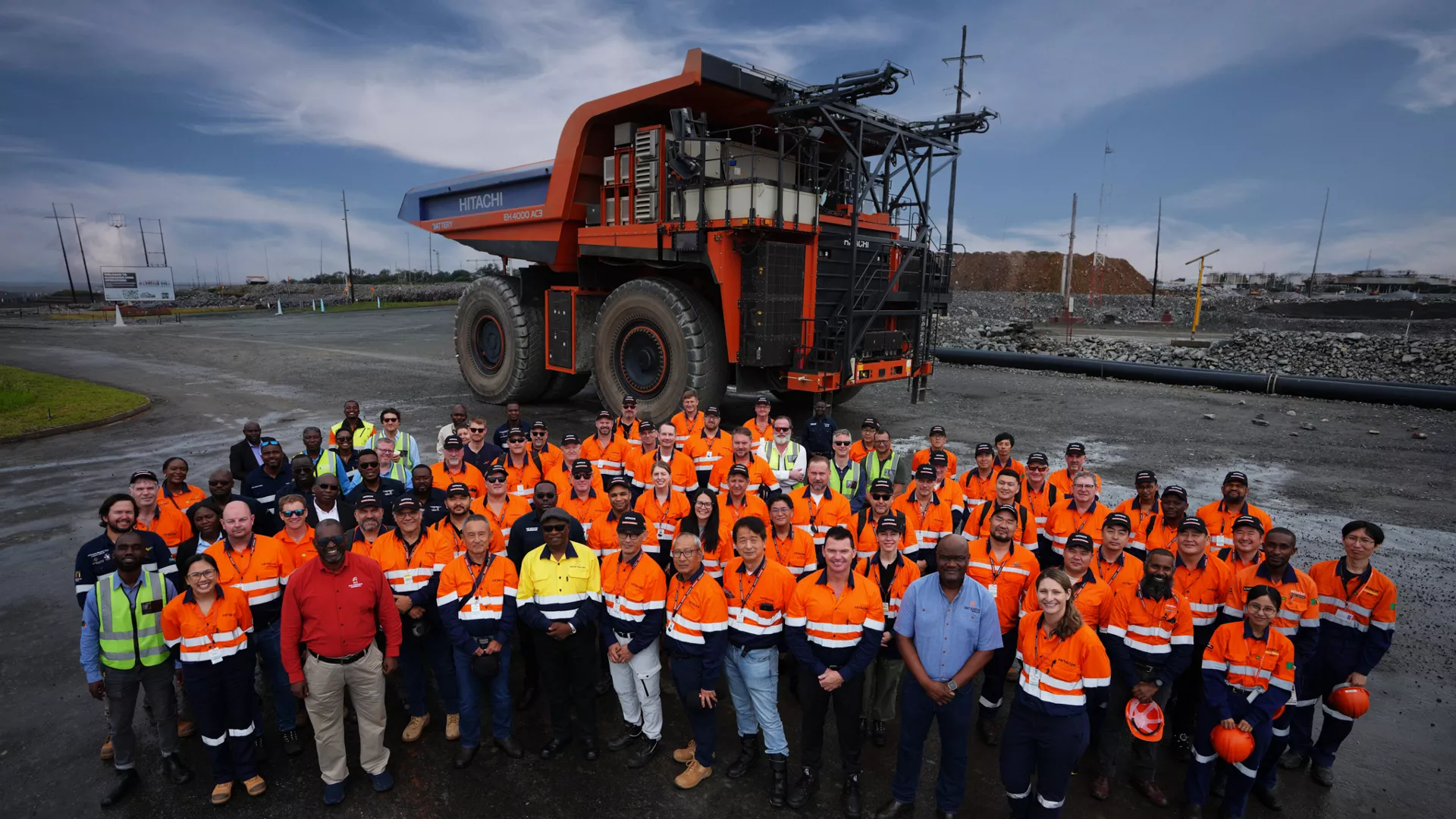
On April 16, 2026, at First Quantum Minerals' Kansanshi copper and gold mine in Zambia's North Western Province, a truck the size of a house rolled forward without a single drop of diesel in its tank. The Hitachi EH4000 AC3, commissioned that day in front of Zambian government officials, mining executives, and journalists, is by both companies' own account the largest battery electric vehicle on the planet.
It carries a 220 tonne payload, identical to the diesel electric version already running at Kansanshi, but where that truck has an engine worth upwards of half a million dollars sitting under its hood, this one has nothing but a bank of batteries and a cooling system. There is no engine at all.
Why Zambia, and why this mine specifically
The choice of Kansanshi was not incidental. First Quantum has run trolley assist infrastructure at the mine since 2012, overhead electric lines that conventional diesel electric trucks can draw power from while climbing loaded, and that existing network gave Hitachi a place to actually test full battery operation rather than building charging infrastructure from nothing. Ray Kitic, vice president of Hitachi's Mining Business Unit, pointed to something else about the country specifically: its electricity supply. Zambia draws the large majority of its power from hydroelectric generation, a proportion various companies involved put between 85 and 92 percent depending on the year and the source, which meant a battery truck charging from the Zambian grid was drawing genuinely clean power rather than simply moving emissions from the truck's exhaust pipe to a diesel or coal fired power station somewhere else. Gordon White, First Quantum's director of mining operations and technology, described the fit in blunt terms: "Our extensive trolley line infrastructure and Zambia's renewable energy provided an optimal environment for validating this groundbreaking technology."
The trial that led to the April commissioning ran quietly for well over a year before anyone outside the companies involved heard much about it. Between June 2024 and August 2025, the Full Battery Dump Truck, as Hitachi called it during that phase, covered more than 4,000 kilometres of haul road and moved over 30,000 tonnes of material at Kansanshi, all while producing zero carbon dioxide emissions during operation. Hitachi reported the truck also showed improved acceleration and noticeably reduced noise compared with its diesel electric sibling, a detail that matters more than it might seem to on paper, since noise and vibration exposure are a real, measurable occupational health issue for operators running heavy haul trucks for entire shifts.
What the diesel comparison actually looks like
The scale of the fuel problem this technology is aimed at is easy to state and genuinely hard to grasp without a number attached to it. A conventional diesel haul truck climbing a ten percent gradient while hauling a full load can burn upward of 400 litres of fuel an hour. Put a diesel electric truck on trolley assist for that same climb and consumption drops to around 80 litres an hour, a fivefold reduction simply from drawing grid power instead of burning diesel while under load. A full battery truck takes that same logic to its endpoint: no diesel consumption during operation at all, only the electricity drawn from the grid or the overhead line to charge and run it.
That comparison is the real commercial case for the technology, more than the emissions headline. Diesel is expensive to buy, expensive and logistically difficult to transport to remote mine sites, and its price is volatile in a way electricity from a domestic hydropower grid generally is not. A mine that can shift even a portion of its haul fleet off diesel entirely, rather than merely improving its efficiency, is insulating a meaningful part of its operating cost structure from a fuel market it has no control over.
The showcase, and who actually showed up
Hitachi did not simply announce the milestone in a press release and move on. On April 15, the day before commissioning, the company hosted what it called the Battery Truck and Electrification Showcase at Kansanshi, bringing together close to 30 mining customers from roughly 25 companies, some travelling from as far as Canada, Finland, and Mongolia, to watch the truck operate and charge under the overhead trolley lines and to climb aboard and inspect it while stationary. That guest list is itself informative. Companies do not send representatives across three continents to look at a single truck unless they consider the underlying technology a serious near term procurement question rather than a research curiosity.
First Quantum's chief executive, Tristan Pascall, framed the achievement as a story about collaboration as much as engineering, crediting the alignment of the mining company, the equipment manufacturer, and the Zambian government itself. Zambia's Ministry of Mines and Minerals Development sent its permanent secretary, Dr Hapenga Kabeta, to the commissioning, where he described the milestone as an important marker for the country's mining sector, a government endorsement that carries weight beyond the ceremony itself, since regulatory and policy support is often the deciding factor in whether a mining technology trial becomes a genuine commercial rollout in a given jurisdiction or stalls indefinitely.
There is a workforce dimension to the Kansanshi story that rarely makes it into coverage of the technology itself but matters directly to the African mining audience this briefing is written for. Approximately 96 percent of First Quantum's workforce in Zambia is made up of Zambian citizens, a figure that extends to senior management roles at the operation, not only the shop floor. A trial of genuinely new mining technology, in other words, was run predominantly by a local workforce rather than imported foreign specialists, which speaks directly to the kind of technical capacity building that gets discussed constantly at industry conferences and far less often gets demonstrated this concretely on an active production site.
Where the technology goes next
Hitachi has been explicit that April's commissioning was a milestone on a path toward commercial deployment rather than the finish line itself. The company has targeted its fiscal year 2027, meaning by the end of March 2028 on Hitachi's accounting calendar, for full commercialization of the Full Battery Dump Truck. The showcase also gave attending customers a look at the wider Hitachi mining equipment lineup running alongside the battery truck at Kansanshi, including the EX5600 electric excavator and the diesel variant EH4000AC-3 trolley truck, underscoring that the company's approach is not a single flagship product but a broader family of electrified equipment aimed at different parts of a mine's fleet.
A different kind of automation story from Botswana
Not every part of Hitachi's African strategy looks like Kansanshi, and that is arguably the more useful lesson for mine managers elsewhere on the continent. At Investing in African Mining Indaba in Cape Town in February 2026, Hitachi Construction Machinery Africa laid out a version of the automation conversation built around a completely different problem. Rather than full electrification, the company used its Botswana presence to promote remote operated excavators and dig assist technologies, aimed specifically at a shortage of skilled operators in the country rather than at fuel costs or emissions. Kohei Mino, the company's mining equipment sales representative, was direct about the underlying logic: automation and remote operation there are being used to help less experienced operators work productively and safely, not to remove operators from the equation altogether.
Set side by side, Zambia and Botswana show two entirely different starting points for the same underlying question, what does automation actually solve here. In Zambia, the answer was a fuel cost and emissions problem, addressed with the largest battery electric mining truck ever built, tested against a genuinely favourable hydropower grid that most countries cannot match. In Botswana, the answer was a skills and staffing problem, addressed with remote operation technology that helps a less experienced workforce run equipment safely rather than replacing that workforce with something autonomous. Neither approach required copying the giant, fully autonomous haul fleets running in the Pilbara or the Atacama. Both started from the specific constraint the local operation actually faced and built toward a solution sized to that constraint.
What this means for mine managers elsewhere on the continent
The Kansanshi story in particular offers a template that is unusually well suited to African conditions rather than borrowed wholesale from a wealthier mining jurisdiction. The single biggest variable determining whether battery electric haulage makes economic sense at a given mine is the cost and cleanliness of the electricity available to charge it, and Zambia's hydropower dominant grid happens to be close to the best case scenario a mine could hope for on that front. Not every African mining jurisdiction shares that advantage, grid reliability and generation mix vary enormously across the continent, but the underlying question, what does our own electricity supply actually cost and where does it come from, is one every mine evaluating this technology needs an honest answer to before assuming the Zambian result will translate directly to their own site.
The trolley assist infrastructure question matters just as much. First Quantum's battery truck trial worked in large part because the mine had already invested in overhead electric line infrastructure back in 2012, long before anyone was discussing full battery haulage. A mine without that existing infrastructure faces a materially different, and more expensive, starting point for evaluating the same technology. For financiers and mine managers modelling a future electrification decision, the Kansanshi case is less a guarantee that battery haulage will work at any given African site and more a demonstration of exactly which underlying conditions, cheap clean grid power, existing electrical infrastructure, and a government willing to publicly back the trial, need to already be in place before it does.