





As mining companies face mounting operational complexity and increasing pressure to reduce greenhouse gas emissions, Hitachi Construction Machinery (HCM), which will rebrand as LANDCROS in April 2027, is accelerating its investment in low carbon haulage technologies. The company believes that decarbonizing large mining trucks will be central to the future of sustainable mining and is pursuing this through a combination of digital technologies and engineering innovation.
HCM’s roadmap includes the commercial launch of fully battery powered mining dump trucks during the 2027 financial year, ending in April 2028. At the same time, it is advancing hybrid mining trucks, with commercial deployment targeted for the 2030 financial year, ending in April 2031. Once field validation is complete, the company intends to roll out the hybrid platform across mining operations globally.
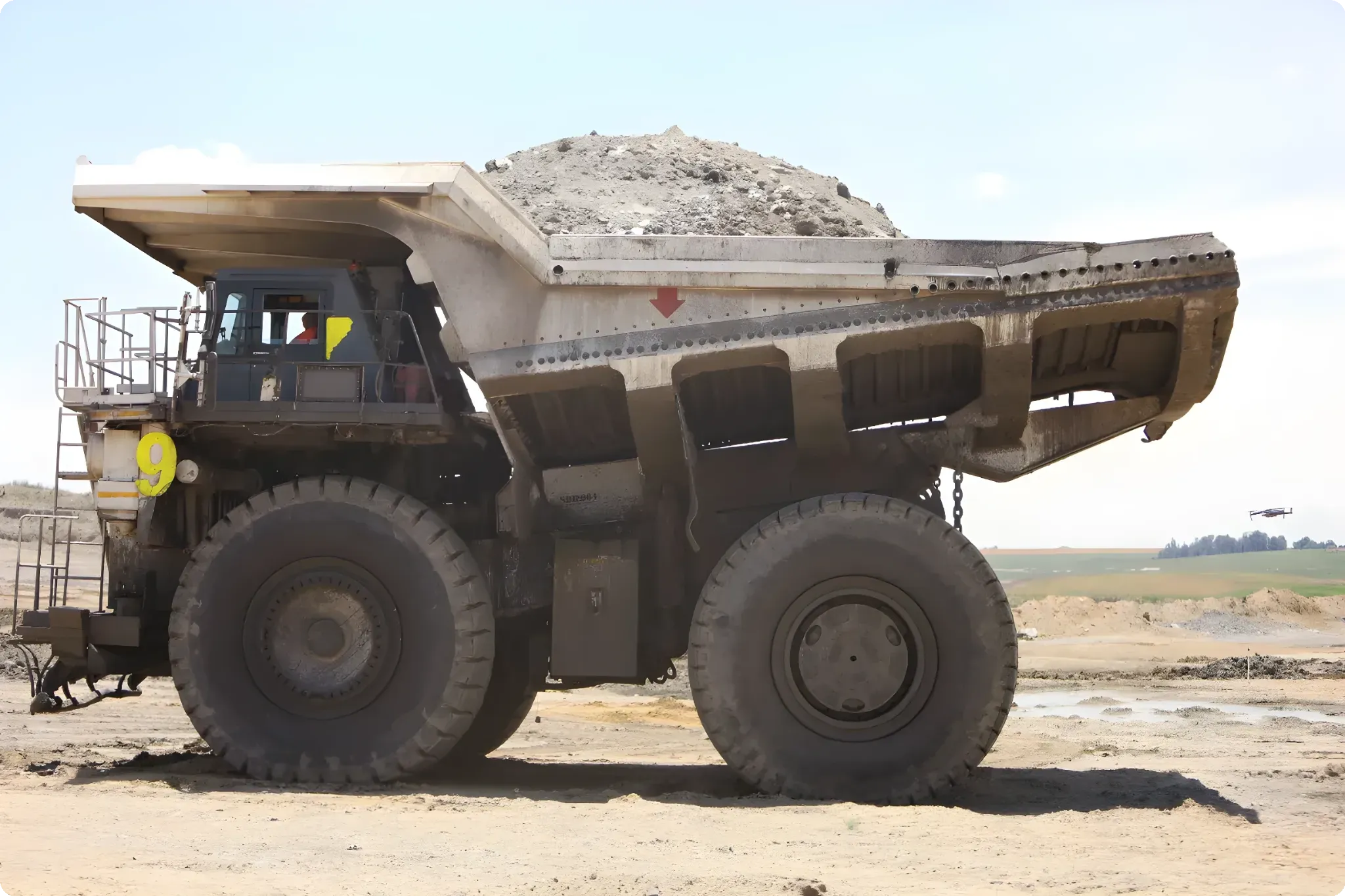
The hybrid concept centres on retrofitting the proven EH4000AC-3 haul truck. Engineers will integrate a battery energy storage system, charging and discharging controls, and modifications to the truck’s AC drive system before commencing extensive field trials at a South African mine. The hybrid system captures energy generated during braking through regenerative technology and stores it in onboard batteries. This recovered energy supplements electricity generated by the diesel engine, improving energy efficiency while lowering diesel consumption and reducing carbon emissions.
To support the demonstration programme, HCM will also train maintenance technicians from South Africa and other Southern African countries in servicing hybrid mining trucks. Beyond technical support, the project is intended to strengthen local engineering capability through skills transfer and workforce development.
According to the company, the technology has the potential to cut both fuel consumption and emissions by more than 10 percent. A conventional mining truck operating approximately 20 hours a day for 350 days each year typically consumes around 1.2 million litres of diesel and produces about 3,000 tonnes of carbon dioxide annually. The hybrid configuration is expected to reduce annual diesel use to roughly one million litres while lowering emissions to about 2,500 tonnes. When operated using hydrotreated vegetable oil (HVO), theoretical carbon dioxide reductions could reach as much as 90 percent.
Development of the prototype began in November 2025 at Hitachinaka Rinko Works in Japan. The company aims to begin technology validation at a South African mine by October 2027 before progressing toward commercial deployment in 2030. Exxaro Resources has confirmed that its Grootegeluk coal mine in Limpopo Province will host the pilot project.
The partnership builds on a long standing relationship between HCM and Exxaro, whose mining fleet already includes Hitachi haul trucks. Similar to the battery electric truck trial undertaken with First Quantum Minerals at the Kansanshi copper mine in Zambia, the collaboration provides HCM with an experienced customer and a large scale operating environment for testing. Grootegeluk offers an ideal proving ground because of its extensive mining footprint and Exxaro’s strong commitment to reducing operational emissions. The mine has already demonstrated significant progress in sustainability, including commissioning the 68 MW Lephalale Solar Plant in December 2025, the company’s first self generated renewable energy project.
Grootegeluk is one of South Africa’s most strategically important coal operations, supplying between 20 and 25 percent of the country’s electricity generating fuel. During the 2025 financial year, the mine delivered 21.4 million tonnes of thermal coal to Eskom’s Matimba and Medupi power stations through its conveyor system, with annual capacity exceeding 25 million tonnes.
Its haulage fleet currently consists of 88 diesel electric trucks, including older Hitachi Euclid EH3500 and EH4500 models, newer Hitachi EH4000AC-3 units, and Komatsu 730E trucks. More recently, Exxaro expanded the fleet with seven Komatsu 830E-5 haul trucks, three additional Hitachi EH4000AC-3 trucks and seven XCMG XDE260 mining trucks, increasing the fleet to more than 100 units.
The mine also retains operational trolley assist infrastructure on its primary haul roads, although significant opportunities remain to improve fuel efficiency during sections where trucks operate independently of the trolley system. Since the EH4000AC-3 serves as the base platform for the hybrid conversion, the existing fleet presents considerable potential for future retrofitting should the demonstration programme prove successful.
The project is being jointly developed by Hitachi Construction Machinery and Hitachi Industrial Products, the manufacturer of the AC drive system, with support from the United Nations Industrial Development Organization (UNIDO). The field trial at Grootegeluk will evaluate vehicle performance under real mining conditions, battery durability, energy recovery efficiency, fuel savings and maintenance requirements while simultaneously providing practical training for mine personnel.
UNIDO notes that successful mining decarbonization requires more than simply introducing new zero emission equipment. Existing mining fleets typically remain in service for decades, making rapid wholesale replacement both financially and operationally unrealistic. Retrofitting existing trucks with hybrid technology therefore provides an effective pathway to reducing emissions while extending the useful life of current assets.
The organization also highlights the practical challenges associated with full battery electric mining trucks. Large scale electrification demands reliable electrical supply, substantial charging infrastructure and careful consideration of mine layout, haul distances, payloads, charging cycles, battery weight, durability and overall operating costs. Hybrid trucks offer an immediate and practical alternative by reducing fuel consumption and emissions without fundamentally changing current mining operations or sacrificing productivity.
A member of the HCM project team said retrofitting hybrid technology allows mining companies to improve environmental performance while continuing to utilize existing equipment, making the solution particularly attractive for operations constrained by capital expenditure or infrastructure limitations.
Tetsuya Hamabe, Vice President and Executive Officer at Hitachi Construction Machinery, believes hybrid technology will play a pivotal role in the industry’s transition toward zero emissions.
“Decarbonization is a mission the mining industry must accomplish. We see hybrid technology as an important bridge toward full electrification. Just as the automotive sector has renewed its focus on hybrid vehicles, mining will benefit from a phased approach where hybrid haul trucks provide meaningful emissions reductions while preparing for the future.”
HCM also aims to become the first original equipment manufacturer to commercialize hybrid mining dump trucks. While several competing solutions are under development, including initiatives involving Cummins First Mode, FLANDERS working with Thiess, United Mining and Rolls Royce Power Solutions, none are currently being led directly by a major mining truck OEM in the same manner.
The company emphasizes that there is no universal pathway to mining decarbonization. Instead, operators will require a combination of technologies, including battery electric trucks, trolley assist systems, renewable energy, hybrid drivetrains and digital optimization, with each solution selected according to the specific operating conditions, infrastructure and energy availability at individual mine sites.