
And more importantly, will they have one in the future?
The concern about the resale value of Chinese vehicles is legitimate. FirstRand’s 2026 financial results show WesBank increasing provisions against the risk that new, lower priced entrants could depress used vehicle prices in South Africa. But perhaps the industry is approaching the question of resale value using a framework that is becoming increasingly outdated.
For decades, the economics of vehicle ownership have rested heavily on residual value. Buyers, financiers and leasing companies have treated the price a vehicle commands at disposal as a principal measure of its economic worth. That assumption is now being challenged by four developments.
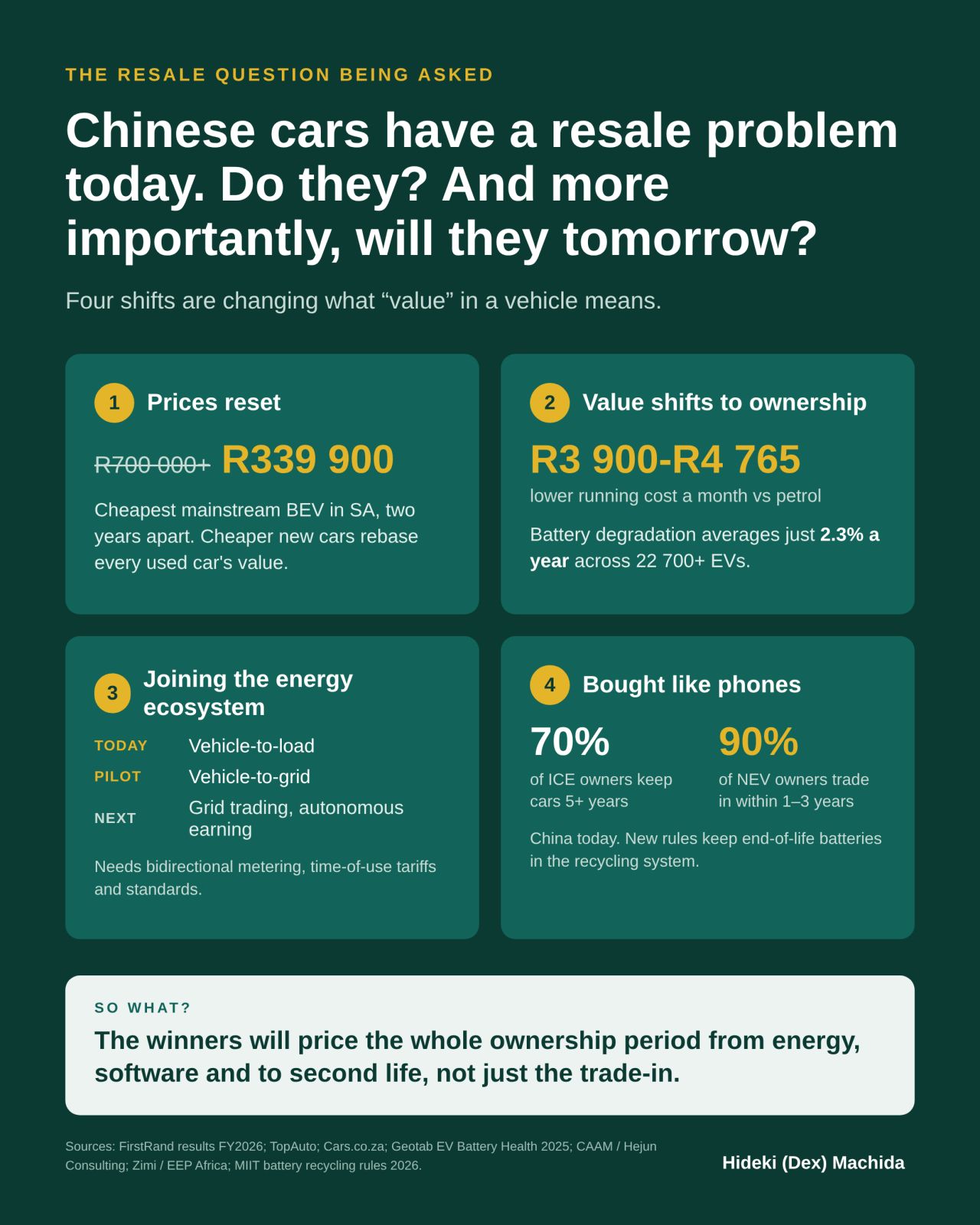
First, Chinese manufacturers are resetting vehicle prices across the market. Two years ago, South Africa’s cheapest mainstream battery electric vehicles cost considerably more than R700,000. Today, the Geely E2 starts at R339,900. Where Chinese manufacturers compete directly with established brands, used vehicle prices are coming under pressure, even as the broader used vehicle market grows. Legacy manufacturers are also responding with price reductions.
This is not exclusively a Chinese vehicle resale problem. When the price of a new vehicle falls substantially, the economic justification for paying yesterday’s price for a comparable used vehicle weakens. The entire market is being repriced, including consumer expectations.
Second, the economic value of a vehicle is increasingly shifting from what an owner recovers at disposal to what the vehicle costs to operate throughout its useful life.
One South African estimate places the monthly running cost advantage of an electric vehicle over a comparable petrol vehicle at between R3,900 and R4,765. Meanwhile, research covering more than 22,700 electric vehicles reports average annual battery degradation of approximately 2.3%.
These developments complicate conventional residual value calculations. A vehicle that saves its owner substantial amounts in energy and maintenance costs may deliver greater economic value over its ownership period, even if its eventual resale price is lower.
Third, the vehicle is gradually becoming part of the wider energy economy.
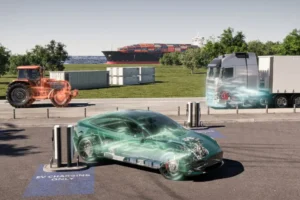
Vehicle to load technology is already available on models such as the Geely E2, allowing owners to use their vehicles as mobile sources of electricity. South Africa has also begun exploring commercial scale vehicle to grid applications.
The longer term possibilities are considerable. Vehicles could eventually trade electricity with the grid, while advances in autonomous mobility may create opportunities to generate income from vehicles that would otherwise remain parked.
These possibilities are not yet established sources of income for ordinary motorists. Bidirectional metering, appropriate electricity tariffs, technical standards and regulatory arrangements must develop before they become commercially meaningful. Nevertheless, they point towards a future in which a vehicle’s economic value extends beyond transportation and resale.
Fourth, vehicle ownership cycles are changing.
In China, estimates suggest that approximately 70% of internal combustion engine vehicle owners retain their cars for more than five years, while as many as 90% of new energy vehicle owners replace theirs within one to three years.
This resembles the replacement cycle of consumer electronics more than the traditional economics of vehicle ownership.
As Chinese manufacturers increasingly influence global automotive product development, pricing and technology cycles, these purchasing patterns could spread into other markets.
The implications for the used vehicle industry are substantial. Faster replacement cycles could increase the supply of relatively young used vehicles, while technological obsolescence may place additional pressure on older models. Recycling, battery reuse and component recovery will consequently become more important alongside conventional resale and exports to markets such as Africa.
Yet Africa presents an important qualification.
In South Africa, where vehicle financing arrangements frequently extend beyond six years, residual values remain central to affordability, lending risk and the economics of ownership. A vehicle depreciating faster than its outstanding loan balance creates a problem that lower operating costs do not automatically resolve.
The same applies across African markets where used vehicle imports, limited financing options and longer ownership periods make resale value an essential consideration.
The mistake would be to assume that these conditions will remain unchanged.
Chinese manufacturers are not merely introducing cheaper vehicles. They are accelerating changes in pricing, technology, ownership cycles and the relationship between vehicles and energy infrastructure.
The more useful measure of vehicle value may therefore become its total economic contribution throughout ownership, incorporating purchase price, financing, energy consumption, maintenance, software capabilities and eventual recovery or reuse.
Residual value will remain important, particularly in Africa. But it may gradually become one component of a much broader calculation rather than the principal measure of whether a vehicle represents good value.
About the author