
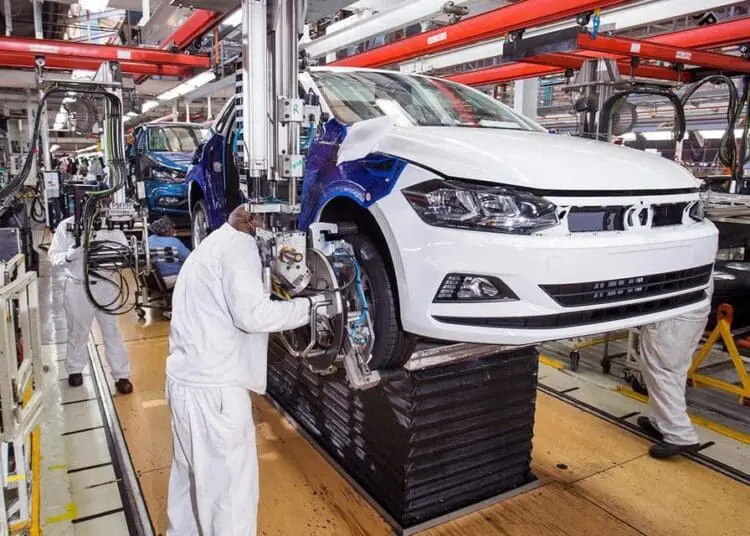
South Africa has announced plans to phase out semi-knocked-down (SKD) vehicle assembly operations and discontinue policy support for new facilities, marking a significant change in the country’s automotive industrial strategy.
The announcement was made on 15 October 2026 by Trade, Industry and Competition Minister Parks Tau, speaking at South African Auto Week in Durban, where he delivered an address on behalf of President Cyril Ramaphosa.
The decision follows sustained pressure from established vehicle manufacturers, including BMW Group South Africa and Toyota South Africa Motors, which have argued that assembling vehicles from largely imported kits creates an uneven competitive environment for companies undertaking more substantial manufacturing operations.
Under the proposed policy direction, existing SKD operations will be phased out, while new facilities will no longer receive government policy support. Medium and heavy commercial vehicles are explicitly excluded from the change.
The government also intends to tighten the legal definition of completely knocked-down (CKD) manufacturing, limiting the ability of companies to qualify for industrial support through relatively limited assembly activities.
The measures form part of an ongoing review of the Automotive Production Development Programme, known as APDP2, which governs incentives and other support for South Africa’s automotive manufacturing industry.
Why South Africa is turning against SKD assembly
At the centre of the policy dispute is the difference between assembling imported vehicles and manufacturing vehicles with substantial domestic industrial participation.
Under SKD arrangements, manufacturers typically import vehicles with major assemblies already completed. Depending on the production configuration, local operations may involve installing wheels, seats, bumpers, electronic systems and other components before final inspection.
These operations can establish a local assembly presence with relatively modest capital investment.
CKD manufacturing generally involves more extensive assembly processes, including body construction, welding, painting, vehicle assembly and quality testing. It can support a much larger domestic supplier network, although CKD production does not automatically guarantee high local content.
For South Africa, the distinction matters because the automotive industry receives government support intended to encourage investment, employment, exports and the development of domestic component manufacturers.
Established manufacturers argue that companies undertaking limited assembly should not receive advantages comparable to those available to businesses investing in more substantial production facilities.
The debate has become particularly important as South Africa faces increasing competition from imported vehicles, including those produced by rapidly expanding Chinese manufacturers.
The government’s concern is that a growing number of relatively inexpensive assembly operations could weaken the commercial case for investing in complete vehicle manufacturing and locally sourced components.
South Africa’s Automotive Master Plan 2035 seeks to increase average local content from approximately 38% to 60%, double automotive industry employment and raise the country’s share of global vehicle production to 1%.
Those objectives require investment extending well beyond final vehicle assembly.
BMW and Toyota executives pressed for reform
Two of the most prominent voices calling for changes to SKD arrangements have been Peter van Binsbergen, Chief Executive Officer of BMW Group South Africa, and Andrew Kirby, Chief Executive Officer of Toyota South Africa Motors.
Van Binsbergen had raised concerns about what he described as an SKD loophole, arguing that certain assemblers were importing vehicle components under tariff classifications that provided advantages unavailable to companies undertaking more extensive manufacturing.
His criticism focused particularly on the treatment of imported engines and other components, which he argued could allow limited assembly operations to achieve very low effective import duties without corresponding commitments to investment and employment.
Kirby similarly argued in July that South Africa’s automotive industry had developed beyond the point where SKD assembly required continued policy support.
Toyota’s position was that the government should strengthen the competitiveness of CKD manufacturing while establishing a more balanced relationship between locally produced vehicles and imports.
These interventions are significant because both companies operate major vehicle manufacturing facilities in South Africa.
BMW manufactures the X3 at its Rosslyn plant in Gauteng, while Toyota produces vehicles including the Hilux, Fortuner and Corolla Cross at its Prospecton manufacturing complex in KwaZulu-Natal.
Their operations support extensive supplier relationships and substantial capital investments, with production serving both domestic and export markets.
The government has now adopted the central direction advocated by these manufacturers, although the precise regulatory changes and transition arrangements remain under development.
BAIC and Mahindra face a different investment environment
The policy change has particular implications for manufacturers that have established South African assembly operations using imported vehicle kits.
Among them are China’s BAIC and India’s Mahindra, both of which have invested in local assembly facilities.
BAIC operates a manufacturing facility in the Coega Special Economic Zone near Gqeberha, established through an investment partnership involving the Industrial Development Corporation of South Africa.
The plant began limited SKD production of the Beijing X55 in January 2024, following construction delays associated partly with the COVID-19 pandemic.
However, BAIC’s circumstances illustrate why the government’s proposed transition may be more complicated than simply distinguishing between manufacturers and assemblers.
In a parliamentary response published in 2026, the Department of Trade, Industry and Competition reported that BAIC had adopted SKD production temporarily because its sales volumes had not reached the threshold required for its intended CKD operations.
The response stated that BAIC had been preparing CKD production lines for the Beijing X55, Beijing B30 and Foton G7 pickup, with the planned start of production in January 2026.
Significantly, the department also reported that BAIC’s interim SKD operations had not benefited from the tax advantages sometimes associated with the assembly method.
This suggests that the government’s concerns about SKD tariff treatment may not apply equally to every operator.
Mahindra faces a comparable strategic decision.
The Indian manufacturer has developed an SKD assembly operation in Durban, including facilities associated with the Dube TradePort Special Economic Zone.
Its locally assembled Pik Up competes in a market dominated by vehicles produced through more extensive manufacturing operations, including the Toyota Hilux, Ford Ranger and Isuzu D-Max.
Mahindra has also examined the feasibility of transitioning toward CKD manufacturing in South Africa.
The government’s announcement increases the importance of that decision. Remaining an SKD assembler may become less attractive as the regulatory environment changes, while moving to CKD production would require greater capital investment, production volumes and supplier development.
Neither BAIC nor Mahindra should automatically be treated as facing plant closure. The government has announced a policy direction, but the detailed transition rules and their application to individual investments remain to be established.
Why medium and heavy commercial vehicles have been exempted
One of the most consequential elements of Tau’s announcement is the exclusion of medium and heavy commercial vehicles.
South Africa has an established truck and bus assembly industry involving manufacturers whose production arrangements differ considerably from those of passenger vehicle producers.
Commercial vehicle assembly often operates at lower volumes, with greater variation in vehicle specifications and more specialized production requirements.
Truck manufacturers may import major vehicle assemblies while sourcing or manufacturing bodies, trailers, specialized equipment and other components locally.
These arrangements can support domestic industrial activity without necessarily following the production model of a high-volume passenger vehicle factory.
Applying the same CKD requirements across passenger cars, pickups, heavy trucks and buses could therefore create unintended consequences for commercial vehicle production.
The exemption preserves a different regulatory approach for medium and heavy commercial vehicles while the government concentrates its reforms on passenger cars and light commercial vehicles.
It also means that the announcement should not be interpreted as a general prohibition on importing vehicle kits into South Africa.
For fleet operators, the distinction is important. The policy does not immediately remove locally assembled heavy trucks or buses from the market, nor does it establish new purchasing restrictions on commercial vehicle fleets.
The longer-term effect on vehicle prices will depend on how the government changes tariffs, production incentives and other industrial support arrangements.
South Africa’s pickup industry faces a separate investigation
Alongside the SKD announcement, Tau disclosed plans for a formal investigation into the competitiveness of South Africa’s ladder-frame light commercial vehicle industry.
This segment includes pickups, commonly known in South Africa as bakkies.
The investigation is particularly important because pickup manufacturing supports some of the country’s largest automotive investments.
Toyota manufactures the Hilux in Durban, Ford produces the Ranger in Silverton, Pretoria, and Isuzu manufactures the D-Max in Gqeberha.
These vehicles are central to South Africa’s domestic commercial vehicle market and its automotive export industry.
They also compete with imported pickups, including models entering the market from China and other Asian manufacturing centres.
Tau said the government had reached agreement that any additional protection for the sector should be accompanied by corresponding commitments from manufacturers.
Those commitments would cover production, localization, employment, transformation, exports and investment.
The minister indicated that he would instruct the International Trade Administration Commission of South Africa (ITAC) to investigate the segment before reaching a final determination.
The significance is that additional protection has not yet been approved.
ITAC must first examine the industry’s circumstances and determine whether changes to trade measures are justified.
Any resulting intervention would also need to balance the interests of established manufacturers, emerging producers, vehicle importers, suppliers and consumers.
For fleet buyers, additional import protection could raise the acquisition cost of some imported pickups. Conversely, measures that sustain domestic production could support vehicle availability, parts supply and the longer-term viability of local manufacturing operations.
The outcome will depend on the actual instruments adopted, rather than the announcement of an investigation alone.
The wider review of automotive incentives
The SKD decision forms part of a broader examination of South Africa’s Automotive Production Development Programme.
The government is working with naamsa | The Automotive Business Council, the National Association of Automotive Component and Allied Manufacturers (NAACAM) and organized labour to review the incentive structure.
The review addresses several longstanding questions about the relationship between production volumes, local content, import duties and industrial investment.
One proposal concerns the ad valorem tax structure. The government is considering adjustments intended to create a clearer distinction between locally manufactured vehicles and imported vehicles.
Another concerns Production Rebate Certificates, which provide duty-related benefits under the automotive incentive framework.
The accumulation and use of these certificates have raised concerns about whether the programme consistently rewards domestic manufacturing and localization.
The government is also considering changes to the Volume Assembly Local Allowance, which supports qualifying vehicle manufacturers based on production and other programme requirements.
These proposals matter because automotive investment decisions are influenced not only by the direct cost of manufacturing but also by the incentives available to offset capital expenditure and import duties.
A manufacturer deciding whether to establish a CKD facility must consider whether anticipated production volumes, market demand and government support can justify investments in assembly equipment, tooling, supplier development and workforce training.
The government has also raised the possibility of time-limited transitional arrangements for existing SKD operators.
Such provisions could allow manufacturers to move toward more substantial production without immediately abandoning investments made under previous policy expectations.
As of 27 October 2026, the government has not publicly established a universal deadline for closing or converting existing SKD operations. Nor has it published a complete schedule of the final tariff and incentive changes arising from the announcement.
The electric vehicle challenge
South Africa’s automotive policy debate is taking place as international vehicle manufacturers accelerate their transition toward electric and hybrid vehicles.
This creates a second challenge for the government.
Protecting established manufacturing operations may preserve employment and investment in the near term, but the country’s export industry must also produce vehicles that remain competitive in markets adopting increasingly stringent emissions requirements.
Europe and the United Kingdom are particularly important destinations for South African vehicle exports.
Tau warned that failure to manufacture vehicles demanded by these markets could threaten both domestic factories and employment.
The government is consequently linking its automotive strategy to the development of new energy vehicles, battery-related industries and the country’s Critical Minerals Beneficiation Strategy.
South Africa possesses mineral resources relevant to automotive and battery supply chains, although converting those resources into competitive industrial production requires investment in processing, manufacturing, technology and infrastructure.
The government has also begun developing an end-of-life vehicle policy, including provisions relevant to battery recycling and reuse.
This creates an additional dimension to the SKD debate.
A manufacturer introducing an electric vehicle through limited assembly may initially contribute less local industrial value than an established CKD producer.
However, emerging technologies and relatively small initial sales volumes can make full-scale local manufacturing difficult to justify.
South Africa will therefore need to determine how new vehicle technologies can enter the market while maintaining incentives for eventual localization.
A policy that requires substantial manufacturing investment from the outset could discourage some new entrants. A policy that indefinitely rewards minimal assembly could undermine the country’s industrial development objectives.
The government’s challenge is to establish a credible transition between those two positions.
What happens next?
The announcement establishes the government’s intended direction, but implementation will depend on several decisions that have yet to be finalized.
First, the government must define CKD manufacturing more precisely. The revised rules will need to distinguish between operations that undertake substantial production and those limited to final assembly. They must also account for differences in production technology, vehicle categories and manufacturing volumes.
Second, existing SKD operators will need a transition framework. Companies that have already invested in facilities, equipment and employment will require clarity on deadlines, qualifying investments and the treatment of existing operations.
Third, ITAC must complete its investigation into ladder-frame light commercial vehicles. Any additional protection for pickup manufacturing will require a separate determination and should be linked to measurable industrial commitments.
Fourth, the APDP2 review must settle the treatment of production rebates, volume allowances and other incentives. These changes will influence the financial attractiveness of both existing factories and future investments.
Finally, South Africa must reconcile its localization objectives with the transition to electric vehicles. The country’s ability to retain export markets will depend increasingly on whether its factories can manufacture the vehicles demanded by international customers.
The industrial question behind the policy
South Africa’s decision represents a shift in how the government intends to evaluate automotive investment.
For years, local assembly has provided an entry point for manufacturers seeking to establish a presence in the South African market without immediately committing to expensive manufacturing facilities.
That approach can create employment, support distribution operations and allow companies to assess demand before expanding production.
But it does not necessarily produce the extensive supplier networks, engineering capabilities and manufacturing employment associated with a mature automotive industry.
The government’s position is that public policy should increasingly reward the latter.
The economic argument is understandable. South Africa has invested heavily in developing an automotive manufacturing industry capable of competing internationally. Allowing limited assembly operations to enjoy disproportionate advantages could weaken incentives for deeper investment.
There is nevertheless a risk that the reforms could favor established manufacturers at the expense of newer competitors, particularly where market volumes do not yet justify CKD production.
The distinction between legitimate industrial protection and barriers to market entry will depend on how the new rules are designed.
For manufacturers such as BAIC and Mahindra, the immediate question is whether they can expand their existing operations into more substantial manufacturing businesses.
For Toyota, Ford, BMW, Isuzu and other established producers, the issue is whether the revised framework will improve the competitiveness of investments already made in South Africa.
For consumers and fleet operators, the consequences will be reflected in vehicle availability, pricing, product choice and the sustainability of domestic manufacturing.
The critical test will be whether South Africa can use the withdrawal of SKD support to attract more substantial investment, rather than merely make it harder for new manufacturers to enter the market.
A successful policy would produce additional factories, stronger component suppliers, higher production volumes and more employment. Without those outcomes, the country risks replacing one set of industrial distortions with another.