Autonomous haulage did not arrive in gold mining by accident of timing. It arrived last, after copper and iron ore, for reasons rooted in the physical character of the ore itself. Iron ore and copper pits tend to be enormous, geometrically simple, and long lived, conditions that reward the heavy upfront investment automation requires because the mine plan barely changes for decades.
Gold deposits behave differently. Grades vary more sharply across a deposit, mine plans shift more frequently as geologists refine their understanding of where the ore actually sits, and individual gold operations, with some notable exceptions, tend to be smaller than the giant Pilbara and Atacama pits where Komatsu and Caterpillar first proved autonomous haulage at scale. Retooling a haul road network for a fleet of driverless trucks makes more financial sense when that haul road will still be in use in fifteen years than when it might be redesigned in three.
Choosing a platform before buying a single truck
The joint venture did not back into automation through a single opportunistic pilot. It ran a structured, multi year evaluation beginning in 2023, led by Matt Majors, NGM's superintendent of mining operations, who would go on to become the project's overall manager. The purpose of that early work was narrower than "should we automate," a question the industry had largely answered elsewhere years earlier. It was, as Majors put it, about identifying precisely where automation would create the most value inside NGM's specific, multi district operation: "We determined the areas where we needed to focus and the tasks that would be most impactful for our own implementation here in Nevada."
That evaluation concluded in late 2023 with the selection of Komatsu's FrontRunner Autonomous Haulage System, chosen ahead of Caterpillar's rival Command for hauling platform, which by that point was already running at comparable scale at operations like Rio Tinto's Pilbara mines. The decision mattered beyond Nevada Gold Mines itself. FrontRunner, introduced commercially in 2008 at Codelco's Gabriela Mistral copper mine in Chile, had by 2023 moved more than ten billion tonnes of material across Komatsu's global customer base but had almost no presence in gold mining specifically. NGM's selection gave Komatsu its clearest opening yet into a commodity segment it had largely watched Caterpillar and, to a lesser extent, other suppliers compete for uncontested.
What actually sits inside an autonomous 930E
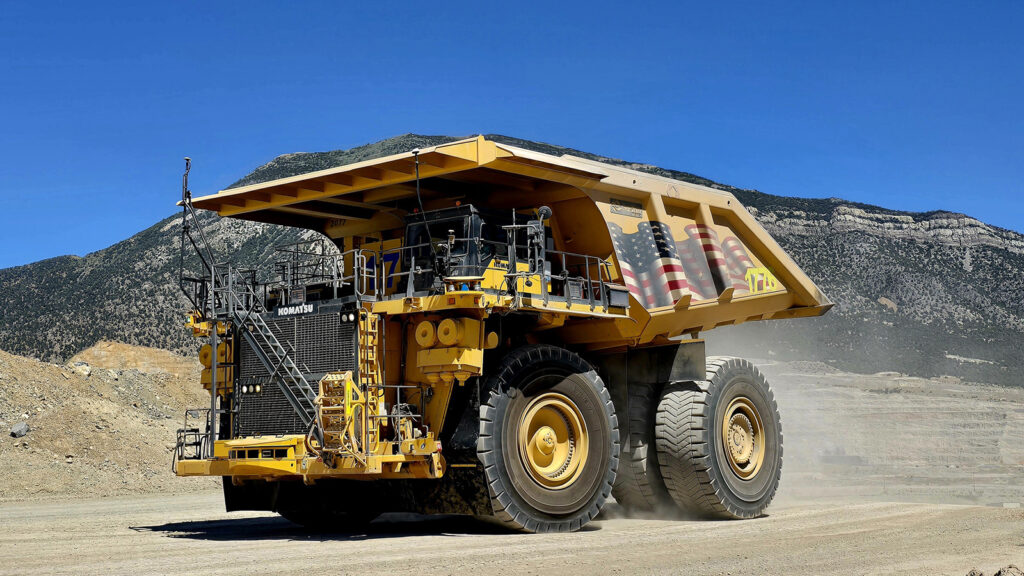
The truck at the centre of the eventual milestone, a Komatsu 930E-5AT, is an ultra class electric drive truck carrying a 290 tonne payload, part of a haul truck lineup that underpins FrontRunner deployments globally and now accounts for more than half of the roughly 1,000 autonomous ultra class trucks Komatsu has commissioned worldwide. Converting one for autonomous operation is a substantial engineering undertaking in its own right, not a software update layered onto an otherwise conventional machine. Each truck carries a dedicated control cabinet mounted just behind the cab seats, wireless antennas supporting both Wi-Fi and LTE connectivity, and a positioning package combining precision GPS with gyroscopes, radar, and laser sensors. Komatsu builds this equipment into new trucks at the factory, but also offers a retrofit service for trucks already in a customer's fleet, a detail that matters considerably for any mine weighing automation against the alternative of simply replacing an ageing fleet outright.

The software architecture running on top of that hardware splits into two cooperating systems that Komatsu's own engineers describe using an aviation analogy: FrontRunner as the pilot, and DISPATCH, the company's fleet management software, as the navigator, tracking every asset's location, whether autonomous or human driven, alongside every active dump and loading point across the site in real time. The interoperability between the two is what allows manned and unmanned equipment to share the same pit safely, since neither system operates with a complete picture on its own.
Layered on top of that core architecture are several distinct safety subsystems, each addressing a different category of risk. Auto Interaction governs how autonomous trucks communicate with one another at intersections and load and dump points, letting the fleet coordinate itself without a human directing traffic from a tower. Manual Vehicle Interaction handles the more delicate task of mixing autonomous trucks safely with the light vehicles, water trucks, and service vehicles that inevitably remain on a working mine site, using three distinct interaction modes, Travel, Passing, and Park, that the system assigns dynamically based on a manned vehicle's position and behaviour. A Collision Detection System maintains a continuously updated digital safety envelope around every vehicle on site and issues an automatic warning whenever an autonomous truck's designated path, referred to internally as its permission line, crosses into another vehicle's envelope. A separate Obstacle Detection System, using radar and laser units mounted at both the front and rear of each truck, brings the vehicle to an automatic stop the instant it detects an obstruction, independent of whatever the broader traffic coordination logic is doing at that moment. The redundancy is deliberate: no single subsystem is trusted to catch every category of hazard on its own.
The operational payoff from that architecture shows up most clearly in wear and maintenance data rather than in any single dramatic safety statistic. Because FrontRunner eliminates the harsh acceleration, late braking, and inconsistent steering that come with normal human variability, Komatsu has consistently reported, backed by extensive testing at its Arizona Proving Grounds, an estimated 40 percent improvement in tyre life compared to conventionally driven trucks of the same class, alongside a roughly 13 percent reduction in overall maintenance requirements. Predictive maintenance capability runs continuously in the background of the same system, monitoring hundreds of performance parameters across the fleet and flagging developing anomalies before they become failures, shifting a mine's maintenance effort from reactive repair toward scheduled intervention.
Building the network the trucks actually need
Selecting a platform turned out to be the more straightforward half of the problem. Autonomous haulage depends on constant, extremely low latency data exchange between every vehicle and the central fleet management system, a requirement conventional mine site wireless infrastructure, generally built for basic radio traffic and light data loads, was never engineered to support at the density a fleet wide rollout demands. Rather than attempt to stretch existing infrastructure to cover the gap, Nevada Gold Mines brought in Sedna and Nokia to design and build a dedicated private 5G network across its surface operations, purpose built specifically to carry autonomous vehicle telemetry and control signals rather than general site communications. Komatsu Mining Technology Solutions general manager Braden Weisheit, describing the scale of that infrastructure partnership, called it representative of the broader undertaking rather than a routine vendor relationship: "We are proud to partner with Nevada Gold Mines on this transformative initiative." For any mine evaluating automation, the Nevada experience is a useful reminder that the truck order is frequently the smaller line item; building a communications network capable of supporting it reliably, at scale, across a multi district operation, is often the larger and slower undertaking.
A rollout sequenced by district, not announced all at once
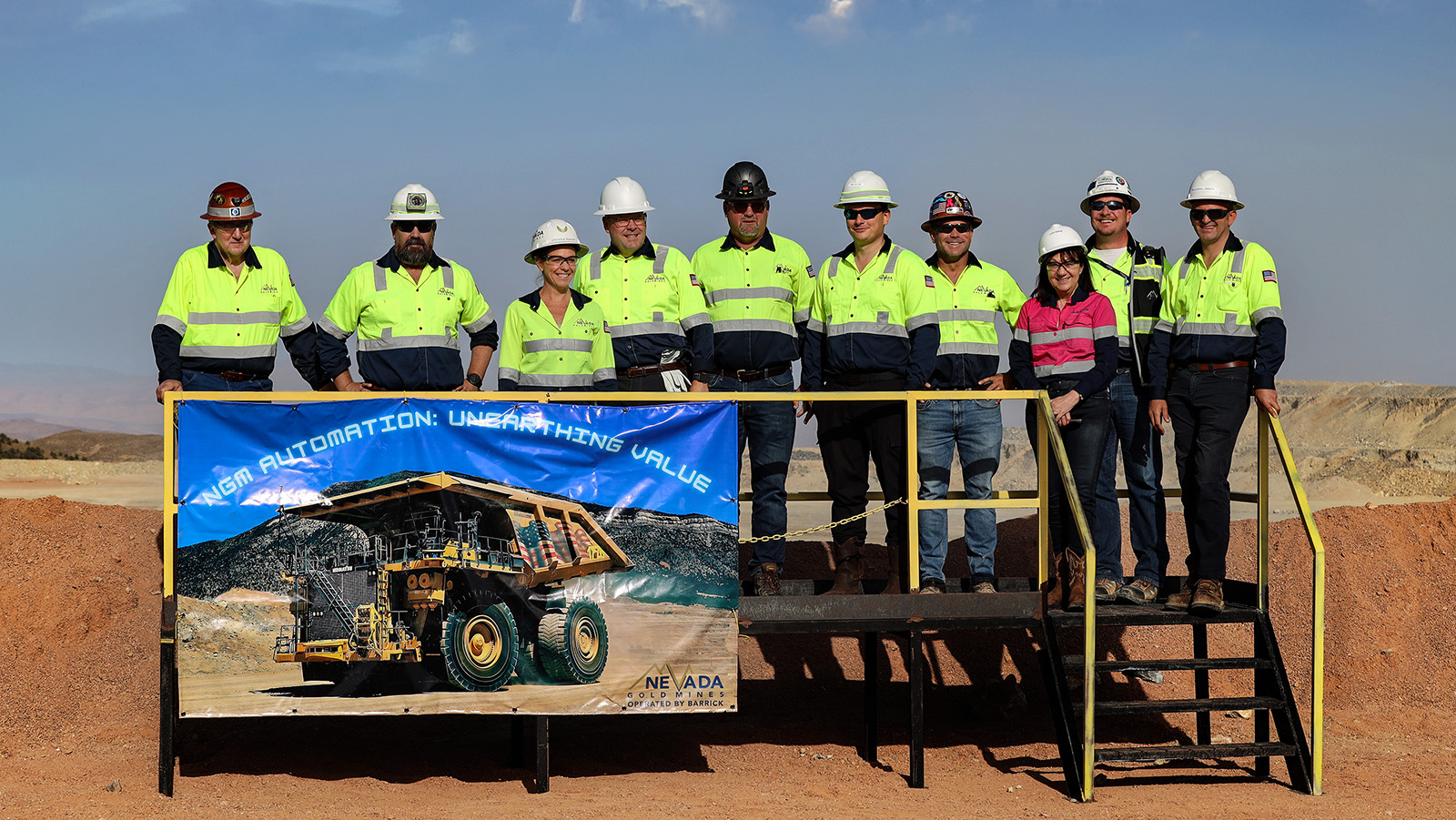
The program that followed was deliberately staged rather than launched simultaneously across NGM's four districts. Phase one and two concentrated entirely on the Cortez district, near Crescent Valley, part of the wider Cortez trend that sits alongside Carlin as one of the most productive gold mining areas in the world. By mid-2026, ten trucks were running fully autonomously at Cortez, with a further thirteen already fitted with the necessary onboard hardware and awaiting activation, forming part of a wider order of 62 Komatsu 930E-5 haul trucks earmarked across Cortez and Carlin combined. Phase three, extending the system into Carlin itself, remained under active assessment rather than committed to a fixed date, and Majors was candid about why NGM was proceeding cautiously rather than accelerating the timeline: "We are currently assessing what Phase 3 would look like. We are making sure our operating assumptions for Carlin align with what we're seeing at Cortez, making sure that our implementation team is adequately resourced to not only support and continue to guide the operation here at Cortez, but migrate to Carlin to stand up another operation again." Asked how far the ambition ultimately extended, his answer left little ambiguity: "The long-term aspiration is for all primary haulage to be automated at NGM."
That sequencing choice reflects a broader pattern visible across nearly every successful large scale autonomous haulage rollout studied in this briefing: mines that treat automation as a phased operational transformation, learning deliberately at each stage before expanding, consistently report smoother rollouts than those attempting to convert an entire fleet at once.
The training program built alongside the trucks
NGM's approach to workforce transition was built with the same deliberateness as the technology rollout itself. Rather than retraining haul truck operators only once the autonomous system went live, the joint venture integrated autonomous vehicle procedures directly into its existing learning management system from early in the program, aiming to bridge conventional operating certification with the different skill set autonomous supervision actually requires, systems monitoring, exception handling, and structured response when the fleet management software flags something the automated system cannot resolve on its own.
One effect of the rollout surprised the project team, and it did not involve the truck drivers whose roles were most directly affected. It was the operators loading those trucks, running shovels and excavators, who found their own work changed. Because an autonomous truck executes the mine plan with identical precision on every cycle, without the fatigue, distraction, or judgment variability a human driver introduces, shovel operators discovered they could set their own working rhythm based on actual face conditions rather than continually adapting to inconsistent truck arrival timing. Majors described the shift as having become something of a recurring comment on site: "Because the trucks follow the plan precisely, the shovels can run much more consistently and at the rate that the shovel operator dictates based on constraints at the face. The shovel operators really like it. We have heard them say, 'the trucks just keep coming.'"
The milestone, and what it signals about the technology's maturity
In April 2026, that accumulated work produced its most visible result. A Komatsu 930E-5AT deployed into the Cortez fleet became the company's 1,000th commissioned autonomous ultra class haul truck worldwide, making Komatsu the first equipment manufacturer to reach that figure, and marking its most significant single entry point yet into gold mining specifically, a segment that had lagged behind copper and iron ore in automation adoption for most of FrontRunner's eighteen year commercial history. Peter Salditt, president of Komatsu's Mining Business Division and chief executive of Komatsu Mining Corporation, framed the milestone as a point of continuity in a much longer engineering effort rather than a standalone achievement: "This is a defining moment for Komatsu and for the mining industry, reflecting nearly two decades of innovation, collaboration with our customers and a relentless focus on creating real operational value."
Barrick's president and CEO, Mark Hill, tied the same milestone directly to the workforce transition the program had been built around from its earliest evaluation stages: "FrontRunner has elevated both the quality of work for our people and the way we meet production goals at our Nevada operations. By transitioning operators away from haulage activities and enabling more predictable operations, autonomy supports safer, more skilled roles while helping us use energy more efficiently and reduce our environmental footprint."
The scale behind that single truck is worth putting in context. Across Komatsu's full global customer base, FrontRunner has now moved more than 11.5 billion tonnes of material since its 2008 commercial introduction, and an independent assessment carried out jointly by the Capitals Coalition and the Value Balancing Alliance, published in Komatsu's 2025 sustainability disclosures, valued the platform's global social impact at approximately 2.4 billion dollars for 2024 alone, spanning measurable gains in safety performance, asset utilisation, energy efficiency, and emissions reduction across every site running the system. Caterpillar's rival Command for hauling platform has moved a broadly comparable volume, more than 11 billion tonnes, and travelled over 380 million kilometres, underscoring that the two dominant platforms now sit close enough in scale that customer choice increasingly comes down to specific operational fit rather than a clear technology gap between them. Between them, the two companies account for roughly 74 percent of tracked autonomous truck brands operating globally.
Where the platform goes next
Komatsu used the Nevada milestone to signal a shift in how it intends to develop FrontRunner going forward, moving toward what the company describes as a unified, software defined vehicle platform, in which trucks and their autonomy systems can be continuously updated and improved across the working life of the asset rather than treated as fixed at the point of sale. That shift matters for any mine considering an automation investment today, since it implies the trucks being commissioned now are intended as a long term software platform the mine will keep updating, rather than a static piece of hardware whose capability is locked in from delivery.
For Nevada Gold Mines specifically, the direction of travel is unambiguous even where the exact timeline remains under review. Having proven the model at Cortez across two deliberate phases, the joint venture is now working through the operational groundwork required to extend the same system into Carlin, the single most productive gold trend in mining history, a decision that, if it proceeds on the timeline NGM's own project leadership has described, would bring autonomous haulage to the majority of primary production across one of the largest gold mining complexes on earth. Few gold operations anywhere in the world are positioned, by scale, ownership structure, and now nearly three years of deliberate technical groundwork, to reach that point as quickly.