Renault Trucks has significantly expanded the capabilities of its electric heavy-duty vehicle portfolio, introducing new E-Tech T models capable of traveling up to 660 kilometres on a single charge, a development that brings electric trucking firmly into the mainstream of regional and long-distance freight transport.
The manufacturer says extensive analysis of operational data collected from 70,000 connected Renault Trucks tractor units operating across Europe over the last two years indicates that the latest generation of electric trucks can already fulfil around 80 percent of daily freight missions. That figure increases to 90 percent when operators incorporate a 45-minute fast charging session during the driver’s legally mandated rest period.
According to Emmanuel Duperray, Senior Vice President for Electromobility at Renault Trucks, concerns over vehicle range have traditionally slowed the adoption of electric trucks in long-haul applications.
“Range has long been considered the principal barrier to the electrification of long-distance road transport. Real-world operational evidence now demonstrates that electric trucks can successfully meet actual transport demands,” he said.
The enhanced performance of the Renault Trucks E-Tech T range is the result of advances in electric driveline efficiency combined with a new generation of high energy density NCA lithium-ion batteries composed of nickel, cobalt and aluminium.
Renault Trucks has also expanded the usable operating window of its battery systems, allowing operators to access as much as 95 percent of total battery capacity. This increase in usable energy has extended the maximum driving range of the E-Tech T to 660 kilometres between charges.
The improvements are based on operational lessons gathered from more than 3,500 Renault Trucks electric vehicles currently in service, which together have accumulated in excess of 130 million kilometres under real operating conditions.
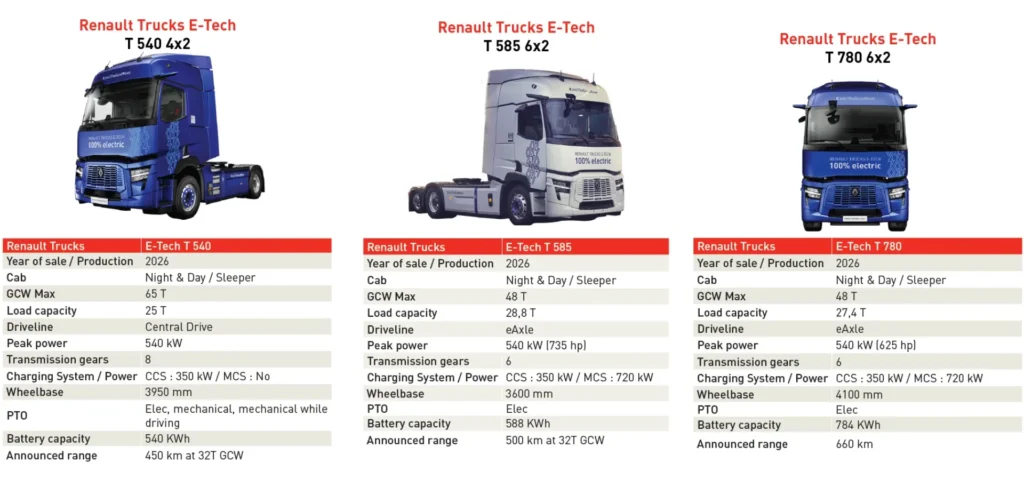
The E-Tech T portfolio now comprises three variants tailored to specific transport requirements.
The flagship Renault Trucks E-Tech T 780 targets long-distance haulage, offering a range of up to 660 kilometres and payload capacity of up to 27 tonnes through its 6×2 configuration, while maintaining manoeuvrability comparable to a conventional 4×2 tractor.
The Renault Trucks E-Tech T 585 delivers a driving range of up to 500 kilometres and can carry payloads of as much as 28 tonnes.
For regional distribution activities, the Renault Trucks E-Tech T 540 provides up to 450 kilometres of range with a payload capability reaching 25 tonnes.
Using currently available 350 kW CCS fast chargers, the trucks can recover as much as 250 kilometres of additional driving range during the driver’s compulsory 45-minute break, enabling operators to extend daily operating distances without disrupting schedules.
Renault Trucks is backing the battery systems on all three models with a standard warranty covering up to six years or 720,000 kilometres. Customers can extend coverage to ten years through the company’s Serenity Pack programme.
While vehicle technology continues to advance rapidly, Renault Trucks believes the next phase of electrification will depend on wider deployment of charging infrastructure, supportive regulatory frameworks and practical assistance to transport operators as they transition their business models.
Duperray noted that the industry has largely overcome the technological limitations of electric heavy vehicles.
“The vehicle technology challenge has effectively been solved. Electric trucks now offer the performance required to electrify an increasing number of long-haul transport operations while delivering an outstanding driving experience,” he said.